
At Pachnada, the river in Uttar Pradesh, the Sindh River meets four other rivers -- Yamuna, Chambal, Kunwari and Pahuj -- in a rare spectacle. Over time, the gentle currents of these rivers have meandered and unloaded their sediment on the floodplains. The floodplains are lush with mustard and wheat fields, and the scrub slopes are dotted with grazing cattle.
“On this fertile land, you can grow anything- gourds, custard apple, potatoes, mustard, peanuts; anything except sugarcane and rice. This is why our ancestors settled here”, says Indrabhan Singh Parihar, a former president of the former Pachnada Yamuna Nadi Mitra Mandali (YNMM). He describes the Yamuna as parivartansheel (in flux) – constantly changing and shaping all else around it.
Pointing at the mustard fields, he explains how the river replenishes the floodplains every year. Like their ancestors, they reap the benefits of seasonal flooding in the form of bountiful harvests. Walking through an endless sea of mustard and wheat along a flowing river could give one a sense of abundance in the floodplains. 
 However, a very small percentage of the population, such as landowners, have a greater access to this abundance. The majority of people work as fisherpeople, agricultural labour, or rear small animals.
Along with precious sediments, the Yamuna River also carries solid wastes dumped in cities and villages. A short distance up from the Yamuna-Sindh confluence, Vivek Kumar and his brother Rahul fill up a gunny bag with plastic waste washed ashore by the Yamuna.
The two brothers make a living from gleaning and selling their synthetic finds at 10 rupees/kilo to junk shops in towns like Muradganj and Auraiyya. From there, the plastic is loaded onto trucks and sent to a plastic recycling plant in Kanpur.
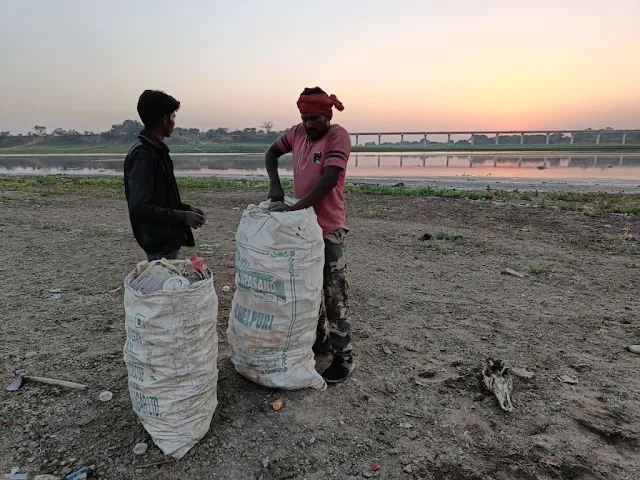
 Kumar and his brother manually sift through toxic waste without any personal protective gear or access to clean water. On a good day, Vivek makes up to Rs 1,500 and on some days nothing. Every day, they walk an average of 40-50 km on their hunt for recyclable plastics.
Workers like Kumar are part of the informal waste sector as their work is neither recognized nor supported by governmental authorities. The informal waste sector is heavily underpaid but performs a majority of the waste collection and material recycling activities in India.
In 2013, the Yamuna had 90,000 cubic meters of debris and other wastes on its banks. The waste dumped consists of construction and demolition debris, garbage, polythene, and organic wastes. The Yamuna’s stretch in Delhi is barely 2% of its total length, but accounts for about 70% of the entire pollution. Several projects have been initiated by governments to clean the river but none have been effective so far.

 At Suda village, across from flood-wrecked farms, a few Sahariya Adivasi families harvest Gondra (Cyperus spp), a wild river weed, from Sindh’s river bed. They harvest, treat and sell the Gondra to contractors, at Rs 20-40 per kilo.
The contractors package the roots and sell them further along the chain to manufacturing units where it is used in perfumes, ayurvedic medicine, soap making and in insect repellents and incense sticks.
At night, they take refuge in a temporary camp along the river. After the gondra season, they move on to work as daily wage labour at agricultural fields. They had noticed that the recent flood and the sudden shift in climate and mismanagement of dams had impacted the access to gondra this year, forcing them to find alternative jobs for this season.

 The Sankua Dham along the Sindh, pulls devotees and tourists from across Datia district. There, I meet a group of young expert gotakhors or divers, from the Kewat (traditional boatmen and fisherfolk) community. Every morning, these boys, between 10-19 years old, wait around the Sankua for incoming pilgrims to arrive. They dive in to collect coins, broken pieces of jewellery, coconuts and other offerings. The divers know the bottom of the river like the back of their hand.
Being highly skilled swimmers they have also voluntarily risked their lives to save drowning tourists on numerous occasions and have been appointed by the police to search for missing bodies in the river. As much as they are engaged in their work, they hope for the formalisation of their work as rescue divers which at present is largely unpaid and unacknowledged.


Lives and livelihoods
While agriculture, animal rearing, and fishing are among the more predictable sources of livelihood along the Sindh River, people’s lives and livelihoods are entwined with the river in more ways than one could conceive.Along with precious sediments, the Yamuna River also carries solid wastes dumped in cities and villages. A short distance up from the Yamuna-Sindh confluence, Vivek Kumar and his brother Rahul fill up a gunny bag with plastic waste washed ashore by the Yamuna.
The two brothers make a living from gleaning and selling their synthetic finds at 10 rupees/kilo to junk shops in towns like Muradganj and Auraiyya. From there, the plastic is loaded onto trucks and sent to a plastic recycling plant in Kanpur.


Workers like Kumar are part of the informal waste sector as their work is neither recognized nor supported by governmental authorities. The informal waste sector is heavily underpaid but performs a majority of the waste collection and material recycling activities in India.
In 2013, the Yamuna had 90,000 cubic meters of debris and other wastes on its banks. The waste dumped consists of construction and demolition debris, garbage, polythene, and organic wastes. The Yamuna’s stretch in Delhi is barely 2% of its total length, but accounts for about 70% of the entire pollution. Several projects have been initiated by governments to clean the river but none have been effective so far.


The contractors package the roots and sell them further along the chain to manufacturing units where it is used in perfumes, ayurvedic medicine, soap making and in insect repellents and incense sticks.
At night, they take refuge in a temporary camp along the river. After the gondra season, they move on to work as daily wage labour at agricultural fields. They had noticed that the recent flood and the sudden shift in climate and mismanagement of dams had impacted the access to gondra this year, forcing them to find alternative jobs for this season.


Being highly skilled swimmers they have also voluntarily risked their lives to save drowning tourists on numerous occasions and have been appointed by the police to search for missing bodies in the river. As much as they are engaged in their work, they hope for the formalisation of their work as rescue divers which at present is largely unpaid and unacknowledged.
Close to Seondha, a family was tending to the saplings they had planted in the sandy river beds of the Sindh, in neat rows of square-ish ditches. Local and migrant families utilize the seasonally dry riverbeds and river water to produce gourds, cucumbers, chillies, coriander etc.


However, the current economic system has a more pronounced impact on this equation. The interests of the few in power such as the urban and rural elite have a greater impact on the river. In the name of development, they decide how the river is put to work by building dams and mining the riverbed for sand. A complex living system of the river and its people is reduced to a series of external objects – sand, water and labour. The resulting exploitation and destruction of the river disproportionately impact the lives of those that depend on it for sustenance, while the spoils of “development” go to those in power.
For example, some believe sand mining, a global multi-billion dollar industry, has its trickle down effect on the locals’ livelihoods. However, not only does it destroy the river’s ecology but also exploits those that are heavily underpaid for lifting sand manually from the riverbed. A local boatsman in Seondha says:
“I don’t want to do it (sand mining). The tractor owners employ local people to mine the sand. They load tractors manually at night. It’s done illegally. I don’t do it because it involves a lot of violence. Sometimes they don’t pay you on time and sometimes nothing at all. The tractor owner makes 10,000-20,000 rupees a night. We do all the work and he takes the money. You have to fight to get your share for your labour which is something I am not able to do.”
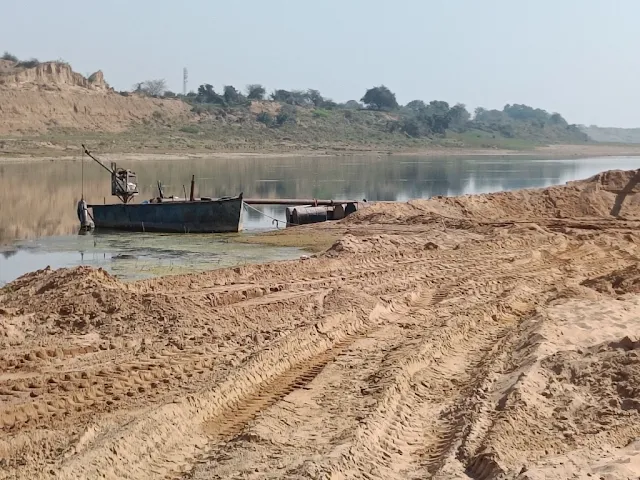 The scale of exploitation only magnifies exponentially as one moves up the chain with contractors, corrupt local authorities and police officers at the top.
The change in land use due to sand mining and environmental degradation has made livelihoods tied to rivers and agriculture less and less viable. This in addition to the pre-existing deficit in opportunities for education and formal sector employment within the region that pushes people to migrate to other states in search of daily wage labour, usually as factory labour or street food hawkers.
The financial distress at home and the condition of government schools in the region make the youth reluctant to attend school. Most young boys and girls start working at an early age to chip in for their families’ day-to-day sustenance. Some candidly shared their struggles and vision for the future. They hope to find more lucrative opportunities within their region so that they can stay close to the River Sindh. The Sindh that they referred to as Ganga Maiyya or Mother Ganges.
---
*Walked for 10 days along a stretch of the Sindh River from Pachnada, Uttar Pradesh, as part of the Moving Upstream: Sindh Fellowship, supported by Veditum India Foundation and the Out of Eden Walk. Source: South Asia Network on Dams, Rivers and People. All pix by the author


This practice of riverbed farming is locally known as kachuari or kachuaee. It is an important source of income and food security for communities, especially landless farmers, living along the Sindh.
Kachuaee is threatened by widespread sand mining in the region. Much of Sindh’s sand that provided livelihood for the marginalised locals has been occupied, extracted and displaced by heavy machinery.Human and nature: Not one without the other
The Sindh River shapes the lives of those that live along it and who in turn shape the river. Sindh and its people come together as a whole to co-produce culture, resources, livelihoods, and paradigms. These have been the key to the world-making of this landscape -- its past, present and future.However, the current economic system has a more pronounced impact on this equation. The interests of the few in power such as the urban and rural elite have a greater impact on the river. In the name of development, they decide how the river is put to work by building dams and mining the riverbed for sand.

For example, some believe sand mining, a global multi-billion dollar industry, has its trickle down effect on the locals’ livelihoods. However, not only does it destroy the river’s ecology but also exploits those that are heavily underpaid for lifting sand manually from the riverbed. A local boatsman in Seondha says:
“I don’t want to do it (sand mining). The tractor owners employ local people to mine the sand. They load tractors manually at night. It’s done illegally. I don’t do it because it involves a lot of violence. Sometimes they don’t pay you on time and sometimes nothing at all. The tractor owner makes 10,000-20,000 rupees a night. We do all the work and he takes the money. You have to fight to get your share for your labour which is something I am not able to do.”

The change in land use due to sand mining and environmental degradation has made livelihoods tied to rivers and agriculture less and less viable. This in addition to the pre-existing deficit in opportunities for education and formal sector employment within the region that pushes people to migrate to other states in search of daily wage labour, usually as factory labour or street food hawkers.
The financial distress at home and the condition of government schools in the region make the youth reluctant to attend school. Most young boys and girls start working at an early age to chip in for their families’ day-to-day sustenance. Some candidly shared their struggles and vision for the future. They hope to find more lucrative opportunities within their region so that they can stay close to the River Sindh. The Sindh that they referred to as Ganga Maiyya or Mother Ganges.
---
*Walked for 10 days along a stretch of the Sindh River from Pachnada, Uttar Pradesh, as part of the Moving Upstream: Sindh Fellowship, supported by Veditum India Foundation and the Out of Eden Walk. Source: South Asia Network on Dams, Rivers and People. All pix by the author
Comments