 |
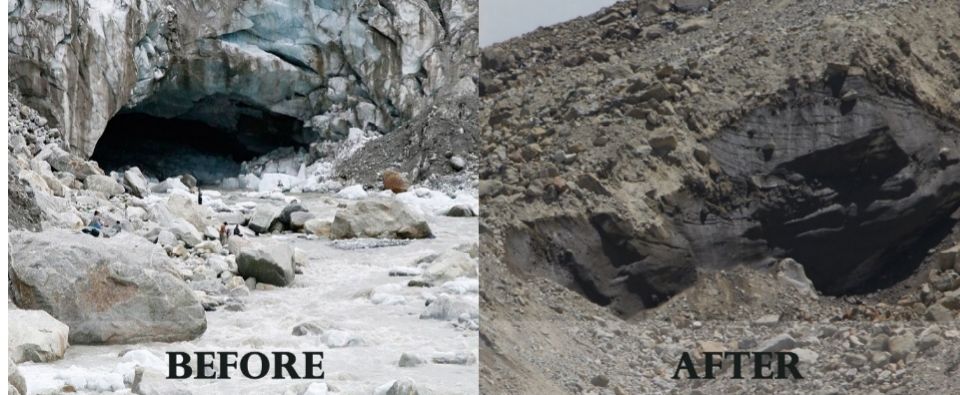
| Gaumukh |
The Char Dham Yatra, a pilgrimage to four Hindu shrines located in the Himalayan region, has been opened for tourists this year from 22nd April. Until last year the government had put restrictions on the number of devotees allowed per destination which were revised, considering the outpour exceeding the daily limit.
The revisions capped the daily limit of 16,000 in Badrinath, 13,000 in Kedarnath, 8,000 in Gangotri and 5,000 in Yamunotri, however this year, these restrictions were altogether abolished through a government order just a day before the commencement of the Yatra. The question remains whether this revision makes sense considering the eco-sensitivity of the Himalayan region.
The Himalayan region is known for its fragile ecology, threatened by human activity over the years. Linking the Char Dham Project, comprising the widening of an 825 km road network is set to claim 56,000 trees in total, out of which 36,000 have already been chopped as of 2021. This is unfolding in a region that is already withering from soil erosion and prone to landslides.
A study by the Wadia Institute finds that up to 51% of Uttarakhand is susceptible to landslides, with Rudraprayag and Chamoli districts being the most prone. The Alaknanda Valley consists of at least 510 landslide-prone zones, and undue construction and blasting create new micro cracks in rocks, giving rise to newer landslides.
Joshimath, a town just miles away from Badrinath, is suffering the consequences of indiscriminate construction and development activity. At least 849 houses are inhabitable due to the development of heavy cracks, the future of the town and its residents is uncertain.
Geologist S P Sati expressed fears for the ecology of the region as the infrastructure was insufficient to accommodate the influx. Various hotels, lodges, and resorts are constructed without proper planning or a mindset to attract and accommodate more tourists. Badrinath has a total capacity of 12,000 tourists, not enough to accommodate the daily visitors to the shrine during yatra time.
A study by Wadia Institute finds 51% Uttarakhand susceptible to landslides with Rudraprayag and Chamoli being the most prone
Let’s not forget the vehicular pollution and waste production that this huge influx of population is going to bring. The combined carbon footprint of this activity is a fundamental contributor towards the melting of ice caps and glaciers in this region.
Gaumukh, where the Ganges emerges from Gangotri Glacier, is not far from where the free reign of human activity has just been sanctioned. It is important to recognize that the Char Dham Yatra is not just a spiritual journey but also an environmental and ecological journey. Sustainable tourism practices that are mindful of the fragile ecology of the region should be prioritized to protect the Himalayan region for future generations.
Considering all these reasons, it is important to reduce human activity in this unique and susceptible ecological zone, but what the present Uttrakhand Government has done is the polar opposite. Recent videos of landslides on Badrinath Highway are only a preview of destruction that also puts the lives of pilgrimage seekers at risk, with the onset of Monsoons such landslides are going to magnify.
It is certain that the revision of the scheme is not a step towards sustainable development but towards dangerous and mindless destruction.
---
*Advocate, alumni of National Law University, Jodhpur, Litigation Lawyer at Dehradun
Gaumukh, where the Ganges emerges from Gangotri Glacier, is not far from where the free reign of human activity has just been sanctioned. It is important to recognize that the Char Dham Yatra is not just a spiritual journey but also an environmental and ecological journey. Sustainable tourism practices that are mindful of the fragile ecology of the region should be prioritized to protect the Himalayan region for future generations.
Considering all these reasons, it is important to reduce human activity in this unique and susceptible ecological zone, but what the present Uttrakhand Government has done is the polar opposite. Recent videos of landslides on Badrinath Highway are only a preview of destruction that also puts the lives of pilgrimage seekers at risk, with the onset of Monsoons such landslides are going to magnify.
It is certain that the revision of the scheme is not a step towards sustainable development but towards dangerous and mindless destruction.
---
*Advocate, alumni of National Law University, Jodhpur, Litigation Lawyer at Dehradun
The disastrous policy of the Uttarakhand Government is blind to the unique himalayan ecosystem and its fragility. Removing caps on flow of tourists is aimed at with impunity driven commercial motivation with political pressure exerted by businesses which largely benefit outsiders. The other commercial interest is of the motor transport association and the Bus operators besides the hospitality industry.The incremental increase in passenger load is without any consideration of the carrying capacity of the himalayan ecosystem. It is anyone's guess that in higher altitude regions what is the percent coverage of waste management handling capacity and waste sites, for liquid and solid waste. The sewerage coverage in Uttarakhand is also questionable and treatment processes for effluents anybody's guess. What is the institutional ability of the state authorities in SUDA, State Sewerage and Water Supply Agency, Uttarakhand Jal Sansthan to manage waster water and storm water is known to everyone.There will be far reaching consequences of destroying this unique himalayan ecosystem which will bring large scale destruction to the entire Indo-Gangetic Plains. The present government and Government of India should understand that excessive exposure to himalayas will generate livelihoods and employment to people definitely but the emerging wide spread destruction will create very large devastation to livelihoods for millions of people who thrive in the Indo-Gangetic plains and threaten our food security. The enormity of costs with this is unimaginable.
ReplyDelete