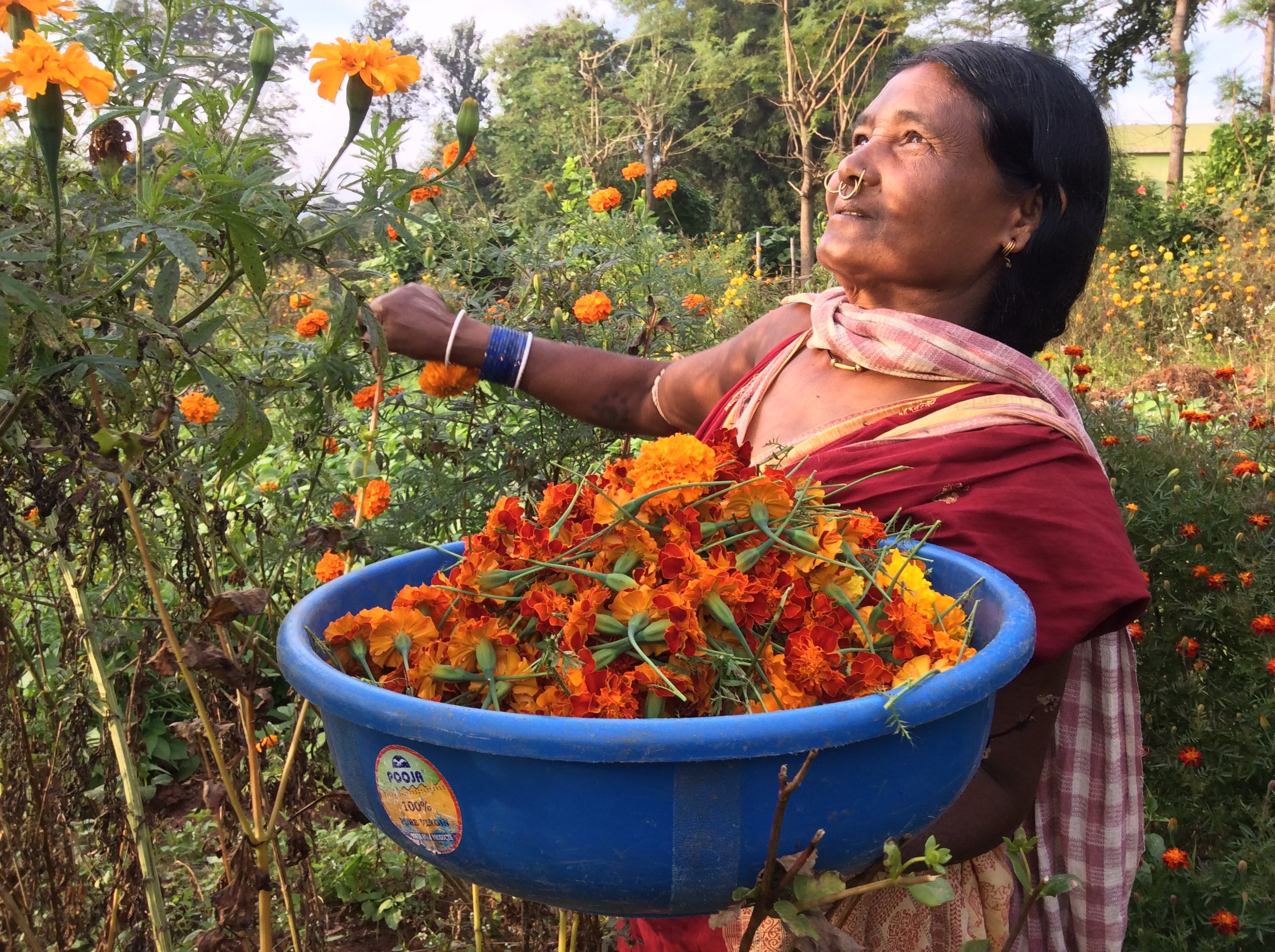
Fragrance of winter: Flower cultivation by Mali community in Odisha's Maliguda village

By Deepanwita Gita Niyogi 
In Maliguda, a village in Koraput district of Odisha dominated by the Mali community, flower cultivation is carried out in the winter season. Water for cultivation is available seasonally in the form of a stream which is used by the villagers for about six months. There are 25-30 households involved in the trade and earnings stand at Rs 300-500 per day on an average. Apart from flowers, residents of Maliguda cultivate small millets and paddy.
Flower 1: A woman farmer at work. Flower cultivation is possible due to water supply from a nearby stream but the supply reduces by February. 
Flower 2: It is important to keep the flowers in a safe place for the night. Flowers will be preserved carefully inside the room throughout the night and sold in the local market the next morning. Many women from the village sell flowers in donas or small leaf bowls. Many women in Maliguda cultivate flowers, along with vegetables and fresh greens like coriander. It is a side business to supplement the family income from November to February.
Flower 3: Apart from marigolds which are mostly grown, seasonal flowers are also a thing in the village.
Flower 4: A man tends to his flowers on a winter afternoon in Maliguda.
Flower 5: A woman plucks marigold flowers in Maliguda. Marigolds are in huge demand in the morning. Garlands made of marigold flowers are offered to deities.
Flower 6: A small girl carries marigold flowers to her house.

Comments

TRENDING

Swami Vivekananda's views on caste and sexuality were 'painfully' regressive

By Bhaskar Sur* Swami Vivekananda now belongs more to the modern Hindu mythology than reality. It makes a daunting job to discover the real human being who knew unemployment, humiliation of losing a teaching job for 'incompetence', longed in vain for the bliss of a happy conjugal life only to suffer the consequent frustration.

Hoping against despair after Myanmar President’s visit to India

By Nava Thakuria  Myanmar President U Min Aung Hlaing’s five-day official visit to India from 30 May to 3 June 2026 drew attention both in New Delhi and in India’s northeastern region, where policymakers and residents closely follow developments in the neighbouring country. The visit was significant because it touched on several issues of mutual concern, including security cooperation, border management, connectivity projects, trade, and regional stability.

Beyond data: The economist who refused to remain in the ivory tower

By Vikas Meshram   There are few people who are born into privilege yet choose to dedicate their lives to the cause of the poor. Jean Drèze is one such individual. Born on January 22, 1959, in Leuven, Belgium, into the family of a distinguished economist, Drèze has become one of the most influential voices in the study of poverty, inequality, and social policy in India. Having lived in India since 1979, he adopted Indian citizenship in 2002 and has since played a pivotal role in shaping some of the country's most important welfare initiatives.