
Almost the whole of India was caught in a serious power crisis from early May 2022. Many industries ground to a near halt. Households were suffering 8-12 hours of unscheduled power cuts, right when a brutal and early summer hit large swathes of the country. Even patients died in hospitals due to lack of power.
And as seen in several other miscalculations and messy management of governance affairs – one other prominent example being caught off-guard by the Chinese in Ladakh borders – the Indian governance of coal and power sectors were caught totally unprepared, with no coherent response plans to get out of the mess which continues today, and is feared to be lingering even till August.
The government has invoked Section 11 of the Electricity Act for all imported coal-based thermal power plants that mandates power utilities to generate electricity under “extraordinary circumstances.” Thirteen more coal blocks are expected to be granted permission for mining in FY 2022-23.
The crisis was labelled as a “coal shortage” by some groups, as the frontline reason was seen to be coal power plants running out of coal stocks. This has led to calls from certain sectors for coal imports and also increasing the coal mining capacity within India.
Ironically, the same Indian government which was pushing for phasing out coal imports in the name of Atmanirbhar Bharat or being self-reliant (in this case – for producing enough thermal coal for all our domestic uses), has started pushing cash-strapped State government utilities for importing expensive coal.
Let us look at the factors that led to this country-wide mess and see where the problems l
Over dependence on coal for power:
India has an installed electricity capacity of about 400,000 MW as on 31-03-2022, with coal (including Lignite) power capacity being 210,700 MW. This constitutes about 52.8% of the total installed capacity. But because of its comparatively higher plant load factor (than intermittent renewable sources), coal power plants provide about 75-77% of the domestic power produced.This situation has not improved much over the last several years, in spite of fairly large increases in installed renewable power sources like solar, wind, biomass, small hydro etc. including large hydropower capacity of 46,723 MW and nuclear fission power of 6,780 MW, the total installed capacity of “nonfossil” power sources comes to about 163,388 MW or 41% of total.
Unfortunately, in case of power production (commonly called ‘generation’), this 41% of installed capacity gives only about 19-20% of the total annual production of power. Thus, in case of electricity, India’s dependence on coal is overwhelming, even with all the talks about climate action, net-zero, etc.
Wide regional disparities:
Another factor complicating this over dependence on coal is the large regional disparities in coal availability and power demands. While largest amount of coal deposits and coal mines are concentrated in the eastern and central Indian States of Chhattisgarh, Jharkhand, Odisha, West Bengal and Madhya Pradesh, the state of industrial and commercial developments – and consequently, coal and power demands -- are much higher in western, northern and southern states.This necessitates large scale transport of coal from mines in the less developed eastern states to the more developed states in other regions, calling for a large role of the Indian railways to transport these. Even though India has regional power grids in all regions, the capacity to carry power from plants in one region to another, are much lower than are needed in case of large shortages in any region/s.
For the last several months, the economy was noticeably coming out of a long low period due to Covid pandemic and the brutal lockdowns. Power demand was rising sharply. This was evident if one looks at the power production and annual increase – the figures show the sharp upturn even in 2021-22.

Over the decade, the PLF of coal power plants have consistently come down from 77.5% in 2009-10 to a paltry 58.87% (refer table). This means, for producing the same amount of power, many more coal power plants have to be operated when higher demands occur.

Climate change impacts:
As was predicted by the Intergovernmental Panel on Climate Change (IPCC) reports and many other studies on climate change impacts, the extreme heat events and hot days are increasing sharply (along with many other climate anomalies). In 2022, the heat waves became extreme and in the months of March, April and May, five heat waves swept over India, with temperatures in many parts of northern, central and western India touching 49 Celsius!One must remember that this was also the period of the crucial Rabi crops ripening and this extreme heat led to increased irrigation (despite preventive actions, the forecasted “bumper harvest” of wheat crashed 20%, leading to cascading effects, even beyond India’s boundaries).
This caused power demand from many sectors to shoot up, from airconditioning / space cooling to irrigation and water pumping. As per reports, the May 2022 power demand shot up by 20% over May 2021 levels. Even in April, the peak power demand hit a high of 201 GW, while it crossed 210 GW on June 16 – both unprecedented levels.
Notably, the India Meteorological Department (IMD) predicted a hotter than normal summer in March itself. Any ordinary mortal would connect the dots and anticipate a higher electricity demand under these circumstances, but India’s Power Minister must have been busier in projecting “Hindutva power” rather than planning for electrical power. Surprisingly, the coal and power production authorities also failed to take proper notice, let alone plan for meeting the sharply increasing demand!
No shortage of coal production:
Sufficient coal production did not lead to sufficient coal power, as enough coal didn’t move from the mines to the power plants in time. Unlike last year’s power shortage, when coal production was disrupted due to heavy rains and flooding of mines, this year the production increased in the mines.Ministry of coal data shows that Coal India produced 23% more, Singareni Collieries increased production by over 34% and private captive mines produced anywhere between 35-40% more than last year. Of course, coal in the pit heads does not lead to electricity generation automatically.
It has to be transported to the power plants to be burned to heat water and run the steam turbines and generators. And these need coordinated logistics planning, routine processes that need coordination between the coal ministry, the power ministry, the railways and power producers.
As seen above, the current cacophony of “coal shortage” and need for more mines to be opened or coal to be imported, have no real basis in data available with the Ministries, and yet they are pushing for importing very expensive coal by cash strapped states and their empty-coffers distribution companies (DISCOMs).
This also leads one to doubt the real motives behind government responses and about the hidden-players. It is public knowledge that one very large, very fast growing and highly influential corporate house stands to gain if coal imports are pushed up, as that business group owns a plethora of ports with coal handling capacities, rakes for coal transport from the ports, a number of coal power plants, and also owns and operates one of the largest overseas coal mines in the world.
They also are operators of a number of coal mines in India, often “on behalf of” state owned power companies getting mining leases -- clear indication of its political clout. Combine this with the fact that due to the Russian invasion of Ukraine, import prices of coal have shot up through the roofs, and even many coastal coal power plants which were designed and built to use then-reasonably-priced and higher quality imported coal, are now very reluctant to import large quantities, for obvious economic reasons.
This surge in imported coal price started in March itself, and should have been accounted for, with increase in domestic production (which was happening by domestic miners), increased allocation of railway rakes for coal transportation and adequate stock build up in the power plants. But as is obvious now, all that was strangely and inexplicably absent from planning and execution!
Failure to arrange for transportation
Failure to arrange for transportation of mined coal from pit-heads to power plants in time, also was baffling. As on May 1, some 83 of the 150 power plants running on domestic coal reported critically low coal levels and many of them cited lack of rakes as the reason.
Looking at the Daily Coal Stock Report of the Central Electricity Authority (CEA), out of 165 operational thermal power plants, 109 had coal stocks of less than 24 percent of the normative levels. As seen earlier, there was no real shortage of coal at the coal mines or pit-heads, and the coal mining companies had enough coal stock.
Looking at the Daily Coal Stock Report of the Central Electricity Authority (CEA), out of 165 operational thermal power plants, 109 had coal stocks of less than 24 percent of the normative levels. As seen earlier, there was no real shortage of coal at the coal mines or pit-heads, and the coal mining companies had enough coal stock.
The statement of the Coal Minister and data from Coal India both confirm this. The Indian Railways was not running enough coal-rakes to transport these coal to the power plants which were running short, with many power plants having 4-10 days of stock at some points.
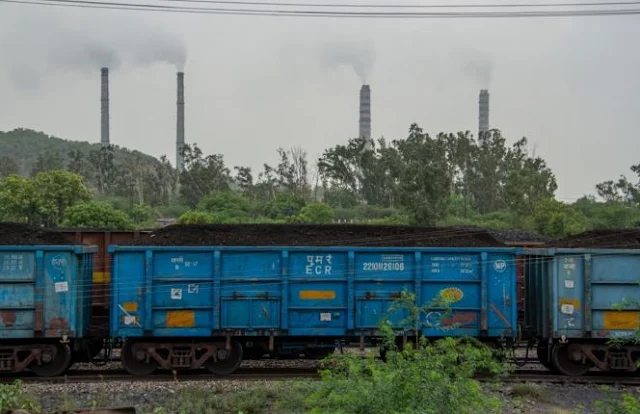 Why the Railways were so inept in addressing such a routine and obvious need, even with the warnings of a very hot summer and the economic activities picking up post Covid lockdowns?
The answer has to come from them, or maybe there was someone higher up controlling the choreographed flow of events? After the crisis got full blown, the govt had to do damage control and the Railways was ordered to cancel large numbers of passenger trains to “clear tracks for coal rakes”.
With so many trains cancelled during Covid lockdowns and passenger traffic forced down earlier, there was enough track capacity for carrying coal. So why did the railways not arrange the same rakes before the power crisis hit?
This has led to some of the GENCOs not being able to pay for coal purchase and transport, resulting in many power units being shut down. The dues to Coal India alone, India’s largest coal producer, is over Rs 12,300 crore. Similarly the railways are owed money for coal transport by many GENCOs.
These have been incorrectly attributed to “coal shortage”, rather than its correct identification of “interwined financial mess”. In face of the power crisis and bad names, the central government has tried to shift all responsibilities to the state governments, asking them to import very expensive coal from international markets, knowing fully well that after the GST implementation, they are perennially dependent on their fair share of tax revenue being given to them on time. And the central government has often used this as a leverage against opposition ruled state governments.
Another financial mess was created as a result of reckless coal power expansion in the earlier phase, often without any sync with actual demand. As per a study by CSE, in FY 21-22, some 3400 MW of coal power plants were lying completely idle because of lack of demand or PPAs. Another 15,472 MW of coal power capacity was generating at less than 50% PLF, either because they do not have PPAs (Power Purchase Agreements) or for over capacity in the grids.
These have badly impacted their financials and many coal power plants have become / are becoming Non Performing Assets. So, even if there is a sudden increase in power demand, as has happened this year, it’s not possible to suddenly make all linkages and restart these idle power plants, rescuing them from the financial mess.

The answer has to come from them, or maybe there was someone higher up controlling the choreographed flow of events? After the crisis got full blown, the govt had to do damage control and the Railways was ordered to cancel large numbers of passenger trains to “clear tracks for coal rakes”.
With so many trains cancelled during Covid lockdowns and passenger traffic forced down earlier, there was enough track capacity for carrying coal. So why did the railways not arrange the same rakes before the power crisis hit?
Financial mess along the coal power chain:
More than enough had been written already about the financial mess of the distribution companies or DISCOMs. With most state govt owned DISCOMs in deep debt, the electricity dues to the power producers (GENCOs) are piling up. Some estimates show this to be over Rs 1,10,000 crore in March 2022, with accumulated losses totalling over an astounding Rs 5,00,000 crore!This has led to some of the GENCOs not being able to pay for coal purchase and transport, resulting in many power units being shut down. The dues to Coal India alone, India’s largest coal producer, is over Rs 12,300 crore. Similarly the railways are owed money for coal transport by many GENCOs.
These have been incorrectly attributed to “coal shortage”, rather than its correct identification of “interwined financial mess”. In face of the power crisis and bad names, the central government has tried to shift all responsibilities to the state governments, asking them to import very expensive coal from international markets, knowing fully well that after the GST implementation, they are perennially dependent on their fair share of tax revenue being given to them on time. And the central government has often used this as a leverage against opposition ruled state governments.
Another financial mess was created as a result of reckless coal power expansion in the earlier phase, often without any sync with actual demand. As per a study by CSE, in FY 21-22, some 3400 MW of coal power plants were lying completely idle because of lack of demand or PPAs. Another 15,472 MW of coal power capacity was generating at less than 50% PLF, either because they do not have PPAs (Power Purchase Agreements) or for over capacity in the grids.
These have badly impacted their financials and many coal power plants have become / are becoming Non Performing Assets. So, even if there is a sudden increase in power demand, as has happened this year, it’s not possible to suddenly make all linkages and restart these idle power plants, rescuing them from the financial mess.
Slow implementation of renewable energy goals:
India has a self-declared goal of installing 175 GW of renewable power capacity by December 2022. This was announced by the Indian Prime Minister at Paris Climate Summit in November-December 2015. Solar PV was to contribute 100,000 MW, Wind power 60,000 MW, with the rest coming from small hydro, biomass power, so called Waste-to-Energy etc.At the end of May 2022, the targets are still far off. We have an installed RE power capacity of 60,000 MW of solar, 41,000 MW of wind, 10,000 MW of biomass power, about 5,000 MW of small hydro – totalling about 113,000 MW of new renewable.
The shortfall from the PMs announced target is a whopping 35%, with a rather poor 65% target achievement. If the PM had been able to guide his team to achieve the announced RE power capacity targets, a large part of the extra power demands could have been taken up by the generation from these RE sources.
According to an analysis by the Climate Risk Horizons, if India had achieved its target of 175 GW of RE power, almost the entire power supply gap could have been filled with a saving of over 44 lakh tons of coal. Another example of big boasts, little achievements.
Thus, it is quite clear that the current power crisis being faced by India, is not a result of the purported “coal shortage”, as has been highlighted in some media and by vested interest groups.
Rather, it is a perfect mess of a tangle of problems not addressed in time, lack of planning and execution, absence of knowledge and anticipation of incoming situations, outright neglect sometimes, and possibly, some deeper designs by vested interest groups.
The shortfall from the PMs announced target is a whopping 35%, with a rather poor 65% target achievement. If the PM had been able to guide his team to achieve the announced RE power capacity targets, a large part of the extra power demands could have been taken up by the generation from these RE sources.
According to an analysis by the Climate Risk Horizons, if India had achieved its target of 175 GW of RE power, almost the entire power supply gap could have been filled with a saving of over 44 lakh tons of coal. Another example of big boasts, little achievements.
Thus, it is quite clear that the current power crisis being faced by India, is not a result of the purported “coal shortage”, as has been highlighted in some media and by vested interest groups.
Rather, it is a perfect mess of a tangle of problems not addressed in time, lack of planning and execution, absence of knowledge and anticipation of incoming situations, outright neglect sometimes, and possibly, some deeper designs by vested interest groups.
---
*Excepts. Source: Centre for Financial Accountability
Comments