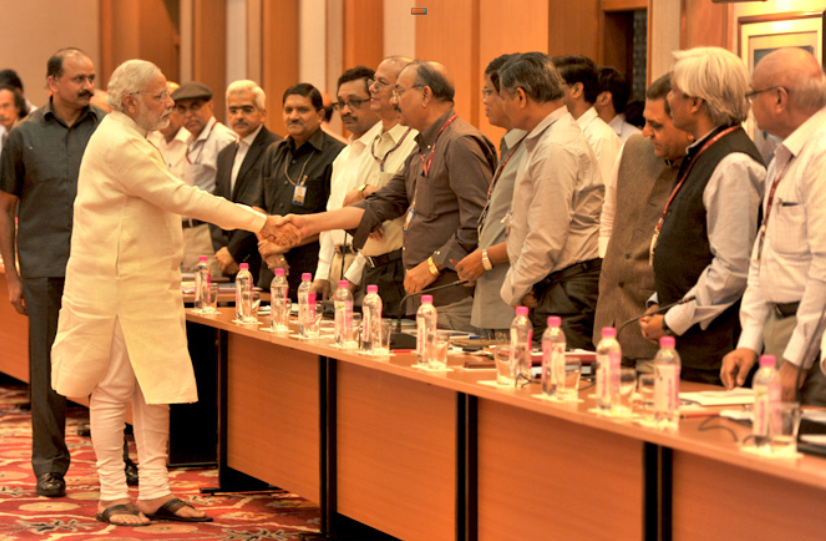
Delhi is abuzz that Prime Minister Narendra Modi plans to unveil a slew of administrative reforms to make India’s creaking public administration apparatus more responsive to the citizenry, more effective in the delivery of services and more accountable. To this start with he has just inducted a few joint secretary level officers -- domain specialists on five-year contract -- into the central bureaucracy.
But the real problem with India’s government is not at this tier of government. As a matter of fact at this tier our bureaucracy is pretty good and is not lacking by much. Our need for government is at the tier closest to the people. It is this tier that needs buttressing and it is here that government has to go down closer to the people. The nerve ends of our public administration don’t reach down to the millions of villages and localities of urban India.
Where is the government when plastic choked drains are to be cleaned? Where is the government when a leaky tap or hand pump is to be fixed? Where is the government when a fused light bulb is to be changed? Who will empty the tens of thousands of new septic tanks as a consequence of Swachch Bharat?
As a matter of fact in most of our villages there is no government presence at all, save for the occasional schoolteacher in the village school. If Prime Minister Narendra Modi contemplates filling this vacuum he must begin with the tier of bureaucracy that interacts with people the most. This is India’s district administration.
India, as one state, has never been larger. With 1.3 billion people under its flag, today’s India, a fractious and youthful democracy with a billion unsatisfied aspirations, would easily be the toughest public administration challenge in the world.
Its system of public administration evolved over the millennia as a system of exercising imperial authority, maintaining law and order, and raising revenues. In return the state offered security and stability, leaving the myriad communities to manage their everyday affairs in the traditional manner.
It was a complex set of systems meeting the needs of a very complex society. The towns were generally directly governed by the imperial state. In the villages the traditional system held sway.
This ended with the 1857 revolt. The abortive revolt had three great consequences. It marked not just the end of the Mughal and Maratha power in central India, but also the end of East India Company rule. This “first great war of independence” actually further enslaved India when on November 1, 1858 when Lord Canning, wearing court dress and riding a black horse emerged out of the fort in Allahabad to read a long proclamation by Queen Victoria.
The Queen, then still 38 years old and still somewhat happily married to Prince Albert who was considered to be somewhat of a progressive, insisted that the “document should breathe feelings of generosity, benevolence and religious tolerance.”
In 1861 the Indian Civil Service (ICS) came into being. Each one of the 400 district officers in British India was henceforth an ICS officer as were all members of the higher bureaucracy. At no given time were there more than 1200 ICS officers in India.
Two other significant events took place in 1861. Thomas Babington Macaulay’s codification of Indian law came into effect and the Indian Police Act introduced uniform police service throughout India. In addition to the British District Officer, each district in British India was henceforth to have a British superintendent of police.
The ICS was divided into separate departments: the executive, which administered the districts, and collected the land revenues and taxes; the judicial, which provided judges for the district and high courts; the political, which provided officers for the diplomatic corps, residents and agents in the princely states; and the secretariat, which provided senior officials for both the central and state governments.
Below this came the largely Indian and uncovenanted civil servants of the police, medical and forestry services, and in the agriculture and engineering departments, all adding up to another 2,000 civil servants. This much-vaunted steel frame of India consisted of no more than 4000 British and Indian officers at even the worst of times.
The bedrock of this system were the 400 district officers, variously called Collectors and District Magistrates or Deputy Commissioners, who administered the districts, each with an average size of 4430 square miles conciliating disputes, dispensing justice and collecting revenues.
An ICS officer became a district officer soon after the completion of his probation and was usually in his twenties usually lording over a million people. Each ICS officer was carefully chosen and was an eclectic combination of brilliance, personality and integrity.
As a matter of fact in most of our villages there is no government presence at all, save for the occasional schoolteacher in the village school. If Prime Minister Narendra Modi contemplates filling this vacuum he must begin with the tier of bureaucracy that interacts with people the most. This is India’s district administration.
India, as one state, has never been larger. With 1.3 billion people under its flag, today’s India, a fractious and youthful democracy with a billion unsatisfied aspirations, would easily be the toughest public administration challenge in the world.
Its system of public administration evolved over the millennia as a system of exercising imperial authority, maintaining law and order, and raising revenues. In return the state offered security and stability, leaving the myriad communities to manage their everyday affairs in the traditional manner.
It was a complex set of systems meeting the needs of a very complex society. The towns were generally directly governed by the imperial state. In the villages the traditional system held sway.
This ended with the 1857 revolt. The abortive revolt had three great consequences. It marked not just the end of the Mughal and Maratha power in central India, but also the end of East India Company rule. This “first great war of independence” actually further enslaved India when on November 1, 1858 when Lord Canning, wearing court dress and riding a black horse emerged out of the fort in Allahabad to read a long proclamation by Queen Victoria.
The Queen, then still 38 years old and still somewhat happily married to Prince Albert who was considered to be somewhat of a progressive, insisted that the “document should breathe feelings of generosity, benevolence and religious tolerance.”
In 1861 the Indian Civil Service (ICS) came into being. Each one of the 400 district officers in British India was henceforth an ICS officer as were all members of the higher bureaucracy. At no given time were there more than 1200 ICS officers in India.
Two other significant events took place in 1861. Thomas Babington Macaulay’s codification of Indian law came into effect and the Indian Police Act introduced uniform police service throughout India. In addition to the British District Officer, each district in British India was henceforth to have a British superintendent of police.
The ICS was divided into separate departments: the executive, which administered the districts, and collected the land revenues and taxes; the judicial, which provided judges for the district and high courts; the political, which provided officers for the diplomatic corps, residents and agents in the princely states; and the secretariat, which provided senior officials for both the central and state governments.
Below this came the largely Indian and uncovenanted civil servants of the police, medical and forestry services, and in the agriculture and engineering departments, all adding up to another 2,000 civil servants. This much-vaunted steel frame of India consisted of no more than 4000 British and Indian officers at even the worst of times.
The bedrock of this system were the 400 district officers, variously called Collectors and District Magistrates or Deputy Commissioners, who administered the districts, each with an average size of 4430 square miles conciliating disputes, dispensing justice and collecting revenues.
An ICS officer became a district officer soon after the completion of his probation and was usually in his twenties usually lording over a million people. Each ICS officer was carefully chosen and was an eclectic combination of brilliance, personality and integrity.
Nehru wanted to dismantle the colonial bureaucratic system but Sardar Patel prevailed upon him to retain the structure that exists today
It was probably the finest civil service ever drawing its men, usually, from Oxford or Cambridge and after a tough entrance examination that included “the ability to jump a five barred gate on horseback with arms folded and stirrups crossed.”
They were well paid and cared for, and usually incorruptible with a well deserved reputation for accepting no gifts other than flowers or fruit. They wore their three initials with pride and saw themselves “as the modern equivalent of Plato’s Guardians, men bred, selected and trained to govern, selflessly and devotedly.”
But what helped them most to stay that way was that they were servants of a foreign empire and agents of an authoritarian system. In 1868 the first Indian, Satyendranath Tagore of that famous family, went to London to take and pass the ICS exam.
Imperial and authoritarian government, racial arrogance coupled with superior education made the ICS a superb instrument to serve British interests. It was no surprise then that Jawaharlal Nehru wanted to dismantle this colonial system with a structure that would be more amenable to serving the people and leading modernization rather than just governing.
But it was Vallabhbhai Patel who prevailed upon him to retain the colonial structure that exists today, however less than meritorious, educated and socially superior it is.
Today’s district administrator is a far cry from the imperious, and ironically enough, impartial, steel frame. This is now a rusty and rickety structure that is vested with the trappings of power, but actually wields little and can do little.
A typical district officer is usually still in his twenties or early thirties. But unlike his ICS predecessor the IAS District Collector or deputy Commissioner has neither the unquestionable authority conferred either by racial exclusivity or superb education or social class or all three to dominate and control the lower bureaucracy.
As required in a democracy the executive is subservient to a government by elected politicians. According to a study by SK Das, IAS, the average tenure of a district officer is now about seven months. He or she invariably falls victim to the constantly changing and treacherous currents of an intensely competitive political system.
Clearly we need to restructure government and administration in each of India’s districts. The District Collector/Deputy Commissioner, like his or her ICS predecessors, must become the executive head of the district with all branches of government subject to his/her authority and power. This must particularly include the police.
The district officer must be re-designated as the Commissioner and should be an officer with over 16 years of service, a mature and seasoned individual with the seniority and clout to exercise complete authority over the administrative apparatus. This seniority will also give him/her the experience and guile needed to deal with the political system.
Above all, the Commissioner must have a fixed tenure of at least five years and a board consisting of elected representatives of the district as well as administrative superiors must make his/her selection to the position.
In most states the district is quite a large administrative unit with an average population of over two millions. But Telangana is an exception now with the original ten districts carved up into 32 new districts. Whether this takes the government closer to the people is yet to be seen. Because the instruments of better governance have not yet been put into place.
For instance, we still have a matrix structure of organization with individual departments such as police, education, health and irrigation reporting to their own hierarchies, which tend to be under centralized control from state capitals. The schools and hospitals have no local governance inputs with the British era structures like the district school and health boards being eliminated.
They were well paid and cared for, and usually incorruptible with a well deserved reputation for accepting no gifts other than flowers or fruit. They wore their three initials with pride and saw themselves “as the modern equivalent of Plato’s Guardians, men bred, selected and trained to govern, selflessly and devotedly.”
But what helped them most to stay that way was that they were servants of a foreign empire and agents of an authoritarian system. In 1868 the first Indian, Satyendranath Tagore of that famous family, went to London to take and pass the ICS exam.
Imperial and authoritarian government, racial arrogance coupled with superior education made the ICS a superb instrument to serve British interests. It was no surprise then that Jawaharlal Nehru wanted to dismantle this colonial system with a structure that would be more amenable to serving the people and leading modernization rather than just governing.
But it was Vallabhbhai Patel who prevailed upon him to retain the colonial structure that exists today, however less than meritorious, educated and socially superior it is.
Today’s district administrator is a far cry from the imperious, and ironically enough, impartial, steel frame. This is now a rusty and rickety structure that is vested with the trappings of power, but actually wields little and can do little.
A typical district officer is usually still in his twenties or early thirties. But unlike his ICS predecessor the IAS District Collector or deputy Commissioner has neither the unquestionable authority conferred either by racial exclusivity or superb education or social class or all three to dominate and control the lower bureaucracy.
As required in a democracy the executive is subservient to a government by elected politicians. According to a study by SK Das, IAS, the average tenure of a district officer is now about seven months. He or she invariably falls victim to the constantly changing and treacherous currents of an intensely competitive political system.
Clearly we need to restructure government and administration in each of India’s districts. The District Collector/Deputy Commissioner, like his or her ICS predecessors, must become the executive head of the district with all branches of government subject to his/her authority and power. This must particularly include the police.
The district officer must be re-designated as the Commissioner and should be an officer with over 16 years of service, a mature and seasoned individual with the seniority and clout to exercise complete authority over the administrative apparatus. This seniority will also give him/her the experience and guile needed to deal with the political system.
Above all, the Commissioner must have a fixed tenure of at least five years and a board consisting of elected representatives of the district as well as administrative superiors must make his/her selection to the position.
In most states the district is quite a large administrative unit with an average population of over two millions. But Telangana is an exception now with the original ten districts carved up into 32 new districts. Whether this takes the government closer to the people is yet to be seen. Because the instruments of better governance have not yet been put into place.
For instance, we still have a matrix structure of organization with individual departments such as police, education, health and irrigation reporting to their own hierarchies, which tend to be under centralized control from state capitals. The schools and hospitals have no local governance inputs with the British era structures like the district school and health boards being eliminated.
Making small districts still leaves a vacuum in terms of local government where schools and dispensaries are not answerable to local communities. The task ahead is clear. Much more needs to be done.
---
*Senior policy expert. Source: Facebook timline. Contact: mohanguru@gmail.com
---
*Senior policy expert. Source: Facebook timline. Contact: mohanguru@gmail.com
Government servants should be redesignated as loksevak e.g. dist collector as jilla loksevak etc. Passing and effectively implementing law for time bound delivery of Central govt services to citizens will have very positive effect.
ReplyDeleteHe should reform BJP controlled municipalitiesHe should reform BJP controlled municipalities
ReplyDeleteGrassroots administration are panchayats - not just Babu’s
ReplyDelete