Kalpasar can't be implemented, is a non-starter: Gujarat BJP's "tallest" intellectual on ambitious Rs 55,000 cr project

A senior Gujarat BJP leader, considered perhaps the only intellectual the state's saffron party can boast of -- one who has spoken out "competently" on developmental issues for its leaders, including Narendra Modi, on critical issues during debates at top English TV news channels -- is all set to stir up a hornet's nest. This leader has declared that the Kalpasar project, conceptualized in early 1960s by "creating" a huge sweet water lake by damming the Gulf of Khambhat, is "not feasible."
Jay Narayan Vyas, who has been the BJP's water resources minister, looking after top irrigation projects, including the Narmada project, has said that this project is not viable for more than one reason, including the quality and quantity of the run off water the proposed sweet water lake is to receive. Passionately taking part in a discussion on Facebook, Vyas, a former technocrat, says, evidence emerged with regard to lack of water from Narmada river, the main source for Kalpasar.
For the first time in history, the Narmada river, which is the main source for Kalpasar, has gone dry this year, Vyas says, insisting, surely, this is not going to be the last year. According to him, sea water has gushed 100 kilometres into the river, starting at Narmada's mouth in the Gulf of Khambhat. As a result of this, the problem of salinity ingress along the river is going to create a major havoc for the farmers.
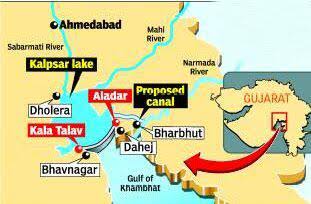
Indicating that it is impossible to rely on any other source of water for Kalpasar, Vyas says, the Sabarmati river, which passes through Ahmedabad and reaches Gulf of Khambhat, about 100 km in the south, is itself dependent on Narmada water. Thus, he notes, sewage and chemically polluted water is released into Sabarmati in the downstream. At Vautha, as a result, what one sees is highly polluted black coloured water, a photograph of which has just been published in a newspaper.
Ironically, the Gujarat government estimates, Kalpasar, which is to cost Rs 55,000 crore, would get 1,515 million cubic metres (MCM) from Sabarmati, about one fifth of what it would get from Narmada, 6,404 MCM. Other rivers that would provide water to Kalpasar include 1901 MCM from Mahi, 486 MCM from Dhadhar, and 116 MCM from Saurashtra rivers. At 50% reliability, in all it comes to 10,414 MCM.
Ironically, the Gujarat government estimates, Kalpasar, which is to cost Rs 55,000 crore, would get 1,515 million cubic metres (MCM) from Sabarmati, about one fifth of what it would get from Narmada, 6,404 MCM. Other rivers that would provide water to Kalpasar include 1901 MCM from Mahi, 486 MCM from Dhadhar, and 116 MCM from Saurashtra rivers. At 50% reliability, in all it comes to 10,414 MCM.
According to Vyas, facts suggest, "There are many ifs and buts in this project from run off estimation to environment and engineering. It is a non-starter and shall never be possible to implement it in the present form." And this is linked, he indicates, with the way water resources are managed.
 |
| Dr Anil Kane |
Thus, he says, as of today, there is no money to preserve the present level of water resources. The irrigation department allocated just 15% for the maintenance of the canals. Of this, 10-12% goes into administrative expenditure. The result is, the canal network is managed most inefficiently. Importantly, Kalpasar is to get Narmada water via a canal, which would a link between Narmada river on the downstream and the Gulf of Khambhat.
Taking a dig at academic Dr Anil Kane, who is currently the most valiant defender of Kalpasar and considers himself the proponent of the project, Vyas says, "Politically, emotionally or fanatically obsessed with any idea is like writing a judgement before the case is heard. Kalpsar of Dr Kane is one such example. Aggressive marketing of the idea and endless exploitation by the powers that be from time to time has coloured this idea so much that it has lost its originality."
Taking a dig at academic Dr Anil Kane, who is currently the most valiant defender of Kalpasar and considers himself the proponent of the project, Vyas says, "Politically, emotionally or fanatically obsessed with any idea is like writing a judgement before the case is heard. Kalpsar of Dr Kane is one such example. Aggressive marketing of the idea and endless exploitation by the powers that be from time to time has coloured this idea so much that it has lost its originality."
Comments
Post a Comment
NOTE: Hateful, abusive comments won't be published. -- Editor