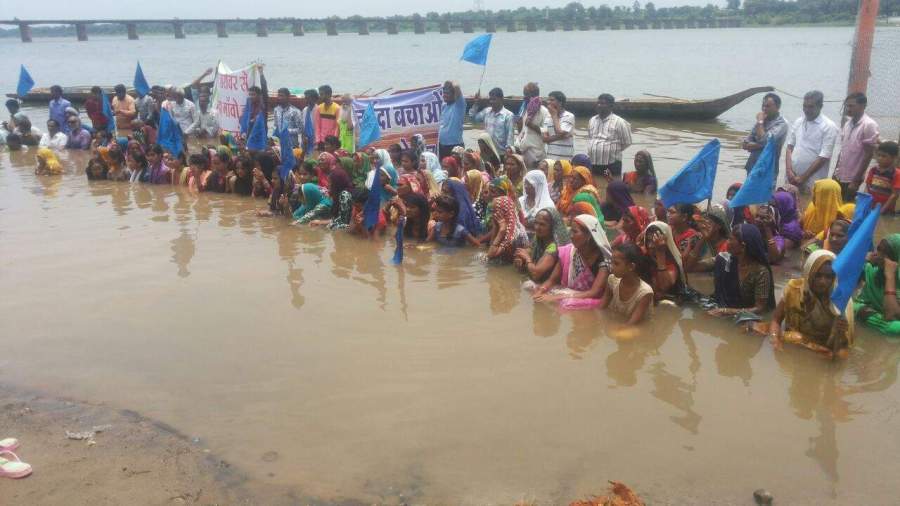
Vadodara-based environmental group Paryavaran Suraksha Samiti’s statement on Narmada mahotsav, to begin on September 17:
The Sardar Sarovar Project on Narmada is to affect 244 villages and one township due to its reservoir spread over 40,000 hectares in Madhya Pradesh, Maharashtra and Gujarat as far as 214 kilometers upstream. Out of 192 villages and one township falling in Madhya Pradesh, at least 150 villages are in the plains, with highest density of population including various occupational categories such as farmers, laborers’, potters, fish workers, boatmen, shopkeepers and various artisans and small entrepreneurs. The adivasis in hilly areas are communities living on the agricultural land as well as forest and fish. The whole of the area and village communities that are to be affected is scheduled tribe where PESA should be applicable.
There are at least 40,000 families residing in the submergence area today (the original villages with generations old communities). The hilly communities where land and forest is lost on an increasing scale since 1990s, comparatively a small area of the affected farms and about 1,000 houses from villages in the plains faced submergence in 2013 during flood and bore huge destruction and loss of farm produce, houses which collapsed, boats and nets flown away.
The Resettlement and Rehabilitation (R&R) of the Sardar Sarovar affected families is governed by the Narmada Water Dispute Tribunal Award (NWDTA), each of the state’s policy and the two main judgments of the Supreme Court of India (2000 and 2005). The landholders are to get minimum 2 hectares of land, if they are severely affected while the landless, as per Action Plan (1993 onwards) submitted before the Apex court, are to get a source of livelihood with a special fund and through a special agency.
The Government of Maharashtra and Gujarat no doubt resettled more than 14,000 families with land, while Madhya Pradesh allotted land to hardly 53 families in its own state. As per the Tribunal, Gujarat had to give land to 5,500 families from Madhya Pradesh and 777 families from Maharashtra while the rest of the oustees chose to resettle in their own state. The Madhya Pradesh government decided to give cash in lieu of land, against the law, that is, Tribunal Award and Supreme Court’s judgments (2000 and 2005) which led to fake registries, scam and derailment of policy depriving thousands of families of their due entitlements in rehabilitation.
The huge corruption in various aspects of rehabilitation in Madhya Pradesh was investigated by the High Court-appointed Justice Jha Commission whose 2000 pages has not been opened as the High Court was prevented from doing so by the apex court which handed it over to the government of Madhya Pradesh and asked it to the take action. No appropriate action on the basis of the recommendations is taken as of yet. The Supreme Court stopped the government from acting against the oustees while the Jha Commission has held the officials of the Narmada Valley Development Authority and the agents (about 400 named) as responsible.
The result is that many farmers got duped in fake registries scam of land based (or farmers) and livelihood based for the landless, fishermen, labourers, potters; the resettlement sites are without 2 hectares land and the landless without alternative livelihood, hundreds are yet to get a house plot and thousands are not able to build their houses at the resettlement sites which lack even basic amenities due to neglect and massive corruption over years.
This is obvious from the fact that 40 engineers-officers were sacked due to corruption in construction works at all R&R sites in Madhya Pradesh, after the CAG report and during the case of Narmada Bachao Andolan before the High Court, Jabalpur. The 2000 page report by Justice Jha Commission incorporated a technical report by MANIT, Bhopal and IIT, Mumbai bringing out a totally unlivable condition at the R&R sites and corruption involved. No work was carried out since then till the Supreme Court order of 8.2.2017.
In Maharashtra too there are a few hundred families yet to get land and house plot, a few hundred are yet to be declared as Project Affected, some are to get forest rights and land measurement to work on amenities is pending in the R&R sites whereas more sites are yet lacking in irrigation and basic amenities. The state has hidden all this and reported false compliance. Problems of adivasis in the hills and those at the sites are serious.
In Gujarat relay fast by the oustees of our state has been on since the 15th of July 2016, just completing one year, yet no final response to the demand for completing rehabilitation and ‘No to taking back land after 20 years’. Gujarat is ready and has begun taking back lands allotted to hundreds of adivasis, after 15-20 years!
This situation obviously could not lead to closure of gates, completing the dam and filling waters upto 139 meters height. This will raise water level by 55 ft, while with 122 meter high dam in 2013 itself water had gushed in and caused submergence of hundreds of houses. Can anyone survive when this happens?
Sardar Sarovar gates have been closed since 17th June onwards and it’s claimed that this has been done with due diligence and approval by the R&R subgroup and Environment subgroup.
However, that is based on false claims and fake figures. There are not less than 40,000 families in the submergence area of Madhya Pradesh itself. All of them are to be drowned and devastated, with their farms and houses, schools, shops, brick kilns, enterprises, temples, mosques and all religious places, huge number of cattle and big trees, the green cover for Narmada. You may judge yourself as to what will be the fate of these lakhs of people and the generations old communities?
This is nothing else but political expediency of Narendra Modi and Shivraj Singh government, all out and ready to benefit corporates in Gujarat and Madhya Pradesh.
This is in violation of legal rights, Supreme Court judgments since 2000 and infringement of right to life.
This must be immediately challenged and stopped.
No force should be used against those sacrificing for development.
Each of the Project Affected Families (PAFs) including the landless must be rehabilitated as per eligibility and benefits granted by law, policy and action plans submitted to the Apex court.
All R&R sites should be ready with all the civic amenities as per tribunal award and R&R policy.
No impoundment affecting any family before complete rehabilitation should be permitted.
Project, its impacts and feasibility of just rehabilitation may be reviewed to find a reasonable way out.
The Prime Minister and his party should realise that their honeymoon is over. Three years of bluff, bluster, empty promises, pompous announcements, jamborees, foreign junkets, photo-shoots with world leaders can neither drown out sane voices nor will questions people ask about concrete performance.
No force should be used against those sacrificing for development.
Each of the Project Affected Families (PAFs) including the landless must be rehabilitated as per eligibility and benefits granted by law, policy and action plans submitted to the Apex court.
All R&R sites should be ready with all the civic amenities as per tribunal award and R&R policy.
No impoundment affecting any family before complete rehabilitation should be permitted.
Project, its impacts and feasibility of just rehabilitation may be reviewed to find a reasonable way out.
The Prime Minister and his party should realise that their honeymoon is over. Three years of bluff, bluster, empty promises, pompous announcements, jamborees, foreign junkets, photo-shoots with world leaders can neither drown out sane voices nor will questions people ask about concrete performance.
— Jyotibhai Desai Rohit Prajapati, Swati Desai Krishnakant and Anand Mazgaonkar
Comments
Post a Comment
NOTE: Hateful, abusive comments won't be published. -- Editor