
By Martin Macwan*
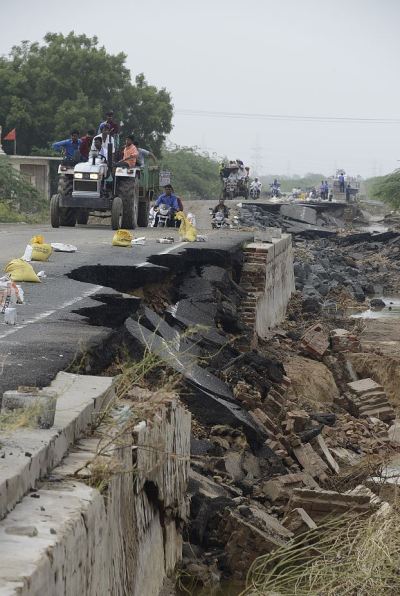
As I was driving down the road from village Baspa (about 15 km from Sami) to Radhanpur, my mind traced the memories of 2001 earthquake of Gujarat. I could see that once again the human disaster was greater than the natural, in the wake of floods. Banas waters had washed away one side of the national highway, but at a distance, one could see the minor Narmada linked canals, washed away like paper trash. Was it the poor construction or the speed at which they were constructed to hit the time target, was a question no one seemed to ask at this point when the chief minister himself is focusing on distributing relief that is limited to food packets, clothing and cash doles of Rs 65 and 45 for an adult and a minor, respectively, covering a period of ten days.
The Maldharis had taken over one side of the road with their buffaloes as self-possessed shelter. The relief truck before me was flinging bundles of used clothes at the local people that eagerly waited for such relief material carrying vehicles. I saw that the pillion riders on a motor cycle too could manage to fetch one such bundle of clothes and shoved the bundle in an empty travel bag. It was a common sight that the local people quickly selected if they found something interesting before throwing away the rest which lay spread on the roads.
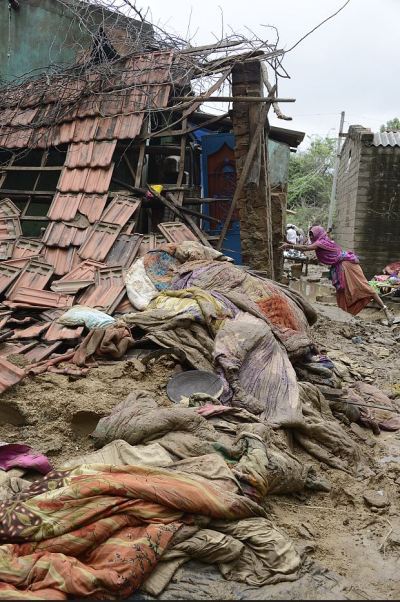
We could see on one room house with terrace that a young Dalit man had lost all his post graduate degree certificates along with two children in the primary school, whose books were drying on the terrace tarred with dirt and water.
It was in 1979, I had volunteered as a college student in Morbi after the Machhu dam had burst. We, as volunteers, helped the locals to clear their homes of the sludge. Here, I saw in the Runi village that there were no volunteers helping the local people. There were only visitors and relief distributors. The rich in the village had access to the JCB machines as Dalits waited to hire tractors to dump away the rotten grain, beddings and other soiled material from their quarters. The Government did not pay them the rents of these hired tractors.

The scavenger families were still stuck with their quarters filled with sludge as many of the old people were unable to clear it themselves in absence of their young children away as migrant labor force. An old woman had the assistance of her two sons-in-law who had come specially to help their mother-in-law to clear her one-room home, as there was no other place for her today. An old man was sitting in one corner. He had lost his buffalo. He earned his living by playing drum and making supda, the caste-based occupations.
Each Dalit family I visited had lost an average of 800 kilograms of grain that they had stored, part of the community system of storing one year of ration for the family. As the trucks distributing packed food occupied the narrow village road, the locals refused to take the food as they were tired of the same. They were worried about cleaning of their homes of the sludge fearing the epidemic. The stench of rotting grain was too strong and they barely had place to sleep leave alone the swamps of mosquitoes.
The rich in the village had access to the JCB machines as Dalits waited to hire tractors to dump away the rotten grain, beddings and other soiled material from their quarters. The Government did not pay them the rents of these hired tractors
At the centre of the village under a tree lay a heap of used garments, dumped by the relief workers as there were no takers. Some families of the Majirana community sat in the midst of some open land around the mud homes with bamboo roofs which had tumbled on the ground. People in the village had never ever in the history of their life met with such tragedy. They said they were battered by the main Narmada Canal. At a distance, the canal was visible, as a large portion of the canal unable to withstand the pressure had given away quickly raising the water levels in the village. As per people, the ganda baval trees have deep roots which have penetrated the base of the canal, weakening it.
Next, we visited village Khariya, the village which has found more than 22 dead bodies from beneath the sand. The road is washed away at the end of the village as several villages could be seen at a far distance, submerged in the flood waters and were accessible only by the boat. The police and the volunteers were guarding the queue of people, whose homes were on the other side and were awaiting their turn to the two boats that were ferrying people. No one has idea here about the human deaths. Most people live here scattered in their farms. Worse, the migrant labourers from other areas lived in these farms and no one has the actual number of these laborers.
Part of the population is at a safer distance from river Banas. Although their homes were flooded, now they were clean and had no sludge as we saw in the previous village. But all the relief teams have focused relief distribution here. We saw large stack of mattresses which were locked away in a room awaiting distribution. Relief teams had their flags on vehicles and the Khastriya-Thakor Sena and RSS were more visible. It was common sight that the local people were rejecting the relief material, as they did not require them anymore. The caste distinctions and prejudices are intact and have refused to be washed away with flood waters or be submerged under the sludge. Local people do ask for the ‘caste’ of the visitors and often the relief workers, too.

The damage has been to the homes of people. They have lost grain stored for their annual requirement. They have lost their savings as most people do not deposit them in the bank. Worst, those who have farm lands have lost the top soil. The farm boundaries have disappeared. My colleagues, who were with me Narendabhai, Mohanbhai, Kalpeshbhai, said, “For some there is blessing in disguise. If one class of people have smile on their faces, they are the sand mafia. The Banas has brought along with its flood water multi-million tons of sand which finds its way even to Ahmedabad construction sites.”
As the politicians are busy blaming each other, it is the army and the civil society that has performed, saving the lives of people and providing them the relief. Except for the police, there is little presence of the government in the area. The quick survey for the purpose of paying cash doles has been completed by the primary school teachers. Poor people’s helplessness is visibly disturbing.
—
*Founder, Navsarjan Trust, Ahmedabad. Pix: Tathya Macwan
As the politicians are busy blaming each other, it is the army and the civil society that has performed, saving the lives of people and providing them the relief. Except for the police, there is little presence of the government in the area. The quick survey for the purpose of paying cash doles has been completed by the primary school teachers. Poor people’s helplessness is visibly disturbing.
—
*Founder, Navsarjan Trust, Ahmedabad. Pix: Tathya Macwan
Comments
Post a Comment
NOTE: Hateful, abusive comments won't be published. -- Editor