 |
By Venkatesh Nayak*
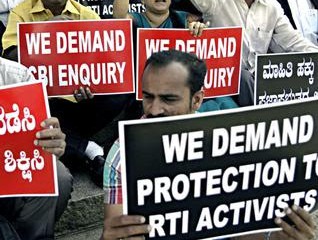
While in one Central Indian State the art of getting rid of whistleblowers is dangerously progressing towards becoming a science, the Government of India has initiated the exercise of collecting data on attacks on Whistleblowers, mediapersons, social activists and RTI activists from across the country. Parliamentarians have frequently sought information from the Government about the number of attacks on RTI activists and the Government has often replied that it does not maintain such a database centrally. Meanwhile, RTI users, activists, organisations and people’s movements for transparency and accountability have frequently highlighted how unsafe it is to seek information in the public interest under the RTI Act. Thanks to a sensitive mass media, instances of attacks- often murderous- on RTI activists and social activists and whistleblowers have received wide coverage. News stories of such attacks are publicised prominently and followed up on in terms of the progress made in the investigation of such cases.
Every year the Government of India collects data from the police station level across the country including Jammu and Kashmir about the occurrence of various crimes under several Central and State laws during the previous year. The focal point for collecting such information is the Delhi-based National Crime Records Bureau (NCRB) at the Centre and its counterparts in the States- State Crime Records Bureaus and their feeders- District Crime Records Bureaus. The NCRB publishes a wealth of information about the occurrence of and actions on crime in its Annual Crime in India Reports (CIR) accessible HERE. The CIR for 2014 is due soon. The Police Station forms the basic unit for reporting crime statistics across the country.
The NCRB has circulated a new template to all States, Union territories and Cities for capturing statistics relating to the occurrence of crime. Data for cities and Union territories often has to be collected separately because they have Police Commissionerate systems unlike other parts of the States which come under the respective Police Departments. The latest version of the data collection template mentions three new categories of crime statistics at pata #20 on Page 1:
1) Attack on Media Person
2) Attack on Whistle Blower
3) Attack on RTI/Social Activist
This data is to be collected under the crime-head – Grievous Hurt of varying degrees- which are recognised in Sections 325, 326, 326A and 326B of the Indian Penal Code. My colleagues at CHRI who work for police accountability and reform, obtained a copy of this template recently.
That the Government has woken up to the cruel reality of attacks on citizens who speak the truth and demand their right to know the truth about public affairs is very welcome. Until now the only source where information about attacks on RTI activists was the dedicated Wikipedia page (click HERE). CHRI also collects data about attacks on RTI users and releases them to the media from time to time to highlight this socio-political malaise.
1) If an RTI activist/ social activist, mediaperson or whistleblower is murdered (Heavens forbid!), then that case will be counted under the Crime Head- Murder (Section 302) at para #1 of the attachyed template. So to be counted separately these activists, whistleblowers and mediapersons will have to ensure that they survive the attack. If not, the deceased will be counted in the larger category of ‘murders’ which gives no breakups regarding the identity of victims.
2) Will a first time user of RTI who is attacked (and survives) for his/her intervention under para #20 be treated as an RTI/Social Activist is a moot question. The recent instance of the alleged murder of an RTI user who filed his first RTI application to inquire about police action against a suspected bootlegger in Gujarat may not even qualify for inclusion in this category (click HERE).
The Police Official at the police station who is in charge of supplying such data on a monthly basis to the NCRB will wield a lot of discretion in counting such numbers unless the template is refined further to reflect all attacks- murderous and grievous ones separately, for RTI users/activists, social activists, mediapersons and whistleblowers.
3) Recording of attacks on whistleblowers may not be easy. While a citizen who blows the whistle on wrongdoing in government may file a complaint about a resultant attack, an internal whistleblower, namely an employee of a government office may not be able to get a complaint registered by the police without adequate support from sympathisers or influential people. Indeed we do not have enough data on how many internal whistleblowers have made complaints about attacks on them to the police till date. The Vyapam scandal in Madhya Pradesh has opened only a peephole into this macabre tradition (and not merely phenomenon) of silencing those who speak the truth.
4) It is quite possible that some cases of attacks may go unregistered by the police at first instance. In such cases if the ‘sufferer’ (and not victim or survivor – because ‘suffering’ reflects the truth of his/her experience and not just its aftermath) or the witness move the Magistrate’s Court through a private complaint under the Criminal Procedure Code, such instances may not necessarily be reflected in the statistics sent by the police to the NCRB.
5) As the Government of India (GoI) drags its feet on ensuring effective whistleblower protection for internal and external whistleblowers, seeking to amend the Whistleblowers Protection Act, 2014 (WBP Act) instead of implementing it, who will the Police Official responsible for sending the data to NCRB, recognise as a whistleblower is a big question. GoI succeeded in pushing through a very retrograde set of amendments to the WBP Act during the budget session of the Lok Sabha (Lower House of Parliament). Will the Rajya Sabha (Upper House) support it or reject it remains to be seen in the monsoon session which has begun.
Sufferers of such attacks or their witnesses who move the police or the courts for redress must ensure that the reason for the attack – whistleblowing, RTI or social activism or media intervention must be clearly mentioned in such complaint to unequivocally establish the link between the activism and the attack.
The NCRB must pay immediate attention to refining its template to cover all kinds of attacks on these categories of persons to be separately and accurately reflected in the statistics instead of being mixed with the general figures about crime. NCRB must work with knowledgeable civil society actors, academics and mediapersons to develop guidelines for police officials who record and transmit such data. For example, attacks on activists who struggle against corruption, gender, caste, religion or language or disability-based discrimination or the rights of children or for protecting the environment or those who expose illegal mining, land mafia, sand mafia and all other kinds of mafia which have become so common place in India, must be faithfully recorded and reported instead of sidelining the issue. The UN Declaration on Human Rights Defenders provides a comprehensive list of such activists who work for accountability and social justice. These categories must be incorporated in the guidelines to capture all instances of attacks on individuals who are engaged in such activities (click HERE).
These portions of the monthly reports must be sent to the National Human Rights Commission and the sector specific Commissions such as those established for protecting the rights of vulnerable groups such as women, children, scheduled castes, scheduled tribes, religious minorities and the differently-abled. This will help them to take suo motu cognizance of such cases and demand immediate action by the police under their supervision.
Further, the template must be refined to include fields regarding the progress of the investigation and the prosecution in such cases on a monthly basis. All this information must be proactively disclosed through the websites of the respective Police Departments (State and District Level and if available Police Station level) as well as the NCRB.
—
*Programme Coordinator, Access to Information Programme, Commonwealth Human Rights Initiative (CHRI), Delhi
While in one Central Indian State the art of getting rid of whistleblowers is dangerously progressing towards becoming a science, the Government of India has initiated the exercise of collecting data on attacks on Whistleblowers, mediapersons, social activists and RTI activists from across the country. Parliamentarians have frequently sought information from the Government about the number of attacks on RTI activists and the Government has often replied that it does not maintain such a database centrally. Meanwhile, RTI users, activists, organisations and people’s movements for transparency and accountability have frequently highlighted how unsafe it is to seek information in the public interest under the RTI Act. Thanks to a sensitive mass media, instances of attacks- often murderous- on RTI activists and social activists and whistleblowers have received wide coverage. News stories of such attacks are publicised prominently and followed up on in terms of the progress made in the investigation of such cases.
Every year the Government of India collects data from the police station level across the country including Jammu and Kashmir about the occurrence of various crimes under several Central and State laws during the previous year. The focal point for collecting such information is the Delhi-based National Crime Records Bureau (NCRB) at the Centre and its counterparts in the States- State Crime Records Bureaus and their feeders- District Crime Records Bureaus. The NCRB publishes a wealth of information about the occurrence of and actions on crime in its Annual Crime in India Reports (CIR) accessible HERE. The CIR for 2014 is due soon. The Police Station forms the basic unit for reporting crime statistics across the country.
The NCRB has circulated a new template to all States, Union territories and Cities for capturing statistics relating to the occurrence of crime. Data for cities and Union territories often has to be collected separately because they have Police Commissionerate systems unlike other parts of the States which come under the respective Police Departments. The latest version of the data collection template mentions three new categories of crime statistics at pata #20 on Page 1:
1) Attack on Media Person
2) Attack on Whistle Blower
3) Attack on RTI/Social Activist
This data is to be collected under the crime-head – Grievous Hurt of varying degrees- which are recognised in Sections 325, 326, 326A and 326B of the Indian Penal Code. My colleagues at CHRI who work for police accountability and reform, obtained a copy of this template recently.
That the Government has woken up to the cruel reality of attacks on citizens who speak the truth and demand their right to know the truth about public affairs is very welcome. Until now the only source where information about attacks on RTI activists was the dedicated Wikipedia page (click HERE). CHRI also collects data about attacks on RTI users and releases them to the media from time to time to highlight this socio-political malaise.
Problems with the NCRB Template
Official efforts to collect data about attacks on RTI activists, whistleblowers and mediapersons is a belated but commendably important first step towards recognising that phenomenon. However there are some technical problems in the manner of collection of such information:1) If an RTI activist/ social activist, mediaperson or whistleblower is murdered (Heavens forbid!), then that case will be counted under the Crime Head- Murder (Section 302) at para #1 of the attachyed template. So to be counted separately these activists, whistleblowers and mediapersons will have to ensure that they survive the attack. If not, the deceased will be counted in the larger category of ‘murders’ which gives no breakups regarding the identity of victims.
2) Will a first time user of RTI who is attacked (and survives) for his/her intervention under para #20 be treated as an RTI/Social Activist is a moot question. The recent instance of the alleged murder of an RTI user who filed his first RTI application to inquire about police action against a suspected bootlegger in Gujarat may not even qualify for inclusion in this category (click HERE).
The Police Official at the police station who is in charge of supplying such data on a monthly basis to the NCRB will wield a lot of discretion in counting such numbers unless the template is refined further to reflect all attacks- murderous and grievous ones separately, for RTI users/activists, social activists, mediapersons and whistleblowers.
3) Recording of attacks on whistleblowers may not be easy. While a citizen who blows the whistle on wrongdoing in government may file a complaint about a resultant attack, an internal whistleblower, namely an employee of a government office may not be able to get a complaint registered by the police without adequate support from sympathisers or influential people. Indeed we do not have enough data on how many internal whistleblowers have made complaints about attacks on them to the police till date. The Vyapam scandal in Madhya Pradesh has opened only a peephole into this macabre tradition (and not merely phenomenon) of silencing those who speak the truth.
4) It is quite possible that some cases of attacks may go unregistered by the police at first instance. In such cases if the ‘sufferer’ (and not victim or survivor – because ‘suffering’ reflects the truth of his/her experience and not just its aftermath) or the witness move the Magistrate’s Court through a private complaint under the Criminal Procedure Code, such instances may not necessarily be reflected in the statistics sent by the police to the NCRB.
5) As the Government of India (GoI) drags its feet on ensuring effective whistleblower protection for internal and external whistleblowers, seeking to amend the Whistleblowers Protection Act, 2014 (WBP Act) instead of implementing it, who will the Police Official responsible for sending the data to NCRB, recognise as a whistleblower is a big question. GoI succeeded in pushing through a very retrograde set of amendments to the WBP Act during the budget session of the Lok Sabha (Lower House of Parliament). Will the Rajya Sabha (Upper House) support it or reject it remains to be seen in the monsoon session which has begun.
Recommendations:
It is very commendable that the Government and the NCRB have started collecting monthly data on attacks on social activists, RTI activists, whistleblowers and media persons. However, citizens, activists, civil society organisations and the media must come forward to suggest to the NCRB how better to record and collect information about attacks on them. Police Officials who record complaints about crime and report crime statistics must be trained to faithfully account for every instance of such attack reported to them and not merely where an activist is the sufferer. It is important to provide practical guidance to them for recognising each case in a sensitive manner rather in a lackadaisical routine fashion.Sufferers of such attacks or their witnesses who move the police or the courts for redress must ensure that the reason for the attack – whistleblowing, RTI or social activism or media intervention must be clearly mentioned in such complaint to unequivocally establish the link between the activism and the attack.
The NCRB must pay immediate attention to refining its template to cover all kinds of attacks on these categories of persons to be separately and accurately reflected in the statistics instead of being mixed with the general figures about crime. NCRB must work with knowledgeable civil society actors, academics and mediapersons to develop guidelines for police officials who record and transmit such data. For example, attacks on activists who struggle against corruption, gender, caste, religion or language or disability-based discrimination or the rights of children or for protecting the environment or those who expose illegal mining, land mafia, sand mafia and all other kinds of mafia which have become so common place in India, must be faithfully recorded and reported instead of sidelining the issue. The UN Declaration on Human Rights Defenders provides a comprehensive list of such activists who work for accountability and social justice. These categories must be incorporated in the guidelines to capture all instances of attacks on individuals who are engaged in such activities (click HERE).
These portions of the monthly reports must be sent to the National Human Rights Commission and the sector specific Commissions such as those established for protecting the rights of vulnerable groups such as women, children, scheduled castes, scheduled tribes, religious minorities and the differently-abled. This will help them to take suo motu cognizance of such cases and demand immediate action by the police under their supervision.
Further, the template must be refined to include fields regarding the progress of the investigation and the prosecution in such cases on a monthly basis. All this information must be proactively disclosed through the websites of the respective Police Departments (State and District Level and if available Police Station level) as well as the NCRB.
—
*Programme Coordinator, Access to Information Programme, Commonwealth Human Rights Initiative (CHRI), Delhi
Comments
Post a Comment
NOTE: Hateful, abusive comments won't be published. -- Editor