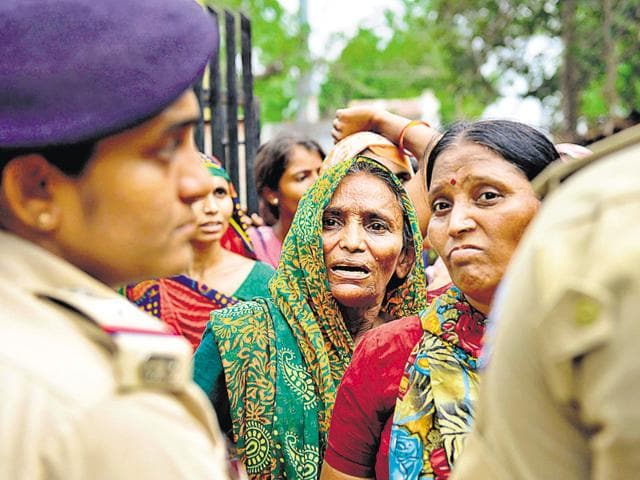
Even eyes can reveal a lot: When village women read the intent of lustful man

By Gagan Sethi* 

This was my first experience in sexual harassment at workplace. It happened in 1983 at Golana, which shot into prominence in 1986 because of the brutal attack on our Dalit colleagues leading to the death of four. The issues were getting land for housing, minimum wages, and refusal to accept insult and humiliation suffered by them for generations. But more about this later.
In 1983 we set up a cooperative in Golana. Situated in the Bhal region of Anand district in Central Gujarat, it is here that river Sabarmati meets the Gulf of Khambhat. The land allocated to us for running the cooperative was along the river. It was part saline and part productive. We decided to grow vegetables, and also some fodder, and get women to take control of the initiative . The target group was Dalits of the village.
After much discussion, we agreed that women were more capable in growing and taking care of vegetables. It was a difficult challenge for us to bring in substantial number of Dalit women in decision making.
Also, it was a challenge for a male outsider to work with rural women. There was a need to train these women in the nitty-gritty of cooperatives, and bringing women, living in a hamlet, for a five-day training to Ahmedabad was a difficult task. It meant six months of convincing.
Building trust with women meant we would have to build trust with male members of the family. After all, women were always under the watchful eyes of men. It also meant that there was a need for a door-to-door contact, understanding women’s fears, building their confidence in us as individuals and an organization.
Most of these meeting would be held in the outer courtyard. One could see gender dynamics working all through: Even when we ate food in any house, women would cook, but men served.
We achieved our goal working diligently. We succeeded in bringing women to Ahmedabad, about 80 kilometres way, for training. The collective got into action, and began discussing the smaller details about how to go about doing things. Soon we realized that we needed an agriculture assistant to be on the site to help women in their job.
We hired a young Patel agricultural scientist, whom we found quite good in issues related with vegetable cultivation. I took him to the village and introduced him to people in the village, arranged for his stay and food, and told the women’s committee to help him adjust.
A week later I returned to the village on my regular visit. I went straight to the Vas, as the hamlet of the Vankar Dalits was called. Soon I sensed an air of unease. I tried to inquire from those present, a little jokingly, whether they had fed our new fellow well. At this point two women came up to me, and said they would like to talk. I was alerted: Something was amiss.
Taking me aside they told me hesitatingly: “Gaganbhai, we don’t know how to say… But this chap you have put in here among us isn’t suitable.” I didn’t understand what had happened. I looked more curious, and they bluntly told me: “His eyes don’t look good” (aa enee aankh barabar nathi).
The import of the statement hit me like a stone. Very angry, I put him behind my motorcycle, and took him straight to my director in Ahmedabad. I told the director to tell him to resign first, and then I would reveal what had happened.
So scared was the young man that he wrote his resignation. I told the director, a priest, who was very compassionate, that it was one year’s trust which this fellow had destroyed in just a week.
Sexual harassment at workplace is a new law. The lesson that we learned was clear enough: If only we listened to women we work with, we would solve the problem. The village women read the intent of the lustful man by reading his eyes. They did not have to wait for an untoward incident to happen, and then set up a committee to inquire. Vigilance and prompt action is all that is needed.

*Author is founder of Janvikas & Centre for Social Justice. First published in Daily News and Analysis, Ahmedabad

Comments

TRENDING

Whither space for the marginalised in Kerala's privately-driven townships after landslides?

By Ipshita Basu, Sudheesh R.C.  In the early hours of July 30 2024, a landslide in the Wayanad district of Kerala state, India, killed 400 people. The Punjirimattom, Mundakkai, Vellarimala and Chooralmala villages in the Western Ghats mountain range turned into a dystopian rubble of uprooted trees and debris.

Election bells ringing in Nepal: Can ousted premier Oli return to power?

By Nava Thakuria*  Nepal is preparing for a national election necessitated by the collapse of KP Sharma Oli’s government at the height of a Gen Z rebellion (youth uprising) in September 2025. The polls are scheduled for 5 March. The Himalayan nation last conducted a general election in 2022, with the next polls originally due in 2027.  However, following the dissolution of Nepal’s lower house of Parliament last year by President Ram Chandra Poudel, the electoral process began under the patronage of an interim government installed on 12 September under the leadership of retired Supreme Court judge Sushila Karki. The Hindu-majority nation of over 29 million people will witness more than 3,400 electoral candidates, including 390 women, representing 68 political parties as well as independents, vying for 165 seats in the 275-member House of Representatives.

Jayanthi Natarajan "never stood by tribals' rights" in MNC Vedanta's move to mine Niyamigiri Hills in Odisha

By A Representative The Odisha Chapter of the Campaign for Survival and Dignity (CSD), which played a vital role in the struggle for the enactment of historic Forest Rights Act, 2006 has blamed former Union environment minister Jaynaynthi Natarjan for failing to play any vital role to defend the tribals' rights in the forest areas during her tenure under the former UPA government. Countering her recent statement that she rejected environmental clearance to Vendanta, the top UK-based NMC, despite tremendous pressure from her colleagues in Cabinet and huge criticism from industry, and the claim that her decision was “upheld by the Supreme Court”, the CSD said this is simply not true, and actually she "disrespected" FRA.

Gig workers hold online strike on republic day; nationwide protests planned on February 3

By A Representative   Gig and platform service workers across the country observed a nationwide online strike on Republic Day, responding to a call given by the Gig & Platform Service Workers Union (GIPSWU) to protest what it described as exploitation, insecurity and denial of basic worker rights in the platform economy. The union said women gig workers led the January 26 action by switching off their work apps as a mark of protest.

'Condonation of war crimes against women and children’: IPSN on Trump’s Gaza Board

By A Representative   The India-Palestine Solidarity Network (IPSN) has strongly condemned the announcement of a proposed “Board of Peace” for Gaza and Palestine by former US President Donald J. Trump, calling it an initiative that “condones war crimes against children and women” and “rubs salt in Palestinian wounds.”

With infant mortality rate of 5, better than US, guarantee to live is 'alive' in Kerala

By Nabil Abdul Majeed, Nitheesh Narayanan   In 1945, two years prior to India's independence, the current Chief Minister of Kerala, Pinarayi Vijayan, was born into a working-class family in northern Kerala. He was his mother’s fourteenth child; of the thirteen siblings born before him, only two survived. His mother was an agricultural labourer and his father a toddy tapper. They belonged to a downtrodden caste, deemed untouchable under the Indian caste system.

India’s road to sustainability: Why alternative fuels matter beyond electric vehicles

By Suyash Gupta*  India’s worsening air quality makes the shift towards clean mobility urgent. However, while electric vehicles (EVs) are central to India’s strategy, they alone cannot address the country’s diverse pollution and energy challenges.

Stands 'exposed': Cavalier attitude towards rushed construction of Char Dham project

By Bharat Dogra*  The nation heaved a big sigh of relief when the 41 workers trapped in the under-construction Silkyara-Barkot tunnel (Uttarkashi district of Uttarakhand) were finally rescued on November 28 after a 17-day rescue effort. All those involved in the rescue effort deserve a big thanks of the entire country. The government deserves appreciation for providing all-round support.

MGNREGA: How caste and power hollowed out India’s largest welfare law

By Sudhir Katiyar, Mallica Patel*  The sudden dismantling of MGNREGA once again exposes the limits of progressive legislation in the absence of transformation of a casteist, semi-feudal rural society. Over two days in the winter session, the Modi government dismantled one of the most progressive legislations of the UPA regime—the Mahatma Gandhi National Rural Employment Guarantee Act (MGNREGA).