
Excerpts from “Preliminary Analysis of Statistics Relating to the Offence of Rape as Reported by the National Crime Records Bureau for 2001‐13”. Research and report by Venkatesh Nayak, Commonwealth Human Rights Initiative (CHRI), New Delhi, and Data Analytics, SS Tech Point, New Delhi:
The total figure for the 28 States alone stands at 2,64,130 rapes during the 13‐year period – an average of almost 56 incidents of rape per day. In the 7 UTs the average is almost two rapes per day (total incidents = 8,714). However Delhi alone accounted for 8,060 reported incidents during this period. While a total of 16,075 cases of rape were reported in 2001 across all States and UTs, in 2013, the figure stood at 33,707 – indicating an increase of 52.30%. However, if the figures for 2013 are omitted, then the increase is 35.5%.
During the 13‐year period, the total figure for the States alone rose every year, except in 2003, when it dipped by a little less than 4%. The total figures in the UTs dipped during the years 2006‐2008 but have risen in all subsequent years. This is due to the dip in the total figures for Delhi during the same years. However Delhi alone accounted for an average of 1.69 rapes per day during the 13‐year period.
Prior to the amendment of the law relating to the offence of rape, Meghalaya witnessed the largest percentage increase in the number of reported cases amongst the 28 States. While only 26 cases were reported in 2001 in Meghalaya, this figure rose to 164 – an increase of 531% in 2012. Goa stood 2nd with an increase of 358% followed by Sikkim (325%) in the 3rd position, Manipur (215%) in the 4th position, West Bengal (188%) in the 5th position, Punjab (128%) in 6th position, Karnataka (112%) in the 7th position, Uttarakhand (100%) in the 8th position, Mizoram (98%) in the 9th position and Rajasthan (95%) in the 10th position.
However, in terms of absolute number of cases reported from each State in 2012, Madhya Pradesh (3,425) topped the list followed by Rajasthan (2,049), West Bengal (2,046), Uttar Pradesh (1,963), Maharashtra (1,839), Assam (1,716) Odisha (1,458), undivided Andhra Pradesh (1,341), Chhattisgarh (1,034) and Kerala (1,019) in descending order.
Prior to the amendment of the law relating to the offence of rape, Daman and Diu witnessed the largest percentage increase in the number of reported cases amongst the 7 UTs. The figure rose 500% from nil to 5 in 2012. However, in terms of absolute numbers Delhi topped the list of UTs with 706 cases in 2012 followed by Chandigarh (27), Puducherry (13) and the Andaman and Nicobar Islands (12).
The expansion of the list of offences that constitute rape through the Criminal Amendment Act, 2013 has had its impact on the figures reported in 2013. The highest percentage rise amongst the 28 States and UTs was in Delhi (329%) as compared to the figure reported in 2001. In view of the figures reported in Maharashtra, in 2013, the rise in the number of cases was more than three times the figure reported in 2001.
In the States of Karnataka, Rajasthan, Uttarakhand Gujarat, Haryana, Jharkhand and Himachal Pradesh the figures are more than double the figures reported in 2001. Another reason for the increase in the number of cases reported in 2013 would be due to the fear of punishment in the minds of the police officers to whom cases of rape are reported. Under the criminal law amendments, if an officer refuses to register a case of rape upon receiving a complaint, he/she commits an offence and may be punished with rigorous imprisonment for a period between six months to two years and will also be liable to pay a fine.
West Bengal is the only State where fewer cases of rape were reported after the 2013 amendments were enforced. The absolute numbers fell from 2,046 in 2012 to 1,685 in 2013. This phenomenon deserves deeper analysis in order to ascertain whether fewer offences of rape were committed or if the police were burking complaints of rape.
After the criminal law amendments, the number of cases reported in 2013 did not rise by leaps and bounds in the States of Madhya Pradesh (52%), Chhattisgarh (44%) and Bihar (27%) which may be indicative of the low levels of awareness about the new law on sexual offences amongst women.
Uttar Pradesh, interestingly, witnessed less than 0.5% increase in the figures reported in 2012 as compared to the figure reported in 2001. However in 2013, with the expansion of the list of offences termed ‘rape’ the number of cases reported increased by 56% .
During the 13‐year period, Madhya Pradesh reported the most number of rapes at 40,422. This figure is 44% higher than that of West Bengal which stands second on this list. The average figure for Madhya Pradesh is more than 8 rapes per day during the 13‐ year period.
West Bengal reported the second highest number of rapes at 22,472 during the 13‐year period. This averages to almost 5 incidents of rape per day across the State during this period. However, the number of cases reported in recent years in West Bengal indicates a downward trend.
Uttar Pradesh stands third in this list with a total of 22,108 instances of rape reported during this period. The recent statements of senior leaders of the ruling 7 political party in that State that, given the size of the population the number of instances reported are minimal, is not borne out by NCRB data. UP averages at 4.65 incidents of rape per day during this 13‐year period.
Maharashtra with 21,049 instances and Rajasthan with 19,083 cases of rape reported during this period complete the list of top five in that order for the 13‐year period. On an average more than 4 rapes occurred per day in Maharashtra and about 4 rapes per day in Rajasthan during this period.
Assam comes 6th with a total of 18,115 instances (average of 3.81 rapes per day) followed by Andhra Pradesh at 7th place with 15,114 cases (average of 3.18 cases per day), Bihar at 8th place with 14,252 cases (average of 3 instances of rape per day), Odisha at 9th place with 13,262 cases (average of 2.79 cases per day) and Chhattisgarh at 10th place with 13,218 cases (average of 2.78 cases per day).
Amongst the 28 States, Sikkim sits at the bottom of the list with only 238 cases of rape reported during this period. The least number of rapes anywhere was reported in the UT of Lakshadweep at 9 cases during the 13‐year period. Delhi, also a UT reported 8,060 cases during this period, much more than the larger States of Tamil Nadu (7,875 cases) Karnataka (6,204 cases), and Gujarat (4,981 cases).
Amongst the 3 States created at the turn of the millennium, Chhattisgarh topped the list with 13,218 cases of rape followed by Jharkhand with 10,363 cases during the 13‐year period. Uttarakhand with 1,606 cases is in the third place. Amongst the States in the northeastern part of India, Nagaland reported the least number of cases of rape ‐ 251 during this period. After Assam, Tripura reported the most number of cases at 2,291 followed by Meghalaya at 1,203, Mizoram at 915 and Arunachal Pradesh at 575 cases during the same period.
Jammu Kashmir reported 3,188 cases during this period while geographically smaller sized states like Haryana and Punjab reported 7,381 and 6,347 cases respectively during this period. Goa reported only 436 cases of rape during this period.
None of the major political parties that have run the governments in the States during this period, have succeed in bringing down the number of instances of rape in a consistent manner year after year despite their election manifesto promises to improve the law and order situation in the concerned State. The All India Trinamool Congress is the only exception where the number of rapes have come down somewhat since it assumed power in the State of West Bengal.
However, it has been in power only for a little more than three years. its performance needs to be watched over the remainder of its term to make a correct assessment of its ability to bring down the figures – not by burking but by taking resolute steps to prevent occurrences of rape in that State.
Analysis of findings from the 20 States and 1 UT covered by this study shows that in some States the number of rapes reported in an election year or a year before general elections to the State Legislative Assembly fell considerably in States like Chhattisgarh and Himachal Pradesh while it rose in a few other States such as Assam, Madhya Pradesh and Maharashtra. This aspect requires deeper analysis to ascertain whether the administration tried to be more sensitive towards sufferers of rape and registered the cases or refused to register cases in order to keep levels of crime low on paper.
***
According to the National Crime Records Bureau (NCRB) data, during the period 2001‐2013, a total of 2,72,844 cases were reported across the 28 states and 7 UTs in India. On an average, a little more than 57 rapes are reported to have occurred every day across the country during this 13 year period. That averages to more than 2 rapes across the country, every hour, every day, during the last 13 years. If the figure for 2013 – the year in which the list of offences that constitute rape was expanded – is discounted, the total for the 12‐year period between 2001‐2012 becomes 2,39,137 cases across all States and UTs. The daily and hourly averages reduce by a few decimal points only .The total figure for the 28 States alone stands at 2,64,130 rapes during the 13‐year period – an average of almost 56 incidents of rape per day. In the 7 UTs the average is almost two rapes per day (total incidents = 8,714). However Delhi alone accounted for 8,060 reported incidents during this period. While a total of 16,075 cases of rape were reported in 2001 across all States and UTs, in 2013, the figure stood at 33,707 – indicating an increase of 52.30%. However, if the figures for 2013 are omitted, then the increase is 35.5%.
During the 13‐year period, the total figure for the States alone rose every year, except in 2003, when it dipped by a little less than 4%. The total figures in the UTs dipped during the years 2006‐2008 but have risen in all subsequent years. This is due to the dip in the total figures for Delhi during the same years. However Delhi alone accounted for an average of 1.69 rapes per day during the 13‐year period.
Prior to the amendment of the law relating to the offence of rape, Meghalaya witnessed the largest percentage increase in the number of reported cases amongst the 28 States. While only 26 cases were reported in 2001 in Meghalaya, this figure rose to 164 – an increase of 531% in 2012. Goa stood 2nd with an increase of 358% followed by Sikkim (325%) in the 3rd position, Manipur (215%) in the 4th position, West Bengal (188%) in the 5th position, Punjab (128%) in 6th position, Karnataka (112%) in the 7th position, Uttarakhand (100%) in the 8th position, Mizoram (98%) in the 9th position and Rajasthan (95%) in the 10th position.
However, in terms of absolute number of cases reported from each State in 2012, Madhya Pradesh (3,425) topped the list followed by Rajasthan (2,049), West Bengal (2,046), Uttar Pradesh (1,963), Maharashtra (1,839), Assam (1,716) Odisha (1,458), undivided Andhra Pradesh (1,341), Chhattisgarh (1,034) and Kerala (1,019) in descending order.
Prior to the amendment of the law relating to the offence of rape, Daman and Diu witnessed the largest percentage increase in the number of reported cases amongst the 7 UTs. The figure rose 500% from nil to 5 in 2012. However, in terms of absolute numbers Delhi topped the list of UTs with 706 cases in 2012 followed by Chandigarh (27), Puducherry (13) and the Andaman and Nicobar Islands (12).
The expansion of the list of offences that constitute rape through the Criminal Amendment Act, 2013 has had its impact on the figures reported in 2013. The highest percentage rise amongst the 28 States and UTs was in Delhi (329%) as compared to the figure reported in 2001. In view of the figures reported in Maharashtra, in 2013, the rise in the number of cases was more than three times the figure reported in 2001.
In the States of Karnataka, Rajasthan, Uttarakhand Gujarat, Haryana, Jharkhand and Himachal Pradesh the figures are more than double the figures reported in 2001. Another reason for the increase in the number of cases reported in 2013 would be due to the fear of punishment in the minds of the police officers to whom cases of rape are reported. Under the criminal law amendments, if an officer refuses to register a case of rape upon receiving a complaint, he/she commits an offence and may be punished with rigorous imprisonment for a period between six months to two years and will also be liable to pay a fine.
West Bengal is the only State where fewer cases of rape were reported after the 2013 amendments were enforced. The absolute numbers fell from 2,046 in 2012 to 1,685 in 2013. This phenomenon deserves deeper analysis in order to ascertain whether fewer offences of rape were committed or if the police were burking complaints of rape.
After the criminal law amendments, the number of cases reported in 2013 did not rise by leaps and bounds in the States of Madhya Pradesh (52%), Chhattisgarh (44%) and Bihar (27%) which may be indicative of the low levels of awareness about the new law on sexual offences amongst women.
Uttar Pradesh, interestingly, witnessed less than 0.5% increase in the figures reported in 2012 as compared to the figure reported in 2001. However in 2013, with the expansion of the list of offences termed ‘rape’ the number of cases reported increased by 56% .
During the 13‐year period, Madhya Pradesh reported the most number of rapes at 40,422. This figure is 44% higher than that of West Bengal which stands second on this list. The average figure for Madhya Pradesh is more than 8 rapes per day during the 13‐ year period.
West Bengal reported the second highest number of rapes at 22,472 during the 13‐year period. This averages to almost 5 incidents of rape per day across the State during this period. However, the number of cases reported in recent years in West Bengal indicates a downward trend.
Uttar Pradesh stands third in this list with a total of 22,108 instances of rape reported during this period. The recent statements of senior leaders of the ruling 7 political party in that State that, given the size of the population the number of instances reported are minimal, is not borne out by NCRB data. UP averages at 4.65 incidents of rape per day during this 13‐year period.
Maharashtra with 21,049 instances and Rajasthan with 19,083 cases of rape reported during this period complete the list of top five in that order for the 13‐year period. On an average more than 4 rapes occurred per day in Maharashtra and about 4 rapes per day in Rajasthan during this period.
Assam comes 6th with a total of 18,115 instances (average of 3.81 rapes per day) followed by Andhra Pradesh at 7th place with 15,114 cases (average of 3.18 cases per day), Bihar at 8th place with 14,252 cases (average of 3 instances of rape per day), Odisha at 9th place with 13,262 cases (average of 2.79 cases per day) and Chhattisgarh at 10th place with 13,218 cases (average of 2.78 cases per day).
Amongst the 28 States, Sikkim sits at the bottom of the list with only 238 cases of rape reported during this period. The least number of rapes anywhere was reported in the UT of Lakshadweep at 9 cases during the 13‐year period. Delhi, also a UT reported 8,060 cases during this period, much more than the larger States of Tamil Nadu (7,875 cases) Karnataka (6,204 cases), and Gujarat (4,981 cases).
Amongst the 3 States created at the turn of the millennium, Chhattisgarh topped the list with 13,218 cases of rape followed by Jharkhand with 10,363 cases during the 13‐year period. Uttarakhand with 1,606 cases is in the third place. Amongst the States in the northeastern part of India, Nagaland reported the least number of cases of rape ‐ 251 during this period. After Assam, Tripura reported the most number of cases at 2,291 followed by Meghalaya at 1,203, Mizoram at 915 and Arunachal Pradesh at 575 cases during the same period.
Jammu Kashmir reported 3,188 cases during this period while geographically smaller sized states like Haryana and Punjab reported 7,381 and 6,347 cases respectively during this period. Goa reported only 436 cases of rape during this period.
None of the major political parties that have run the governments in the States during this period, have succeed in bringing down the number of instances of rape in a consistent manner year after year despite their election manifesto promises to improve the law and order situation in the concerned State. The All India Trinamool Congress is the only exception where the number of rapes have come down somewhat since it assumed power in the State of West Bengal.
However, it has been in power only for a little more than three years. its performance needs to be watched over the remainder of its term to make a correct assessment of its ability to bring down the figures – not by burking but by taking resolute steps to prevent occurrences of rape in that State.
Analysis of findings from the 20 States and 1 UT covered by this study shows that in some States the number of rapes reported in an election year or a year before general elections to the State Legislative Assembly fell considerably in States like Chhattisgarh and Himachal Pradesh while it rose in a few other States such as Assam, Madhya Pradesh and Maharashtra. This aspect requires deeper analysis to ascertain whether the administration tried to be more sensitive towards sufferers of rape and registered the cases or refused to register cases in order to keep levels of crime low on paper.
Rape trial related trends – 2012 vis‐à‐vis 2013
Our findings comparing the data for the two year period are given below:While 1,01,041 cases were under trial in 2012, with 1,14,785 cases under trial this amounts to a 12% increase.
In 2012 trial was completed in 14,717 cases whereas in 2013 this figure rose by a little less than 22% to 18,833. While 3,563 persons were convicted for rape in 2012, 5,101 culprits were convicted in 2013 indicating an increase by a little more than 30%.
The number of acquittals rose by 18.79% in 2013 when 13,735 accused persons were pronounced not guilty as compared to 11,154 persons in 2012.
In 2013, the proportion of cases where the offence of rape was compounded9 fell by a little more than 24% as compared to 2012.
The proportion of rape cases where trial was pending rose by a little more than 10% in 2013 (95,731 cases) as compared to 2012 (86,032 cases).
In 2012 trial was completed in 14,717 cases whereas in 2013 this figure rose by a little less than 22% to 18,833. While 3,563 persons were convicted for rape in 2012, 5,101 culprits were convicted in 2013 indicating an increase by a little more than 30%.
The number of acquittals rose by 18.79% in 2013 when 13,735 accused persons were pronounced not guilty as compared to 11,154 persons in 2012.
In 2013, the proportion of cases where the offence of rape was compounded9 fell by a little more than 24% as compared to 2012.
The proportion of rape cases where trial was pending rose by a little more than 10% in 2013 (95,731 cases) as compared to 2012 (86,032 cases).

Trend in Gujarat
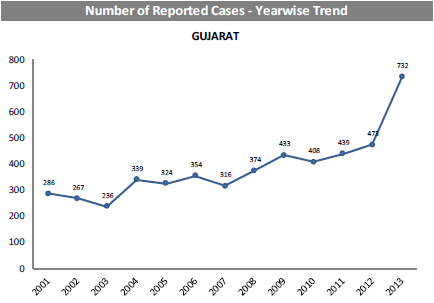
At the start of the period under study, in 2001, Gujarat reported only 286 cases of rape (Graph 35). In 2013 the figure had risen to 732 indicating almost 156% increase since 2001.
The steepest hike in any year as compared to the previous year was in 2012 at almost 55%. The State witnessed a declining trend during the years 2002, 2003, 2005 and 2010. Upward trend in the figures was reported in all other years. The BJP was in power during all these years.
71% of the rape cases were reported during the years 2013, 2012, 2011, 2009, 2010, 2008, 2006 and 2004 in descending order of the number of cases reported in each successive year (Graph 36). 2012 was an election year in Gujarat.
The steepest hike in any year as compared to the previous year was in 2012 at almost 55%. The State witnessed a declining trend during the years 2002, 2003, 2005 and 2010. Upward trend in the figures was reported in all other years. The BJP was in power during all these years.
71% of the rape cases were reported during the years 2013, 2012, 2011, 2009, 2010, 2008, 2006 and 2004 in descending order of the number of cases reported in each successive year (Graph 36). 2012 was an election year in Gujarat.
Comments