
Rallies, hunger strike, demand for self-rule in Narmada Valley villages of Madhya Pradesh, Maharashtra

By A Representative
Following demonstrations and meeting in several villages of Madhya Pradesh protesting against the alleged failure to rehabilitate Narmada dam oustees, top anti-dam organization, Narmada Bachao Andolan (NBA), in a statement, has regretted that the state government’s top functionaries, including the chief minister and his ministers, appeared to think that the World Indigenous Day, which it celebrated a week ago, was a religious festival.
NBA accused them of  spending crores of rupees, "even as the question of ‘self-rule’ is being categorically denied to adivasis". NBA said, “Part IX of the Indian Constitution states that in spite of any other article or section, there will be independent administration for tribals. Article 243-N clearly states that after the 73rd amendment of the Constitution in 1992 any laws of states contrary to it will not be applicable after 1993.”
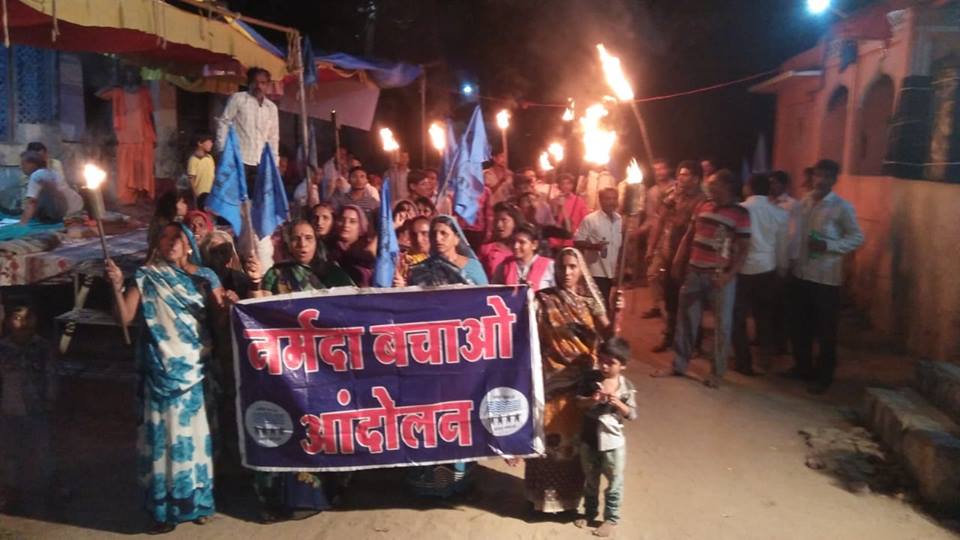
It added, “After the 73rd amendment came the Panchayati Raj (Extension to Schedule Areas) Act (PESA Act) in 1996, which was an addition to the Panchayati Raj Act 1993. But instead of extending the special powers given to villagers and panchayats to adivasi gramsabhas, their rights are being crushed. PESA is in cold storage.”
According to NBA, “States, including Madhya Pradesh, are rejecting the claim and ownership of adivasi gramsabhas to natural resources and right to participation in development planning of those resources. Widespread exploitation of natural resources are being undertaken without due process, consultation and consent of gram sabhas.”
Pointing out that “sonsent is the minimum required by law and still it is not being followed. Even Rules for PESA have not been made in Madhya Pradesh”, NBA regretted that the situation is not very different in other states. Thus, “There is death by starvation of dalit-adivasis in Jharkhand, malnutrition of adivasis of Nandurbar or Melghat (Maharashtra) or the displacement of tribals all over India is a result of this.”
NBA regretted, “In a valley like Narmada, where adivasis co-owned the rivers and mountains for generations, they were not even told of the disastrous consequences of damming the river, let alone rehabilitating them. The Narmada Tribunal in its 10 years of inspection hasn’t even met the tribal representation.”
“Even today”, NBA said, “In hilly areas adivasi homes have been broken by the administration without any hope to gain alternative house plot. After fighting for 33 years adivasis have secured their right to rehabilitation. But after submitting false reports the government wants to exclude thousands of adivasis from rehabilitation benefits.”
“Neither PESA Act, nor rehabilitation, nor prohibition of alcohol sales is being implemented by the state”, NBA said, adding, “The Forest Rights Act is not even implemented in single village situated on the banks of Narmada in Badwani, Alirajpur and Nandurbar districts.”  
“Does the Madhya Pradesh government (or any other) have any right to ‘play empty drums’ in the name of adivasi rights?”, it asked, adding, it wasn’t without reason that on the occasion of the World Indigenous Day, relay hunger strike was undertaken in several of the villages, including “Pichhodi, Avalda, Kasravad, Rajghat, Kukra, Bhilkheda, Bagud, Piplud, Seganv, Dhanora, Nisarpur, Kapadkheda, Kadmal, Bajarikheda, Chikhalda, Gopalpura, Gangli, Kavthi, Bada Barda, Dharampuri, Navdatoli etc.”
As part of the protest, submergence villages hoisted the tricolour on the occasion of Independence Day, and special gram sabhas passed the resolution for the stay of the fake displacement process, NBA said, adding, “Until now, 192 villages and 1 town displaced by the Sardar Sarovar Dam have not been rehabilitated.”
Claiming that 35,000 displaced are yet to be rehabilitated by the Madhya Pradesh government, the Narmada Valley Development Corporation, and the Narmada Control Authority, NBA recalled, “Avalda, Pichhodi, Bagud, Kasravad, Chikhalda and Kaparkheda gram sabhas belong to Scheduled Areas and hence PESA Act is applicable.”
It said, “According to Section 4 of this act prior consultation and consent of gram sabha is mandatory before land acquisition. But since this is not followed in Madhya Pradesh, it is contempt of this law and of the gram sabha. The gram sabhas on August 15, 2018 condemned such an attitude, unanimously passed the resolution to keep the gates of the Sardar Sarovar Dam opened and let river Narmada flow.”

Comments

TRENDING

Whither space for the marginalised in Kerala's privately-driven townships after landslides?

By Ipshita Basu, Sudheesh R.C.  In the early hours of July 30 2024, a landslide in the Wayanad district of Kerala state, India, killed 400 people. The Punjirimattom, Mundakkai, Vellarimala and Chooralmala villages in the Western Ghats mountain range turned into a dystopian rubble of uprooted trees and debris.

Election bells ringing in Nepal: Can ousted premier Oli return to power?

By Nava Thakuria*  Nepal is preparing for a national election necessitated by the collapse of KP Sharma Oli’s government at the height of a Gen Z rebellion (youth uprising) in September 2025. The polls are scheduled for 5 March. The Himalayan nation last conducted a general election in 2022, with the next polls originally due in 2027.  However, following the dissolution of Nepal’s lower house of Parliament last year by President Ram Chandra Poudel, the electoral process began under the patronage of an interim government installed on 12 September under the leadership of retired Supreme Court judge Sushila Karki. The Hindu-majority nation of over 29 million people will witness more than 3,400 electoral candidates, including 390 women, representing 68 political parties as well as independents, vying for 165 seats in the 275-member House of Representatives.

Jayanthi Natarajan "never stood by tribals' rights" in MNC Vedanta's move to mine Niyamigiri Hills in Odisha

By A Representative The Odisha Chapter of the Campaign for Survival and Dignity (CSD), which played a vital role in the struggle for the enactment of historic Forest Rights Act, 2006 has blamed former Union environment minister Jaynaynthi Natarjan for failing to play any vital role to defend the tribals' rights in the forest areas during her tenure under the former UPA government. Countering her recent statement that she rejected environmental clearance to Vendanta, the top UK-based NMC, despite tremendous pressure from her colleagues in Cabinet and huge criticism from industry, and the claim that her decision was “upheld by the Supreme Court”, the CSD said this is simply not true, and actually she "disrespected" FRA.

Gig workers hold online strike on republic day; nationwide protests planned on February 3

By A Representative   Gig and platform service workers across the country observed a nationwide online strike on Republic Day, responding to a call given by the Gig & Platform Service Workers Union (GIPSWU) to protest what it described as exploitation, insecurity and denial of basic worker rights in the platform economy. The union said women gig workers led the January 26 action by switching off their work apps as a mark of protest.

'Condonation of war crimes against women and children’: IPSN on Trump’s Gaza Board

By A Representative   The India-Palestine Solidarity Network (IPSN) has strongly condemned the announcement of a proposed “Board of Peace” for Gaza and Palestine by former US President Donald J. Trump, calling it an initiative that “condones war crimes against children and women” and “rubs salt in Palestinian wounds.”

With infant mortality rate of 5, better than US, guarantee to live is 'alive' in Kerala

By Nabil Abdul Majeed, Nitheesh Narayanan   In 1945, two years prior to India's independence, the current Chief Minister of Kerala, Pinarayi Vijayan, was born into a working-class family in northern Kerala. He was his mother’s fourteenth child; of the thirteen siblings born before him, only two survived. His mother was an agricultural labourer and his father a toddy tapper. They belonged to a downtrodden caste, deemed untouchable under the Indian caste system.

India’s road to sustainability: Why alternative fuels matter beyond electric vehicles

By Suyash Gupta*  India’s worsening air quality makes the shift towards clean mobility urgent. However, while electric vehicles (EVs) are central to India’s strategy, they alone cannot address the country’s diverse pollution and energy challenges.

Stands 'exposed': Cavalier attitude towards rushed construction of Char Dham project

By Bharat Dogra*  The nation heaved a big sigh of relief when the 41 workers trapped in the under-construction Silkyara-Barkot tunnel (Uttarkashi district of Uttarakhand) were finally rescued on November 28 after a 17-day rescue effort. All those involved in the rescue effort deserve a big thanks of the entire country. The government deserves appreciation for providing all-round support.

MGNREGA: How caste and power hollowed out India’s largest welfare law

By Sudhir Katiyar, Mallica Patel*  The sudden dismantling of MGNREGA once again exposes the limits of progressive legislation in the absence of transformation of a casteist, semi-feudal rural society. Over two days in the winter session, the Modi government dismantled one of the most progressive legislations of the UPA regime—the Mahatma Gandhi National Rural Employment Guarantee Act (MGNREGA).