
Gujarat Dalit activist sends 25 kg plastic "responsible" for cow slaughter to chief minister, insists, punish the guilty

Plastic from cow womb for Gujarat CM on display
at Surendranagar district collector's office
By A Representative
Gujarat's grassroots Dalit rights activist Natubhai Parmar -- who created a flutter by dumping a tractor full of dead cows in front of Surendranagar district office in 2016 following cow vigilantes beating up Dalits belonging to the Rohit community in Una on July 11, 2016 on suspicion of cow slaughter -- has stunned the state administration yet again. Now he has sent across 25 kg of plastic recovered from the womb of a cow to Gujarat chief minister Vijay Rupani to tell him: Plastics are the main cause of cow slaughter.
The cow vigilantes tied up four Dalit boys on an SUV with a chain, and paraded them for about a kilometre up to a local police station, caning them up all the way. The boys were beaten up on suspicion cow slaughter, even as their plea that they were skinning a dead cow, their hereditary occupation, was ignored. After a video went viral showing the incident, protests broken out across Gujarat, with Rohits pledging they would not skin cows any more.
Parmar, an activist with Navsarjan Trust, Gujarat's biggest Dalit rights organization, took this opportunity to tell the administration that Rohits were being forced to do this caste-based occupation, of skinning cows, and would not do it any more because of repeated harassment by the administration and vigilantes, which blamed them for slaughtering cows.
The cow protection exhibition 
A year ago, on May 10, 2017, Parmar led a Dalit rally in Surendranagar, highlighting that cows dead because the ate plastic. A tractor carrying tens of kilos of plastic taken out of dead cows' womb accompanied the rally, insisting, those responsible for failing to take care of cows, setting them free as stray cattle, forcing them to eat leftovers on roadsides mixed with plastic, should be held responsible for cow slaughter.
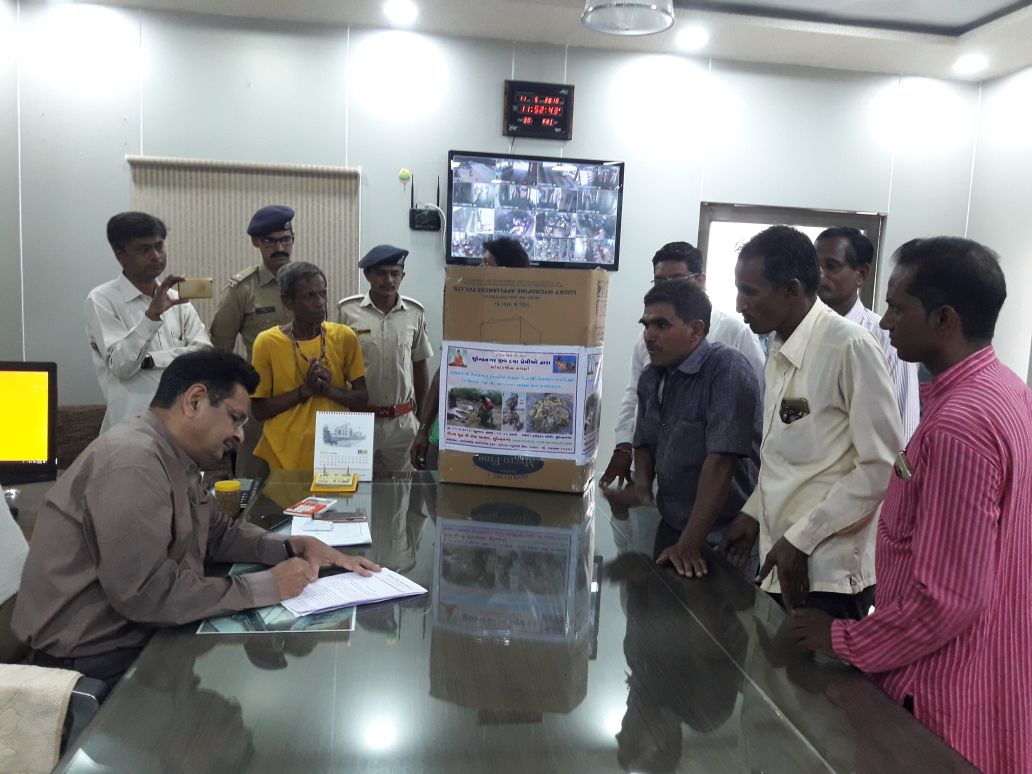
Marking the first anniversary of the rally, on Friday, Parmar organized another rally, taking a 25 kg box, plastic taken out from a dead cow after skinning the animal, to be hands over to the chief minister. The box and a memorandum addressed to the chief minister were given to the district collector, who was told, even though the government claims to revere it as a holy animal, it does not take its proper care.
He told Counterview, "I was told I wouldn't be able to hand over the plastic to the chief minister, who is visiting here for a function. So we decided to hand over this to the district collector, meant as a gift to the chief minister."
Memorandum and plastic being handed over
to district collector
The 12-point memorandum, a copy of which he gave to Counterview, said, the main reason why cows die is because of the state policy which led to disappearance of grazing land across Gujarat. While cow sheds or panjrapols were being closed down, the existing ones do not take care of unproductive cows, hence the animal is forced to go astray, eating whatever it gets on streets, including food mixed with plastics.
The memorandum to the chief minister said, "The government should x-ray dead cows to find out the reason of their death. If plastic is found, the responsibility of setting the cows go astray should be fixed, and those found guilty should be tried under the the state's law which seeks to punish those slaughtering cow."
The memorandum demands taking back grazing land handed over to industrialists, setting up special fodder ration shops for cows, setting up of special veterinary hospital in each Gujarat district by operating upon live cows and taking out out plastic from their womb, a complete ban on plastics, and so on.
Parmar's move follows a unique permanent exhibition on cow protection he has organized on the road leading to Wadhvan town off Ahmedabad-Gandhidham highway. The exhibit is an installation of sorts highlighted by a cow prototype with its stomach exposed, intestines choked with plastic. At the exhibit, swathes of blood and fluid are soaked in plastic, removed by kilos from dead bovines during cow skinning, all of it hung on bamboo rods.
Comments

TRENDING

A comrade in culture and controversy: Yao Wenyuan’s revolutionary legacy

By Harsh Thakor*  This year marks two important anniversaries in Chinese revolutionary history—the 20th death anniversary of Yao Wenyuan, and the 50th anniversary of his seminal essay "On the Social Basis of the Lin Biao Anti-Party Clique". These milestones invite reflection on the man whose pen ignited the first sparks of the Great Proletarian Cultural Revolution and whose sharp ideological interventions left an indelible imprint on the political and cultural landscape of socialist China.

Ahmedabad's Sabarmati riverfront under scrutiny after Subhash Bridge damage

By Rosamma Thomas*  Large cracks have appeared on Subhash Bridge across the Sabarmati in Ahmedabad, close to the Gandhi Ashram . Built in 1973, this bridge, named after Subhash Chandra Bose , connects the eastern and western parts of the city and is located close to major commercial areas. The four-lane bridge has sidewalks for pedestrians, and is vital for access to Ashram Road , Ellis Bridge , Gandhinagar and the Sabarmati Railway Station .

The Vande Mataram debate and the politics of manufactured controversy

By Vidya Bhushan Rawat*  The recent Vande Mataram debate in Parliament was never meant to foster genuine dialogue. Each political party spoke past the other, addressing its own constituency, ensuring that clips went viral rather than contributing to meaningful deliberation. The objective was clear: to construct a Hindutva narrative ahead of the Bengal elections. Predictably, the Lok Sabha will likely expunge the opposition’s “controversial” remarks while retaining blatant inaccuracies voiced by ministers and ruling-party members. The BJP has mastered the art of inserting distortions into parliamentary records to provide them with a veneer of historical legitimacy.

No action yet on complaint over assault on lawyer during Tirunelveli public hearing

By A Representative   A day after a detailed complaint was filed seeking disciplinary action against ten lawyers in Tirunelveli for allegedly assaulting human rights lawyer Dr. V. Suresh, no action has yet been taken by the Bar Council of Tamil Nadu and Puducherry, according to the People’s Union for Civil Liberties (PUCL).

Farewell to Robin Smith, England’s Lionhearted Warrior Against Pace

By Harsh Thakor*  Robin Smith, who has died at the age of 62, was among the most adept and convincing players of fast bowling during an era when English cricket was in decline and pace bowling was at its most lethal. Unwavering against the tormenting West Indies pace attack or the relentless Australians, Smith epitomised courage and stroke-making prowess. His trademark shot, an immensely powerful square cut, made him a scourge of opponents. Wearing a blue England helmet without a visor or grille, he relished pulling, hooking and cutting the quicks. 

Proposals for Babri Masjid, Ram Temple spark fears of polarisation before West Bengal polls

By A Representative   A political debate has emerged in West Bengal following recent announcements about plans for new religious structures in Murshidabad district, including a proposed mosque to be named Babri Masjid and a separate announcement by a BJP leader regarding the construction of a Ram temple in another location within Behrampur.

Latur’s quiet rebel: Dr Suryanarayan Ransubhe and his war on Manuvad

By Ravi Ranjan*  In an India still fractured by caste, religion, and language, where narrow loyalties repeatedly threaten to tear the nation apart, Rammanohar Lohia once observed that the true leader of the bahujans is one under whose banner even non-bahujans feel proud to march. The remark applies far beyond politics. In the literary-cultural and social spheres as well, only a person armed with unflinching historical consciousness and the moral courage to refuse every form of personality worship—including worship of oneself—can hope to touch the weak pulse of the age and speak its bitter truths without fear or favour. 

Myanmar prepares for elections widely seen as a junta-controlled exercise

By Nava Thakuria*  Trouble-torn Myanmar (also known as Burma or Brahmadesh) is preparing for three-phase national elections starting on 28 December 2025, with results expected in January 2026. Several political parties—primarily proxies of the Burmese military junta—are participating, while Aung San Suu Kyi’s National League for Democracy (NLD) remains banned. Observers expect a one-sided contest where junta-backed candidates are likely to dominate.

Differences in 2002 and 2025 SIR revision procedures spark alarm in Gujarat

By A Representative   Civil rights groups and electoral reform activists have raised serious concerns over the ongoing Special Intensive Revision (SIR) of electoral rolls in Gujarat and 11 other states, alleging that the newly enforced requirements could lead to large-scale deletion of legitimate voters, particularly those unable to furnish documentation linking them to the 2002 electoral list.