By Martin Macwan*
The father of the boy who was assaulted by sharp razor on October 3 by two assailants riding a motorcycle without number plate and covered faces sports the biggest and twisted moustache I witnessed in village Limbodra of Mansa taluka. His moustache is not new or recent, as I saw his past photographs. He has been working as an agricultural labourer, mostly on the farms of Kshatriya landowners, engaged in specialized job of cross fertilizing the BT cotton flowers. He also has the work award of chopping the wood in the village Panchayat that adds to his income. Never before his moustache has been a problem to the Kshatriya population, which forms the majority in the village.
I met about 40 Dalit men in the village, young and old, and most had moustache, although not big and twirled. Everyone had grown moustache and unshaved beards, which is due to the fact that, on account of untouchability, the village barber does not give them a shave or haircut. They have to travel about four kilometers to the next point where the barber’s service is available.
Untouchability is nothing new to the village Dalits. Elderly Dalits have to address the Kshatriya children as ‘Bapu’, whose children would address Dalit elders derogatorily. A year-and-a-half back, a Dalit family for the first time tried to get a horse for their bridegroom son to mount up to the wedding hut, but he was unable to do it. Some Dalit elders have internalized this act of forced prohibition of mounting the horse, a symbol of Kshatriya clan pride, as the good advice from the latter not to spend lavishly on marriages.
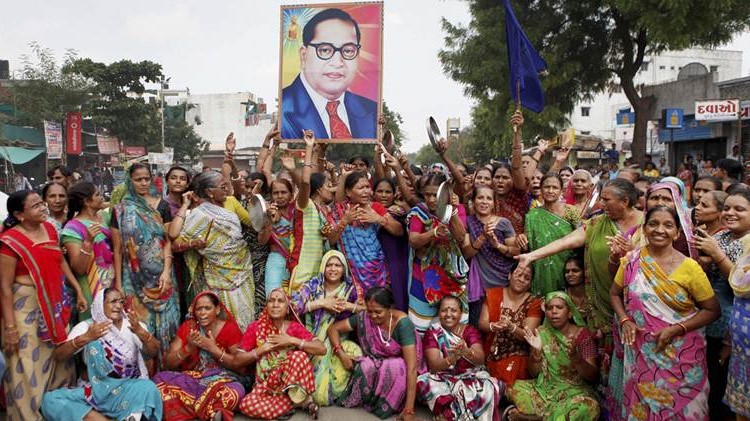
As the third incident of assault on Dalits happened in the village, the Kshatriyas, who were politically divided, have united, taking seriously the clarion call of Dr Ambedkar to Dalits ‘to organize’, as he knew, Dalits must Dalits to shed their fear of being targeted to come together and fight for justice. The Kshatriyas’ “need” for unity is also a sort of reaction to social media of the world outside the village, which portrays photographs, videos and challenging massages from Dalit youth across the state. The Kshatriya youth in the village are finding themselves nervous and helpless. They seem to be feeling deprived of their superiority over their village Dalit youth, both in the real and the virtual world of social media, which more than often than not is faceless, and yet is able to create a humiliating perception in the minds, influenced by caste psyche, challenging one’s identity.
It’s clear, the moustache is only a stimulus and a bubble of simmering reality of unrest, humiliation, and frustration of Dalit youth. Unlike their parents, they are better educated, studying subjects of law and commerce, are better clothed in fashionable attires, ride motorcycles, and have access to the same internet that any other youth have access to.
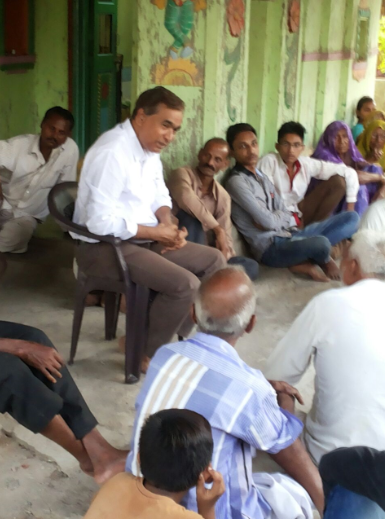 |
| Martin Macwan interacting with Limbodra Dalits |
My mind raced back to memories of working in the village of Bhal region in 1980s. The same untouchability practices and social prohibitions which I had witnessed Dalits facing at the hands of Kshatriyas were present unbelievably in Limbodra, barely 20 kilometers away from State Capital of Gujarat, which has decorated itself in the colours of ‘samrasta’, social integration diced with equality.
In 1980 we were witness to Kshatriya men in Bhal villages entering Dalit homes at any time of the day, misbehaving with Dalit women, and there was no protest. Except for a few Dalit farmers, most of them were landless agricultural labourers, who were paid Re 1 as wage against the stipulated Rs 7. Dalits were prohibited riding a cycle, leave aside a horse, and they buried their dead on the road sides. Dalit men had to tie a turban on the head, which habituated them to do so immediately, even when we visited them in their homes as the first reaction.
Limbodra Dalit labourers are paid Rs 140 per day for their farm labour, half the amount than what is stipulated by the state. The only difference I saw in Limbodra as compared to Bhal villages in a time span of 37 years is that, Dalits have much better homes, are not totally economic dependent on the Kshatriya community, the youth among them are better educated and employed, and women have a spark of anger in their eyes. Why then has the practices of untouchability not changed in Limbodra?, it baffled me.
I recall, one night I and my colleague heard the knocking sound of the window of a Dalit home that fell on the road. Next day, we learnt that the person knocking was a Kshatriya, who had lost his wife and was unable to feed his children, and found safety in the darkness of the night to knock at the Dalit’s window to beg for some wheat flour to feed his children. The same man had earlier tried to be employed in an agricultural cooperative that we had set up for Dalits, but his community scorned at him for lowering his and entire community’s social status. The man later hung himself, humiliated by his community for begging at night to the Dalit home, although the community never came forward to help him. I learnt that many Kshatriya families in Limbodra were equally poor.
On two occasions earlier, 15 and 25 years ago, Dalits of Limbodra had filed police complaints, but both of them ended in a compromise. Their ability to file a complaint was less based on Dalits’ might and more on infighting among Kshatriyas, in which the rival group would support Dalits. Despite glaring injustices and humiliating caste ruling, the village does not have any record a single complaint filed by a Dalit or a Dalit protest ending either in conviction or strengthening of Dalits organizationally. Interestingly, even the initiative of celebrating Dr Ambedkar’s birth anniversary has turned out to be short lived.
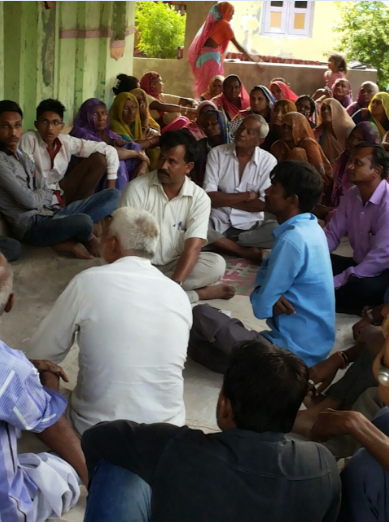 |
| Limbodra Dalits… men and women |
The incident of public flogging of Dalit youth of Una left a deep impact on the group of about 40 Dalit youth of village Limbodra, who decided on the first ever action of not participating in the common meal of the village on social occasions, where Dalits were made to sit separately from others. This silent protest and ‘boycott’ has been perceived by the younger generation of Kshatriyas as a challenge, who otherwise play and study together in school.
Over the years, the older generation of Dalits found employment in the textile mills of Ahmedabad, where not only did they earn better, but escaped the humiliation of the Kshatriyas in farms. With closing of the mills, many took up self-employment activities such as selling chappals etc. About 50 Dalit youth today have found employment in a company in Gandhinagar, where they earn a minimum of Rs 375; some earn about Rs 15,000 per month. With their incomes rising, their houses have become better and visually more prosperous than some of the Kshatriyas.
Since the ‘development’ has favoured those who have laboured hard, although in a small way, the Kshatriya youth probably have found themselves lagging behind. The Kshatriyas’ parents had learnt to adjust with the mismatch of ‘higher’ social status and ‘lower’ economic status, and therefore had no shame in working in tea shops. The Kshatriya youth cannot follow their parents and have fallen on petty issues like moustache pride, which actually does not help them overcome their social and psychological backwardness.
As I sat there with a group of 25 men and 35 women sharing with them my experiences, they listened to me with attention. My colleagues Bharatbhai, Shantaben and Prahladbhai — who had worked hard last week to ensure that the due procedure of law is followed in the incidents of attack — accompanied me. As I ended speaking, an elderly woman spoke up, directly looking into my eyes; ‘I agree with you. Our enemy is not the Kshatriyas, but the fear’. Many women shook their heads. Their eyes were focused, angry and determined. They did not sport a moustache. I learnt that the moustache may be a symbol of manhood for the male, but for women it is a symbol of humiliation, subjugation and exploitation, both of their mind and body.
—
*Founder, Navsarjan Trust, Ahmedabad
Comments
Post a Comment
NOTE: Hateful, abusive comments won't be published. -- Editor