
Late evening on June 12, a senior sociologist of Indian origin, who lives in Vienna, asked me a pointed question: Of the 241 persons who died as a result of the devastating plane crash in Ahmedabad the other day, did I know anyone? I had no hesitation in telling her: former Gujarat chief minister Vijay Rupani, whom I described to her as "one of the more sensible persons in the BJP leadership."
Gujarat chief minister from 2016 to 2021, I may not have met Rupani after I retired from the Times of India in January 2013, though I would speak to him on the phone as and when needed for writing a blog or an article. But let me be frank: I disagree with Prime Minister Narendra Modi's X post after Rupani's terrible loss. Modi appeared to stress more on how loyal the departed soul was to the BJP ideology.
Surely, it must be a personal loss for Modi and the BJP, but it is also a loss to those who do not belong to the party or its ideology—a person who was frank, soft-spoken, humble, had the capacity to listen and understand issues, and didn’t mind interacting with down-to-earth individuals even if they were inimical to his party’s ideology. Surely, the loss is felt outside the party, among those who had nothing to do with the BJP.
Let me recall what happened a few months after Rupani was sworn in as Gujarat chief minister in August 2016. At that time, I was working as a media consultant with an NGO, sitting in the office of the Centre for Social Justice in Ahmedabad. A Valmiki leader who headed a grassroots organisation called Manav Garima Trust, Parsottam Vaghela—supported by a sister NGO, Janvikas—would often reach out to me with news about the plight of manual scavengers in Ahmedabad.
Always seeking a solution, one day he complained that he was tired of pleading with Ahmedabad Municipal Corporation officials to ban manual cleaning work assigned to gutter workers, which he qualified as manual scavenging. He would also point out that despite tall claims about ending open defecation, he had identified many spots where it still occurred, and Valmiki community members were regularly asked to clean them up.
In November 2016, Vaghela approached me, wondering if he could apprise the new chief minister of the community’s plight. I said he should try, as I had found Rupani to be a good listener, someone who genuinely tried to understand problems and look for administrative solutions. Vaghela decided to seek an appointment with Rupani.
In late November, Vaghela came to me, visibly happy that he had managed to meet Rupani. Based on what he told me, I published a story in Counterview about his in-person representation to the chief minister. He said he gave Rupani a glimpse into Prime Minister Narendra Modi’s model city, Ahmedabad, highlighting how as many as 1,250 Valmiki families were living in western Ahmedabad’s posh localities without any basic amenities—not even housing.
He told Rupani these families were “without any basic facilities and live either in the open or in makeshift shanties, with most of them working as sanitary workers under private contractors,” pointing out that Valmikis, considered the lowest sub-caste among Dalits, had traditionally worked as manual scavengers.
Vaghela further said, “When I told the chief minister that, lacking basic amenities, these families defecate in the open, he was in a state of disbelief and immediately picked up the phone, asking the Ahmedabad municipal commissioner to look into the matter.”
“Living in an atmosphere of insecurity, they have stayed amidst filth for the last 15 to 20 years after migrating from other parts of Gujarat in search of work,” Vaghela added. “Most of them work as sanitary workers in nearby posh houses and flats.”
Pointing out that their average life span was between 50 and 55 years, Vaghela handed over a written representation, stating, “It has been our long-standing demand to provide them with permanent housing, just as Modi, as Gujarat chief minister, gave housing to 370 families in Maninagar constituency in 2005 and 2008.”
Identifying the areas where these Valmiki families live—Vejalpur, Jodhpur, Thaltej, Bhamriya, Sola, Sarkhej, Makarba, Salpara, Bodakdev and Vastrapur—the representation said nearly 2,800 children from these families lacked access to proper education.
“Though enrolled in school, these children accompany their parents to posh housing societies for cleaning work,” the representation said, adding, “Most drop out early. In fact, they are not part of any state government social policy.”
Giving the example of 54 families living in temporary shanties on Plot No. 185 next to Ishant Tower in the “developed” Jodhpur area, Vaghela said, “They have lived there for the last 12 years. Though they possess all documents—election cards, ration cards—and were even included in Modi’s Garib Melas, they face constant eviction threats.”
Seeking alternative housing for these families, Vaghela accused AMC authorities of keeping them in fear and uncertainty. He said these families are among the worst off in Ahmedabad’s Valmiki community.
The representation also demanded that Rs 10 lakh be provided, as directed by the Supreme Court, to each of the 170 Valmikis who died in Gujarat due to asphyxiation while cleaning gutters, along with a complete ban on manual scavenging across the city and the state.
 |
| Parsottam Vaghela |
It added, “There are 200 spots in Ahmedabad where dry latrines still exist, and sanitary workers must clean them manually every day. Many are employed as manhole workers and forced to dangerously enter gutters without masks or safety equipment, exposing them to poisonous gases.”
“All through, Rupani listened to me attentively in order to ascertain what was happening. I found in him a person trying to understand the problems of a community at the lowest rung of the Indian social order,” Vaghela told me. I don’t know whether Rupani acted on what Vaghela told him, beyond calling the municipal commissioner—usually an IAS officer—but the very fact that he took time to listen was unusual for a politician of his stature.
After Rupani’s appointment as Gujarat CM in August 2016, I wrote a blog for the Times of India about my impressions of him during my interactions while covering the Gujarat government between 1997 and 2012. I noted that while Rupani—whom I had known for about a decade—was frank and approachable, that alone wasn’t enough for a leader to address deep-rooted social issues. Despite praising him, I also observed that he appeared insensitive to caste realities, which were critical at the time.
I quoted an ex-bureaucrat who had worked with him in Rajkot—the city where Rupani hailed from—saying it was “really great” working with him because he was humble, straightforward, and supportive of new ideas. The official said candidly, “Rupani was frank, approachable, dynamic. It was a boon to work with him, quite unlike other politicians who are arrogant and bring political pressure to get odd jobs done.”
A similar view is taken by other top officials who have worked with him. Talking with me after the tragic plane crash, a top technocrat who has worked with Rupani told me, "I had worked with Vijay Rupani when he was chief minister, and I found him as a very cultured, soft spoken and modest person. This is something quite rare among the present-day politicians."
I knew Rupani a little, though certainly not as much as this ex-official, who had tracked him closely since his days as Rajkot municipal commissioner. Without doubt, Rupani was “approachable.” While covering Sachivalaya, I would occasionally consult him about the political goings-on around Modi, and though he was candid, he never crossed the BJP’s invisible ideological line.
Once, needing to urgently speak with him for a report on internal BJP dynamics under Modi, I called him. He was in Gandhinagar but said he’d come to my Times of India office. He insisted I keep tea ready, which I did. I think this was ahead of the 2012 Gujarat assembly polls. Over tea, we spoke for an hour, and he answered all my questions without hesitation.
In my 2016 blog, I wondered—does this make him dynamic? Recalling the Dalit agitation after the Una outrage, where several Dalit boys were thrashed by cow vigilantes, I phoned Rupani, who was then BJP state president. He said the issue had been “blown out of proportion” due to upcoming elections in Punjab and Uttar Pradesh—one reason, he claimed, why Arvind Kejriwal and Mayawati were politicising the incident. He called it a “law and order problem,” not a caste issue.
I don’t know whether he truly believed what he said. But if he did, it raised a question: did he think caste discrimination was merely a matter of perception? As an RSS man, perhaps he lacked awareness that the skinning of cows is a caste-based occupation—one that led cow vigilantes to attack Dalits. Perhaps he shared the rural, non-Dalit notion that handling dead cows was “impure,” and those who did so were “polluted.”
Be that as it may, Rupani played his political cards well ahead of becoming CM. He kept saying he was “not in the race” and that he had only “served” the BJP. A top stock market player in Saurashtra, he was careful in his words. While affirming Hindutva as BJP’s guiding principle, he was not “a rabid,” to quote scribe Bashir Pathan, who had known him for years.
Sending a photograph featuring Rupani, Pathan told me after the plane crash, “This picture may complement what you wish to convey in your blog about Rupani’s amicable and approachable nature. It was taken during a public function in Ahmedabad in May 2021. In the photo, the late chief minister is seen shaking hands with a Muslim spiritual leader who had expressed a strong desire to meet him, even if just for a few seconds. I am also seen in the frame.”
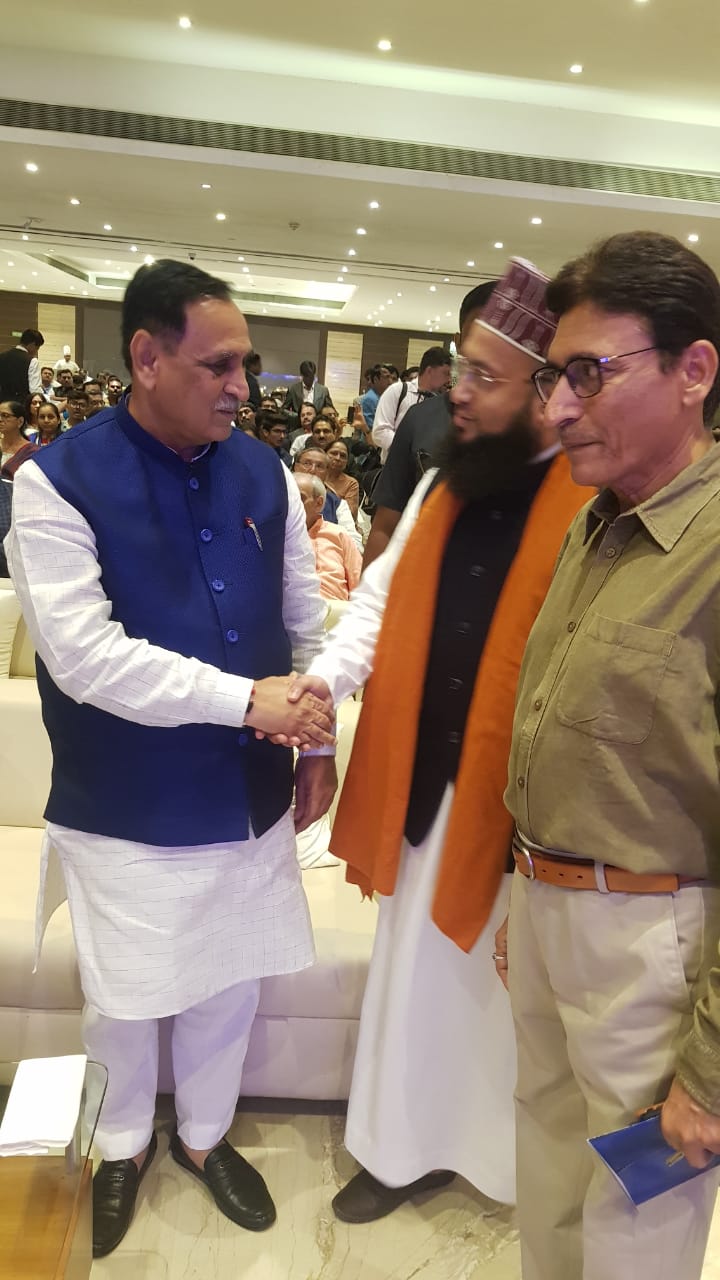
Whatever the case, despite what I felt was his limited grasp of Gujarat’s caste dynamics—hardly rare among politicians of his ilk—the fact that he granted audience to a grassroots Valmiki leader showed his effort to understand the most marginalised.
There was, however, one blot on his record I cannot ignore. He had an unpleasant relationship with the media after a journalist reported his potential replacement. The journalist, Dhaval Patel, who edited the news portal Face of the Nation, was charged with sedition in 2020 for what was essentially a political story and was arrested. This occurred amidst widespread allegations of government mismanagement during the pandemic.
A former editor of a Gujarati daily told me that he, along with a senior media professional, went to meet then Chief Minister Vijay Rupani with a list of 55 journalists who had died during the COVID-19 pandemic.
"We sought government assistance for their families," he said. "However, Rupani refused, arguing that if compensation was given to journalists, doctors and lawyers would also start demanding the same."
"We pointed out that several other states — both BJP- and Congress-ruled — had provided such compensation, but he remained unmoved."
Comments