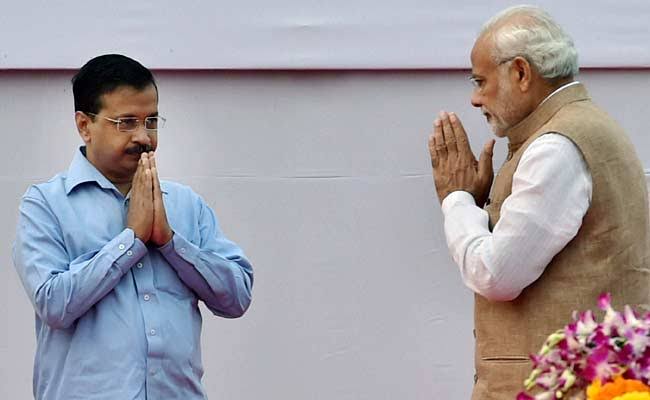
The two comments below were first published in February and May 2015, respectively. By then, the country had witnessed both faces of counter-revolution—‘Kejriwal-kranti’ and ‘Modi-kranti.’ The people of the nation were fortunate enough to witness this, courtesy of progressive and secular intellectuals. Much has changed since then. However, in corporate India, the rivers of the country rot more than they flow, and they are used more for winning elections than for washing away sins.
In the recently concluded Delhi Assembly elections (2025), the larger face of counter-revolution defeated the smaller face of counter-revolution in a mutual contest. Progressive and secular intellectuals, particularly those associated with alternative politics, are deeply upset by this sudden setback and are busy analyzing it. They are convincing themselves more than the people that they were right, they are right, and they will remain right. For them, the struggle to save secularism and democracy in the country's politics continues in this manner and will persist similarly in the future.
---
Fellow-Travelers of Counter-Revolution
“What is happening across the world today is perhaps the largest counter-revolution in world history. It is organized, global, and poised to transform every aspect of society and life. It will even impact nature and the animal kingdom. If human society and civilization survive beyond the twenty-first century, history books will undoubtedly describe this era in such terms. The date of the Dunkel Treaty can be considered the starting point of this counter-revolution.
Counter-revolution does not signify decline or decay. Decline occurs where maturity has been achieved or a peak has been reached. Soviet Russia collapsed, or we could say that the decay of modern civilization began long ago. In contrast, counter-revolution resembles revolution in form but serves the opposite purpose. It is organized, ideologically driven, and seeks to uproot established values and foundations. Its ideology ensures that its movement is a campaign led by well-organized small groups.” (‘Vikalpheen Nahin Hai Duniya’ [The World is Not Without Options], Kishan Patnaik, Rajkamal Prakashan, Delhi, p. 172)
Kishan Patnaik wrote this in February 1994. Since then, the path of counter-revolution has been steadily paved globally and in India. The ideology of counter-revolution has gained significant strength due to the central roles of Narendra Modi and Arvind Kejriwal in Indian politics over the last three to four years. Both have achieved this status by employing similar propaganda styles, leveraging the immense power of media and money. Many Marxists, socialists, advocates of social justice, Gandhians, and intellectuals have lent political legitimacy to this counter-revolution by supporting Arvind Kejriwal, either directly or indirectly, in the Delhi Assembly elections. Whether the Aam Aadmi Party (AAP) or the BJP forms the government in Delhi, it will not change the fact that there is no genuine opposition to the ongoing counter-revolution in India's mainstream politics.
Kejriwal's supporters have consoled themselves and assured others that he would eventually align with their cause. However, the opposite has happened—Kejriwal has brought everyone to his side. I have heard that Kiran Bedi's 'Chhota Gandhi' is the Lenin of the comrades! Prakash Karat has claimed that those who oppose Kejriwal do not understand Marx. The counter-revolution is so pervasive that even Marx has been dragged into its support. This phenomenon reflects the fatigue and confusion of India's progressive politics.
The statement between the two paragraphs by Kishanji reads: “Revolution was a major theme of discussion throughout the twentieth century. A specific meaning of revolution had reached the common people: it meant radical change through an organized movement that would advance society and improve the lives of ordinary people, ensuring that the last person was not ignored. The central importance of the ordinary person and the rights of the last person dominated the politics and economics of the twentieth century like never before.”
When Kishanji wrote this, he could not have anticipated that NGO leaders would transform millionaires into the 'aam aadmi' (common man), use the votes of the poor to further their own prosperity, and that leaders and intellectuals claiming to champion socialist revolution would support this! In the same article, Kishanji stated, “In the 1980s, a chapter of counter-revolution began under the guise of Hindutva to change the political culture of the country. It aligns with the global wave of counter-revolution flowing at this time…” We know that the Babri Masjid was demolished in 1992 as part of the communal counter-revolution operating within the channels of capitalist counter-revolution.
Kishanji envisioned the ideology and struggle of alternative politics against the counter-revolution that began with the Dunkel Agreement. He also wrote a detailed manifesto on secularism (‘Dharmnirpekshta Ka Ghoshnapatra’). Most of those associated with him today have aligned with the counter-revolution. Clearly, they deceived Kishanji during his lifetime and are now engaged in dismantling his lifelong political endeavor after his death.
In such a situation, there is little left to say or listen to. However, a few points are worth noting:
1. The Modi-Kejriwal Dynamic: The uncritical support given to Kejriwal to counter Modi is, in reality, support for corporate capitalism. Marxists, socialists, social justice activists, Gandhians, and intellectuals have prolonged the life of this very talisman by backing Kejriwal.
2. Kejriwal’s Victory and Secularism: Kejriwal’s victory is not a triumph of secularism, as many from the far left to political illiterates have claimed. Secularism, built on the fear of Muslims, has collapsed repeatedly. India’s secularism has faced defeat multiple times before Modi’s rise—Partition, Gandhi’s assassination, post-independence riots, the 1984 Sikh massacre, the Babri Masjid demolition in 1992, and the 2002 Gujarat riots are indelible marks of its failure.
3. Psychology Behind Supporting Kejriwal: Those claiming to champion secularism are aware of this history. Their support for Kejriwal stems from their inability to digest Modi’s crushing victory. They believed someone like Modi could never become India’s Prime Minister. Their faith shattered, they now seek to see anyone defeat Modi.
The second reason for their support is rooted in the politics of hatred. While the RSS practices this openly, secularists harbor contempt or hatred for the Sangh. Kejriwal’s victory satisfies this sentiment. The third reason is related to government positions and prestige. Secularists, accustomed to enjoying power during Congress rule, know Congress will not return to power in Delhi. They feel ashamed to accept BJP’s invitations directly. With Kejriwal in power, they can join various government bodies without guilt. However, they fail to realize that NGO leaders entering politics will prioritize their own over secularists.
4. The Role of Delhi’s Voters: The poor of Delhi cannot be blamed for voting for Kejriwal. The media and intellectuals shielded them from information about AAP’s economic and anti-poor ideological roots. The working class will soon realize they have been used against themselves. However, the idealistic youth who fervently supported Kejriwal cannot be excused as naive. They have effectively served as foot soldiers of the counter-revolution.
5. Dalit Capitalism: Advocates of Dalit capitalism should note that most upper-caste leaders, administrators, thinkers, and NRIs, including Shudras, have joined the capitalist counter-revolution. Equality is never achievable in the race of capitalism.
6. The Invisible Agency: We must acknowledge the strength of the invisible agency that orchestrated Kejriwal’s election campaign. It has demonstrated how a “people’s CM” (janata ka mukhyamantri) is made, comparable to the agency that created the “people’s chief servant” (janata ka pradhan sewak).
A Lesson in Conclusion: There has been continuous resistance to the counter-revolution that began with the implementation of New Economic Policies in 1992. Now that all illusions have been dispelled, the struggle for revolution must intensify toward a decisive victory.
---
Guilty Men of Alternate Politics
In this era of globalization, liberalization, and privatization, the creation of a comprehensive political philosophy—one that emerges from the struggles of the marginalized to build a self-reliant, equitable economy—has stalled. Neo-liberalism has largely succeeded in preventing such political thought from gaining strength. The limited efforts by certain activists to juxtapose political thought against neo-liberalism have failed to make an impact on the political discourse. As a result, neo-liberalism’s grip on Indian life tightens daily.
In these times of TINA (There Is No Alternative), Kishan Patnaik, a prominent political thinker and socialist leader, asserted that the world is not without alternatives—'Vikalpheen Nahi Hai Duniya.' While the neo-liberal establishment opposed this endeavor, even some socialists, Gandhians, and activists with vested interests blocked his vision of alternative politics.
The legacy of India’s freedom movement and its anti-capitalist, anti-imperialist struggle can and should be utilized. However, the neo-liberal ruling class, including veiled neo-liberals within civil society and academia, has distorted this legacy. The battle over icons of this legacy has further fragmented what remains.
Modern Indian political philosophy was largely shaped by active political figures. Its genesis lies in the Indian psyche’s resistance to colonialism. Literature, arts, and scholarship have complemented this philosophy. However, in the absence of a comprehensive political vision opposing neo-liberalism, many intellectuals and writers have been co-opted by the system.
The anti-corruption movement and the Aam Aadmi Party (AAP), born from its ashes, have been championed by many intellectuals. A group thriving on foreign funding has schemed to seize political power by strengthening the neo-liberal and communal nexus. The Indian intellectual class has become complicit in this counter-revolution.
Under Manmohan Singh’s leadership, neo-liberalism entered a ‘reticent era.’ Intellectuals supporting globalization silenced the suffering of the masses by claiming a national consensus in favor of neo-liberalism. The National Knowledge Commission (NKC) and the National Advisory Committee (NAC) worked to make neo-liberalism acceptable even to its victims.
Suddenly, the India Against Corruption (IAC) movement, AAP, and a host of civil society activists, intellectuals, and NGO leaders propelled Indian political thought from the ‘reticent era’ to the ‘babbler era.’ Corporate houses and NRIs supported this ‘great movement’ against corruption. The devaluation of language reached its nadir, and civil society became impatient to lash out everywhere.
The mainstream media, social media, and literary magazines played their part, all under the auspices of the RSS. Intrinsically, they supported neo-liberalism. The anti-neo-liberal strength built over two decades was dismantled by NGO leaders and communal forces.
Indian political discourse became an open market where figures like Baba Ramdev could peddle their ideas. Socialist leaders and thinkers, including A.B. Bardhan, participated in this carnival. The ‘Aam Aadmi,’ emerging from market capitalism, charmed Gandhians and socialists alike.
Concepts like Satyagraha, Swaraj, and alternative politics were distorted amidst this noise. Revolution became a trivialized term, and thinkers like Gandhi, Bhagat Singh, and Ambedkar were devalued. Team Modi rode this wave of irreverent language and media manipulation to victory, strengthening neo-liberalism.
Satyagraha and Swaraj are established concepts of modern Indian political thought. They will likely regain prominence. However, the concept of alternative politics, still in its infancy, is the most needed. It represents a holistic ideological alternative to neo-liberalism.
The destruction of the Babri Masjid in 1992 and the imposition of neo-liberal policies in 1991 inspired the creation of alternative politics. Strengthening secular democracy is a key dimension of this ideology.
Creating an alternative to neo-liberalism cannot be rushed. Even one genuine step in this direction, as Gandhi suggested, is enough. If opponents of neo-liberalism unite, a national movement can emerge, forcing mainstream politics to take notice.
AAP, born from neo-liberalism, cannot be an instrument of alternative politics. Its leaders’ claims are hollow and an extension of the blabbering that has dominated Indian politics. Those who raised the flag of revolt within AAP have betrayed the legacy of alternative politics.
The examples of Kishan Patnaik and Sunil, who championed alternative politics, highlight the incompatibility between NGOs funded by foreign sources and genuine political movements.
In conclusion, the counter-revolution loves its children dearly. It will care for Kejriwal and his supporters, even as it devours the legacy of alternative politics.
---
The author, associated with the socialist movement, is a former teacher at Delhi University and a former fellow at the Indian Institute of Advanced Study, Shimla
Comments