
The Indian Institute of Management-Ahmedabad's (IIM-A's) latest round of Business Inflation Expectations Survey (BIES) has found that sales and profit margins of Indian businesses have remained subdued despite tall claims by the Government of India (GoI) that the Indian economy doing well even as world is going in wrong direction.
The survey says that about 56% of the firms are reporting ‘much less than normal’ or ‘somewhat less than normal’ sales in September 2023 – up from 52% reported in August 2023, even as the percentage of firms reporting ‘normal’ and above normal sales has marginally declined to 45% in September 2023 from 47% reported in August 2023.
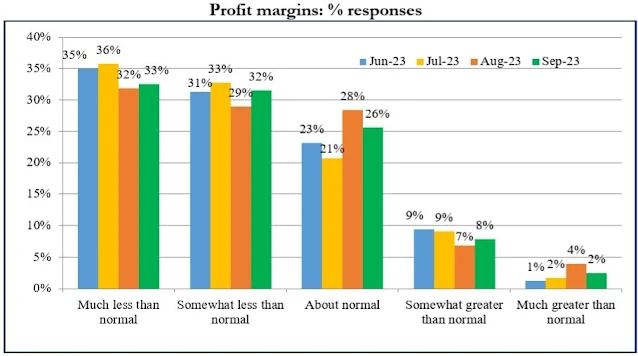
The IIM-A survey further says that around 36% of the firms in September 2023 are reporting profit margins to be ‘about normal’ or greater, as compared to 39% reported in August 2023, even as pointing ou that, "Overall, the profit margins expectations have remained somewhat subdued" for businesses.
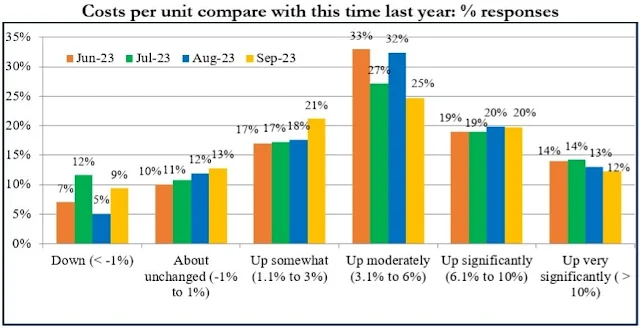
 At the same time, the survey says that the cost perceptions data in September 2023 does not indicate any significant increase in cost pressures. The percentage of firms perceiving significant cost increase (over 6%) has remained unchanged around 33% during last four rounds.
The survey seeks to examine the amount of slack in the economy by polling a panel of business leaders, asking them questions about year-ahead cost expectations and the factors influencing price changes, such as profit, sales levels, etc. It is considered unique in that it goes straight to businesses -- the price setters -- rather than to consumers or households, to understand their expectations of the price level changes.
Providing an indirect assessment of overall demand condition of the economy, results of the Survey are claimed to be useful in understanding the inflation expectations of businesses and complement other macro data required for policy making. Carried out by the Misra Centre for Financial Markets and Economy, IIM-A, results of the survey are based on the responses of around 1,100 companies.
 According to the survey, "One year ahead business inflation expectation, as estimated from the mean of individual probability distribution of unit cost increase, has marginally increased to 4.39% in September 2023, from 4.32% reported in August 2023. Average inflation expectation of the firms remained anchored around 4.3% for the past five consecutive months."

The survey seeks to examine the amount of slack in the economy by polling a panel of business leaders, asking them questions about year-ahead cost expectations and the factors influencing price changes, such as profit, sales levels, etc. It is considered unique in that it goes straight to businesses -- the price setters -- rather than to consumers or households, to understand their expectations of the price level changes.
Providing an indirect assessment of overall demand condition of the economy, results of the Survey are claimed to be useful in understanding the inflation expectations of businesses and complement other macro data required for policy making. Carried out by the Misra Centre for Financial Markets and Economy, IIM-A, results of the survey are based on the responses of around 1,100 companies.

I am not an expert. But have a question after reading this blog. If business is operating in less than normal profit or turnover is below normal than the survey sample may not be statistically correct as monthly GST collection is rising from ₹1.59 lakh crore to more than ₹1.62 lakh crore in Aug to Sept 23.
ReplyDeleteGST is rising because fewcompanies are earning profits at the cost of others. It is like this:700 orfinary passengers travel they pay ony 100.total collection 70000. But if 500 travel in AC they each 300 total 150000.Nirmala using this technique.
ReplyDeleteThe IIM-A study is quite contrary to the analysis. May be the sample surveyed must be skewed. May be even a Narrative building exercise. (Academics are full of leftist ideologues). The increasing GST collections is contrary to these claims.
ReplyDeleteGST is a function of Sales turnover and not of Profit.
ReplyDeleteBesides, who tells the real picture anyways? This is a publicity article by phony academics.
ReplyDeletePerception surveys are mostly misleading and naturally biased. Look for factual data like GST collection, income tax return etc
ReplyDeleteGST collection is a function of manufaty and services output. These figures are not being correlated. Also.GST collection has to read along with no of raids conducted showing ITC claims without actual sales.
ReplyDelete