
Demonizing Indian Muslims as barbarians is a project as old as the birth of Hindu nationalism courtesy high caste Hindus in the second half of the 19th century. Muslims were described as mleccha a Sanskrit term used for non-Aryans or barbarians. It is interesting to note that when the same barbarians, the dynasties with Muslim names, ruled India for almost a millennium, the same Hindu high castes served them most loyally as military commanders and senior administrators even occupying posts of Vazier-e-aalaa (prime minister).
The ‘Muslim’ rule was an oligarchy of Muslim rulers plus Hindu high castes. India is the only country in the world history where absolute majority of the country did not convert to the religion of the rulers. It is corroborated by the 1872-73 Census undertaken by the British rulers. It was the first census held at the time when even ceremonial ‘Muslim’ rule was over.
According to this census report:
“The population of British India is, in round numbers, divided into 140½ millions [sic] of Hindoos (including Sikhs), or 73½ per cent., 40¾ millions of Mahomedans, or 21½ per cent. And 9¼ millions of others, or barely 5 per cent., including under this title Buddhists and Jains, Christians, Jews, Parsees, Brahmoes…” ("Memorandum on the Census Of British India of 1871-72: Presented to both Houses of Parliament by Command of Her Majesty London, George Edward Eyre and William Spottiswoode", Her Majesty's Stationary Office 1875, p. 16)
In this context another important point not to be lost sight is that the demonization of the Indian Muslims by the Hindu nationalists followed a pattern set by the British masters in the post-1857 War of Independence.
The British held Muslims responsible for the “mutiny” (though Hindus-Muslims-Sikhs unitedly fought against the East India Company rule throughout India and jointly laid down lives in every nook and corner of the country) describing them as uncivilized, untrustworthy, butchers, rapists and fit for annihilation.
With the birth of RSS in 1925 Hindu nationalists committed to Hindutva offered a singular platform to carry forward this hatred to new heights with a military-like apparatus to cleanse Muslims of India. To the bad luck of RSS, India chose to be a democratic-secular polity in which emulation of Hitler was not possible in India.
With the birth of RSS in 1925 Hindu nationalists committed to Hindutva offered a singular platform to carry forward this hatred to new heights with a military-like apparatus to cleanse Muslims of India. To the bad luck of RSS, India chose to be a democratic-secular polity in which emulation of Hitler was not possible in India.
Though violence against the largest religious minority of India continued through its innumerable clandestine and open appendages, more emphasis was accorded to use of propaganda machinery for demonizing them.
Love jihad, land jihad, abnormal population growth, appeasement and beef-eating and many more issues have been and being used to spread hatred against Muslims. With Hindu nationalist PM Modi the Hindutva juggernaut started running amok. State approved films became another powerful tool to spread hatred against Muslims.
“The Kashmir Files” (2022) and the May 2023 release of “The Kerala Story” are part of the same strategy of targeting a large section of Indians as barbarians thus making it vulnerable to physical annihilation.
Love jihad, land jihad, abnormal population growth, appeasement and beef-eating and many more issues have been and being used to spread hatred against Muslims. With Hindu nationalist PM Modi the Hindutva juggernaut started running amok. State approved films became another powerful tool to spread hatred against Muslims.
“The Kashmir Files” (2022) and the May 2023 release of “The Kerala Story” are part of the same strategy of targeting a large section of Indians as barbarians thus making it vulnerable to physical annihilation.
“The Kerala Story” touted as the truthful narration of happenings in Kerala has turned out to be a bunch of lies as has been confessed by the director. This film conceived and executed by RSS-trained personnel at the surface seems to be the outcome concern for the tragic end of Hindu/Christian women wronged by Islamic jehadists.
How much RSS cares about the honour of Kerala Hindu women needs to be judged by a speech of the most prominent ideologue of the RSS till date, MS Golwalkar, addressed as Guruji. This Guru is religiously followed by RSS leaders and cadres. Prime Minister Narendra Modi credits Golwalkar for grooming him into a political leader.
Golwalkar was invited to address the students of the School of Social Sciences of Gujarat University on December 17, 1960. In this address, while underlying his firm belief in the Race Theory, he touched upon the issue of cross-breeding amongst Hindus in Kerala in history.
How much RSS cares about the honour of Kerala Hindu women needs to be judged by a speech of the most prominent ideologue of the RSS till date, MS Golwalkar, addressed as Guruji. This Guru is religiously followed by RSS leaders and cadres. Prime Minister Narendra Modi credits Golwalkar for grooming him into a political leader.
Golwalkar was invited to address the students of the School of Social Sciences of Gujarat University on December 17, 1960. In this address, while underlying his firm belief in the Race Theory, he touched upon the issue of cross-breeding amongst Hindus in Kerala in history.
Prime Minister Narendra Modi credits Golwalkar for grooming him into a political leader
He said:
“Today experiments in cross-breeding are made only on animals. But the courage to make such experiments on human beings is not shown even by the so-called modern scientist of today. If some human cross-breeding is seen today it is the result not of scientific experiments but of carnal lust. Now let us see the experiments our ancestors made in this sphere.
“In an effort to better the human species through cross-breeding the Namboodri Brahamanas of the North were settled in Kerala and a rule was laid down that the eldest son of a Namboodri family could marry only the daughter of Vaishya, Kashtriya or Shudra communities of Kerala.
“Another still more courageous rule was that the first off-spring of a married woman of any class must be fathered by a Namboodri Brahman and then she could beget children by her husband. Today this experiment will be called adultery but it was not so, as it was limited to the first child.” (MS Golwalkar cited in “Organizer”, January 2, 1961, p 5)
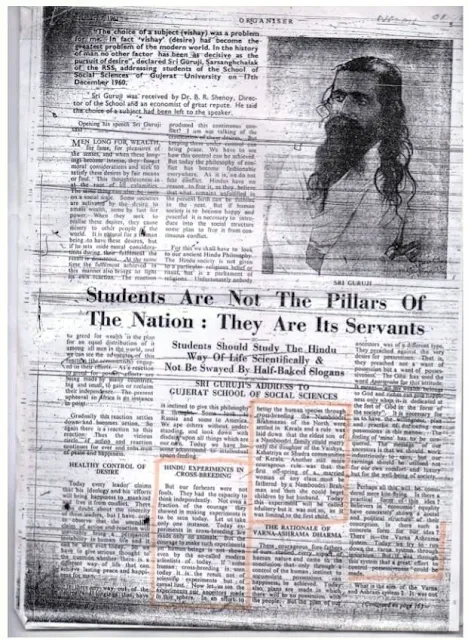 The above statement of Golwalkar is highly worrying in many respects.
First of all, it proves that Golwalkar believed that India had a superior race or breed and also an inferior race which needed to be improved through cross-breeding.
Secondly, a more worrying aspect was his belief that Brahmans of the North (India), and especially Namboodri Brahamans, belonged to a superior race. Due to this quality, Namboodri Brahamans were sent from the North to Kerala to improve the breed of inferior Hindus there. Interestingly, this was being argued by a person who claimed to uphold the unity of Hindus world over.
And thirdly, Golwalkar believed that a Namboodri Brahman male belonging to a superior race from the North alone could improve the inferior human race from South. For him wombs of Kerala’s Hindu women enjoyed no sanctity and were simply objects of improving breed through intercourse with Namboodri Brahamans who in no way were related to them. These were nothing but rapes.
Thus, Golwalkar was, in fact, corroborating the fact that in the past male dominated high caste Hindu society forced newly-wedded women of other castes to pass their first nights by sleeping with superior caste males.
Astonishingly, Golwalkar expressed these racist, anti-women and anti-egalitarian views not in the presence of some uneducated or lumpen crowd but before a noble gathering of gentry consisting of the faculty and students of a prime university in Gujarat.
“In an effort to better the human species through cross-breeding the Namboodri Brahamanas of the North were settled in Kerala and a rule was laid down that the eldest son of a Namboodri family could marry only the daughter of Vaishya, Kashtriya or Shudra communities of Kerala.
“Another still more courageous rule was that the first off-spring of a married woman of any class must be fathered by a Namboodri Brahman and then she could beget children by her husband. Today this experiment will be called adultery but it was not so, as it was limited to the first child.” (MS Golwalkar cited in “Organizer”, January 2, 1961, p 5)

First of all, it proves that Golwalkar believed that India had a superior race or breed and also an inferior race which needed to be improved through cross-breeding.
Secondly, a more worrying aspect was his belief that Brahmans of the North (India), and especially Namboodri Brahamans, belonged to a superior race. Due to this quality, Namboodri Brahamans were sent from the North to Kerala to improve the breed of inferior Hindus there. Interestingly, this was being argued by a person who claimed to uphold the unity of Hindus world over.
And thirdly, Golwalkar believed that a Namboodri Brahman male belonging to a superior race from the North alone could improve the inferior human race from South. For him wombs of Kerala’s Hindu women enjoyed no sanctity and were simply objects of improving breed through intercourse with Namboodri Brahamans who in no way were related to them. These were nothing but rapes.
Thus, Golwalkar was, in fact, corroborating the fact that in the past male dominated high caste Hindu society forced newly-wedded women of other castes to pass their first nights by sleeping with superior caste males.
Astonishingly, Golwalkar expressed these racist, anti-women and anti-egalitarian views not in the presence of some uneducated or lumpen crowd but before a noble gathering of gentry consisting of the faculty and students of a prime university in Gujarat.
In fact, Golwalkar was welcomed by Dr BR Shenoy, director of the School of Social Sciences, while he arrived at the auditorium. Press reports make it clear that there was no murmur of protest against such fascist and ridiculous ideas. It shows the degree of respectability which high caste oratory enjoyed in Gujarat and explains why Hindutva could make inroads in this region.
It is surprising that despite holding such ideas which openly denigrated Hindu women and society of Kerala, RSS has been able to create pockets of influence in Kerala.
Not only as Keralites but as Indians we must demand that RSS should tell us for how many centuries such rapes of Kerala women continued! Can films like “The Kerala Story” hide the criminal deeds glorified by Golwalkar?
---
*Political scientist, formerly with Delhi University
It is surprising that despite holding such ideas which openly denigrated Hindu women and society of Kerala, RSS has been able to create pockets of influence in Kerala.
Not only as Keralites but as Indians we must demand that RSS should tell us for how many centuries such rapes of Kerala women continued! Can films like “The Kerala Story” hide the criminal deeds glorified by Golwalkar?
---
*Political scientist, formerly with Delhi University
Comments