
Survey: Gujarat tops in 'supporting' digital surveillance to curb opposition, protests

By Rajiv Shah 

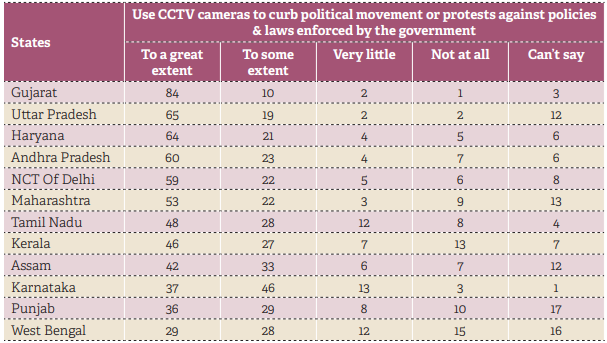
In a surprise revelation, which may send shock wave among those who consider agitations as a democratic right and believe this right is being eroded by the powers-that-be, nearly 95 percent of the respondents in a recent survey in Gujarat have justified the government’s use of CCTV as a means to control political movements of all sorts.
The highest in India, this is followed by two-thirds of the respondents from Uttar Pradesh and Haryana (65% and 64% respectively) completely supporting CCTV use for clamping down on protests. The result comes amidst sharp increase in mobile surveillance and drones by the police in the recent past in these States.
Says the report, “A State-wise analysis revealed that in Andhra Pradesh and Gujarat, more than 85 percent believed that the use of CCTVs by the police in their areas has increased”, adding, “More than two out of three respondents from Gujarat reported a significant increase in the use of mobile surveillance and drone technologies by the police in their localities in the past 4-5 years.”
The survey, carried out by Delhi-based non-profits Common Cause and Lokniti – Centre for the Study of Developing Societies (CSDS), and titled “Status of Policing in India Report 2023 Surveillance and the Question of Privacy” (SPIR 2023), also reveals that, in sharp contrast, respondents from West Bengal, Punjab and Karnataka “were not as enthusiastic in their support.”
“Only one-third of the respondents (29%) from Bengal completely justified the use of surveillance footage to curb dissent. The number is slightly higher in Punjab (36%) and Karnataka (37%)”, it notes.
Seeking to explore public opinions and experiences regarding digital surveillance, SPIR 2023 has been prepared against the backdrop of “recent developments, such as the Supreme Court's recognition of the right to privacy and discussions surrounding data protection, have intensified debates around privacy and surveillance”, the report claims.
It has also been prepared in context of recent concerns regarding “allegations of illegal government surveillance using the Pegasus spyware and the enactment of the Criminal Procedure (Identification) Act, 2022, which grants police the power to collect biometric information from suspects and detainees”, it adds.
In order to prepare the report, Common Cause, in collaboration with the Lokniti Programme of CSDS, conducted a face-to-face survey with 9,779 individuals across 12 Indian States and UTs to understand perceptions around digital surveillance. At the same time, the organisers conducted Focused Group Discussions (FGDs) with “domain experts, in-depth interviews with serving police officials, and an analysis of media coverage of surveillance-related issues”.
Admitting that the survey suggests “a lack of public awareness regarding critical issues” pertaining to “digital surveillance by the government”, helping the authorities to easily to go in for curbs on “freedom of expression”, the report underlines, however, the “support for any form of surveillance decreases with a decline in the respondent's socioeconomic status”, with the “poor, Adivasis, Dalits, and Muslims” being “least trustful of the police.”
Regarding the overall use of drones by state agencies, a State-wise comparisons suggest that respondents from Gujarat (81%) and Uttar Pradesh (72%) showed substantially high levels of support. Respondents from Karnataka (60%) also indicated moderate support, but relatively higher opposition to this was seen in Punjab (17%) and West Bengal (17%).
At the same time, the report notes, “Across the occupation category, the lowest levels of support were observed amongst farmers (14%)”, adding, “Relatively lower levels of support for drone usage by government agencies amongst farmers is a noteworthy finding, especially in view of the fact that the Centre has been pushing for incentivising the use of drones for farming.”
Coming to the impact of surveillance by police and government through drones on people, while across India four of every ten (43%) respondents said that it is justified ‘to a great extent’, “Significant support came from States such as Gujarat (63%), UP (57%) and Delhi (56%). In contrast, the opposing States were Kerala (30%) and Punjab (14%)”.
Also, “the highest proportion of respondents from Gujarat supported the usage of drones by the police for law enforcement (95%), followed by Kerala, (94%) and Andhra Pradesh (91%); while Assam, Karnataka, and Punjab stood at the opposite end of the spectrum”, the report says, adding, “Those from Assam were least likely to support police usage of drone for rule enforcement, those from Gujarat were most likely to support.”
At the same time, pointing out that “over four of five people in Gujarat support drone usage by government to quell dissent”, the report notes, “While doing a State-wise comparative analysis, we found that in BJP-ruled States such as Gujarat (85%), Haryana (67%), and Uttar Pradesh (65%), the support for using drones for curbing political protest was highest”.
On being asked if they felt that political parties view their photos, messages, videos or searched objects from their phones or computers, the report says, “A little less than two-thirds, about 65 percent, disagreed.” But out of the 16 percent that agreed, a significant proportion of 27 percent belonged to Gujarat and Karnataka. “Conversely, a significant proportion of respondents from Kerala (83%) and Tamil Nadu (74%) disagreed that political parties can view their data.”
Ironically, despite wide support to digital surveillance, fear on its usage prevailed among large sections. Thus, “those in Haryana (41%), Gujarat (33%), and Delhi (32%) were very scared of provoking legal action by expressing their political opinions online, whereas in Karnataka, Maharashtra and Kerala not many people exhibit their fear of legal action for posting political or social opinion.”
Asked whether they think the police should be able to collect the biometric details (such as fingerprint, footprint, iris, retina scan, facial recognition, etc.) of all suspects, including those who haven’t been declared guilty by the court, while close to half (48%) across India agreed that police should be allowed to collect such details, “a large proportion of the respondents from Haryana (74%), Gujarat (69%) and Delhi - NCT (65%) were of the opinion that police should have this power.”
“Conversely”, the report states, “A significant proportion of respondents from Tamil Nadu (56%) and Karnataka (54%) were of the opinion that police should not be allowed to possess such powers. Those belonging to the Adivasi community (44%) were significantly more likely to oppose giving the power to the police to collect biometric data, as compared to the general caste group (28%).”

Comments

This is, indeed, surprising. I have a feeling that the questionnaire was not worded properly.

TRENDING

When democracy becomes a performance: The Tibetan exile experience

By Tseten Lhundup*  I was born in Bylakuppe, one of the largest Tibetan settlements in southern India. From childhood, I grew up in simple barracks, along muddy roads, and in fields with limited resources. Over the years, I have watched our democratic system slowly erode. Observing the recent budget session of the 17th Tibetan Parliament-in-Exile, these “democratic procedures” appear grand and orderly on the surface, yet in reality they amount to little more than empty formalities. The parliamentarians seem largely disconnected from the everyday struggles faced by ordinary exiled Tibetans like us.

Study links sanctions to 500,000 deaths annually leading to rise in global backlash

By Bharat Dogra  International opinion is increasingly turning against the expanding burden of sanctions imposed on a growing number of countries. These measures are contributing to humanitarian crises, intensifying domestic discord, and heightening international tensions, thereby increasing the risks of conflicts and wars. 

Dhurandhar: The Revenge — Blurring the line between fiction and political narrative

By Mohd. Ziyaullah Khan*  "Dhurandhar: The Revenge" does not wait to be remembered; it arrives almost on the heels of its predecessor, released on March 19, 2026, just months after the first film’s December 2025 debut. The speed of its arrival feels less like creative urgency and more like calculated timing—cinema responding not to storytelling rhythm but to the emotional climate of its audience. Director Aditya Dhar, along with actor Yami Gautam, appears acutely aware of this moment and how to harness it.

Beyond the island: Top mythologist reorients the geography of the Ramayana

By Jag Jivan   In a compelling new analysis that challenges conventional geographical assumptions about the ancient epic, writer and mythologist Devdutt Pattanaik has traced the roots of the Ramayana to the forests and river systems of Central and Eastern India, rather than the peninsular south or the modern island nation of Sri Lanka.

BJP accounts for 99% of political donations in Gujarat: Corporate giants dominate

By Jag Jivan   An analysis of the official data on donations received by national parties from Gujarat during the Financial Year 2024-25 reveals a staggering concentration of funding, with the Bharatiya Janata Party (BJP) accounting for nearly the entirety of the contributions. The data, compiled in a document titled "National Parties donations received from Gujarat during FY-2024-25," lists thousands of transactions, painting a detailed picture of the financial backing for political parties from one of India’s most industrially significant states.

Alarming decline in India's repair culture threatens circular economy goals: Study

By Jag Jivan  A comprehensive new study by environmental research and advocacy organisation Toxics Link has painted a worrying picture of India's fading repair culture, warning that the trend towards replacement over repair is accelerating the country's already critical e-waste crisis.

Captains extraordinaire: Ranking cricket’s most influential skippers

By Harsh Thakor*  Ranking the greatest cricket captains is a subjective exercise, often sparking passionate debate among fans. The following list is not merely a tally of wins and losses; it is an assessment of leadership’s deeper impact. My criteria fuse a captain’s playing record with their tactical skill, placing the highest consideration on their ability to reshape a team’s fortunes and inspire those around them. A captain who inherited a dominant empire is judged differently from one who resurrected a nation’s cricket from the doldrums. With that in mind, here is my perspective on the finest leaders the game has ever seen.

Swami Vivekananda's views on caste and sexuality were 'painfully' regressive

By Bhaskar Sur* Swami Vivekananda now belongs more to the modern Hindu mythology than reality. It makes a daunting job to discover the real human being who knew unemployment, humiliation of losing a teaching job for 'incompetence', longed in vain for the bliss of a happy conjugal life only to suffer the consequent frustration.

‘No merit’ in Chakraborty’s claims: Personal ethics talk sans details raises questions

By Jag Jivan  A recent opinion piece published in The Quint by Subhash Chandra Garg has raised questions over the circumstances surrounding the resignation of Atanu Chakraborty from HDFC Bank , with Garg stating that the exit “raises doubts about his own ‘ethics’.” Garg, currently Chief Policy Advisor at Subhanjali and former Secretary of the Department of Economic Affairs, Government of India, writes that the Reserve Bank of India ( RBI ) appears to find no substance in Chakraborty’s claims, noting, “It is clear the RBI sees no merit in Atanu Chakraborty’s wild and vague assertions.”