
Many of us admire the wall paintings of Lodhi Art Colony in Delhi, but in faraway Bastar district of Chhattisgarh, murals executed in bright colours showcase the rich cultural heritage of a place yet unspoilt by modernity.
Nagpur-based architect Shivani Sharma who developed the Bastar art gallery said many painters and artists were involved in the paintings. “Many sites were developed in Jagdalpur (district headquarters of Bastar) to attract tourists and the paintings add to the overall ambience of the city.”
Art 1: A tribal man is depicted on the wall of a residential building with a bow and arrow in his hand. The integration of human beings with nature has been depicted by the peacock symbolising a peaceful coexistence in tune with the Adivasi culture.
 Art 2: Different kinds of facial expressions leap out of a wall in Jagdalpur, the district headquarters of Bastar. A visit to the scenic Dalpat Sagar lake in the city will guarantee visitors a glimpse of these paintings.
 Art 3: The famous cock fight of Bastar has been depicted on the wall along with tribal musical instruments.
 Art 4: A tribal man and a woman of Bastar. The district is known for its vibrant tribal culture.
 Art 5: The depiction of the well-known bison horn dance performed by the Dandami Maria tribe of Bastar district.
 Art 6: The paintings part of the district administration’s plan to develop the entire look and feel of Jagdalpur.
 Art 7: In a place teeming with forest and wildlife, deer and birds come alive on walls at the Gadh Kalewa, a cultural space in Jagdalpur.
 Art 8: Deer on wall and the traditional tribal depiction of humans.
 Art 9: A close up of a woman’s face.
 Art 10: Another depiction of a male bison horn dancer. The dancers are a spectacle with their colourful attire and they wear the headgear made of bison horns.
 Art 11: A blue deer? One can spot it on a wall in Jagdalpur.
 Art 12: The peacock comes alive on a wall.
 Art 13: A wall mural at BADAL, a centre for performing arts in Jagdalpur, has been developed by the district administration. The paintings here have been visualised by Bastar-based architect Nisha Bothra. “Extensive research was made before the paintings were created on walls,” Bothra who worked as the project architect said.
 Art 14: With so many water sources, fresh fish is an easy find even on walls at night.
 Art 15: Who doesn’t adore elephants? And this looks like a children’s story book.
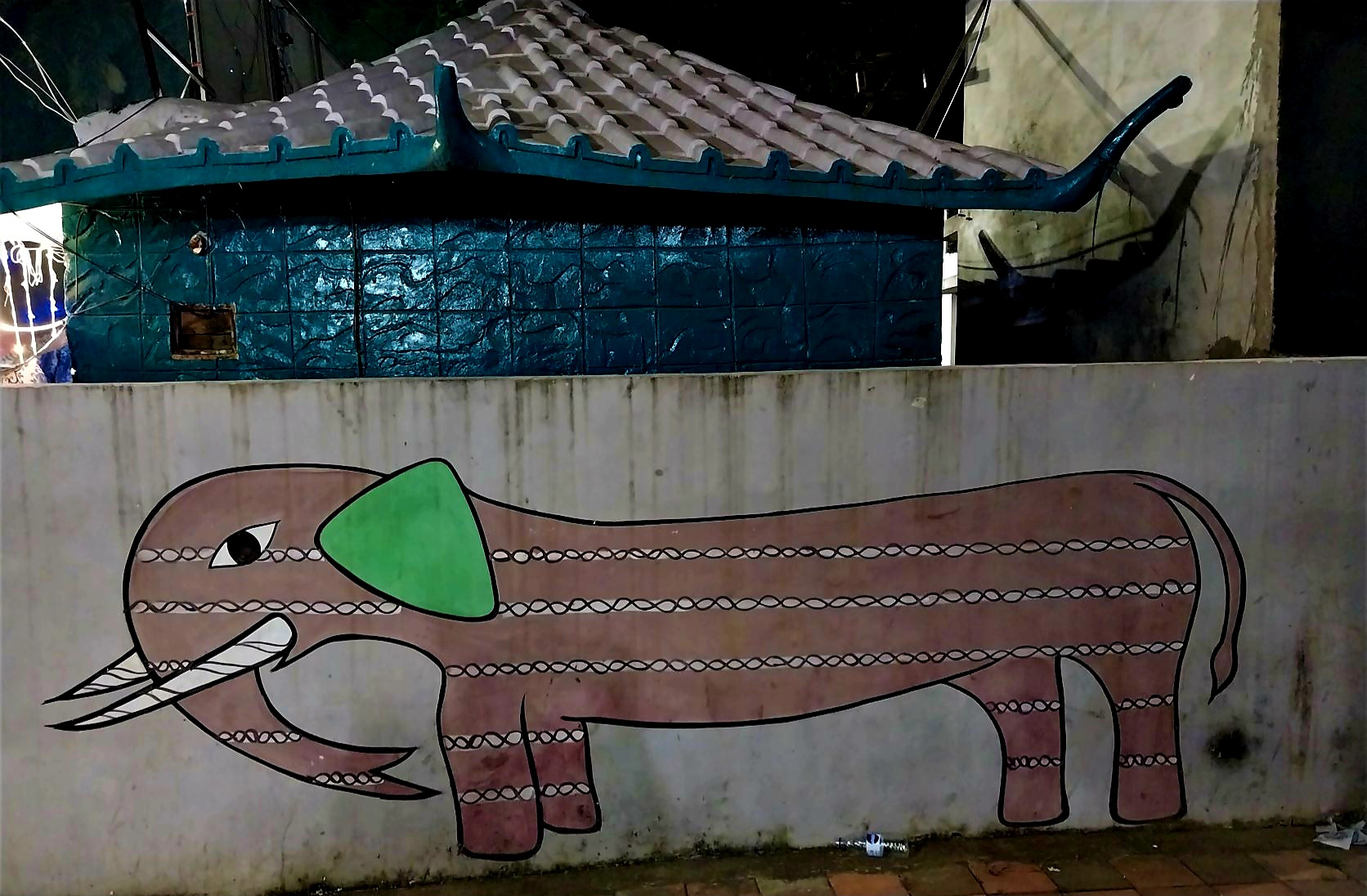
 Art 16: A really elongated elephant don’t you think?
 Art 17: A beautiful depiction of two birds.



Comments