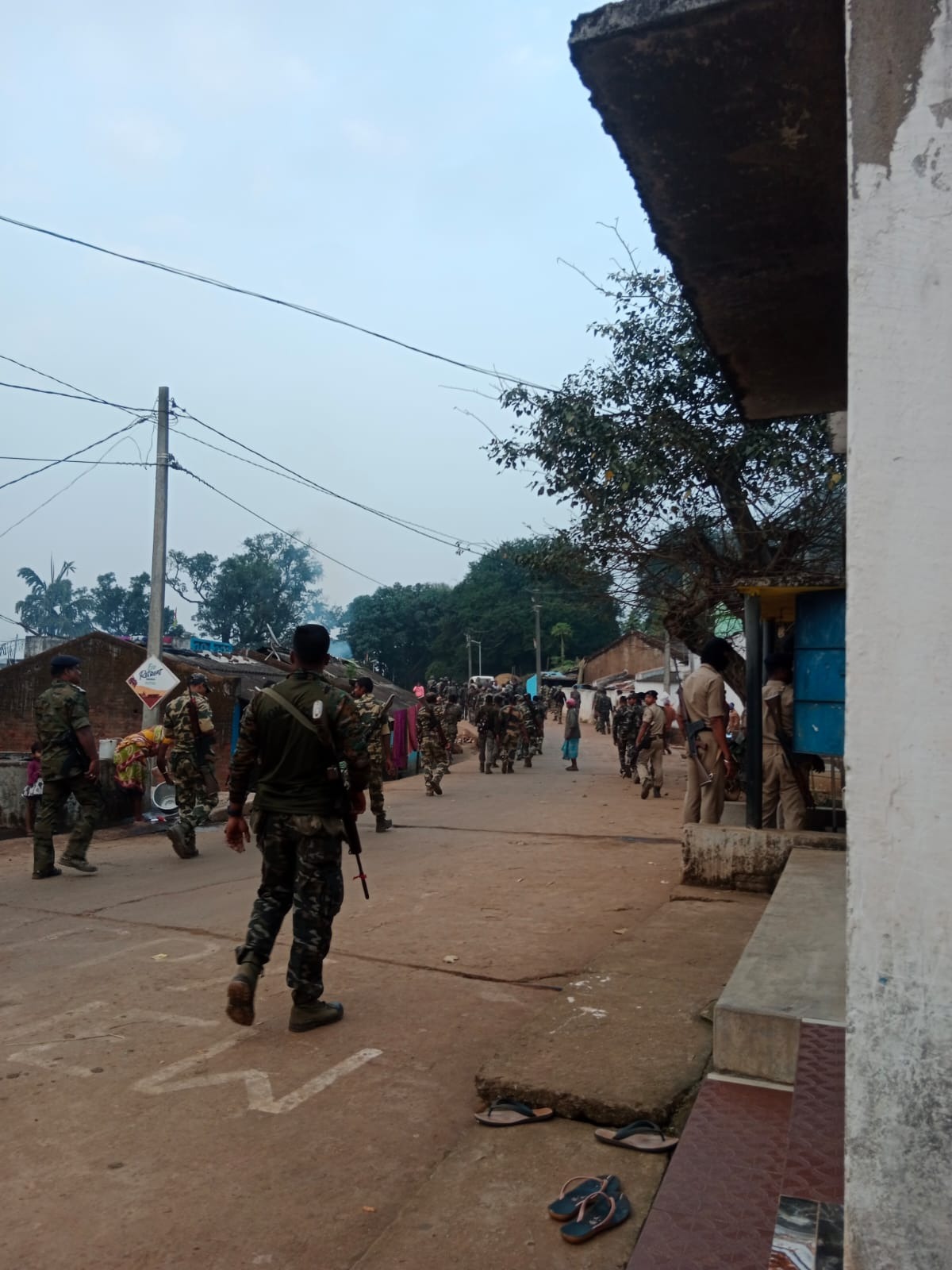
Armed cops, paramilitary sent to 'protect' top mining group, 'oppose' Odisha tribal rights

Counterview Desk 

The civil rights group, Forum Against Corporatization And Militarization (FACAM), New Delhi, insisting on the need to resist “intimidation and repression on the people of Mali Parbat opposing Hindalco mining”, has said that the hill, “rich with bauxite, sacred to local tribes in Koraput district of Odisha, is facing threat of destruction” from the mining giant Hindalco (Aditya Birla Group), which “is seeking to mine 268.1 hectares of land.”
In a “solidarity statement, it said, “The people are opposing the proposed mining for almost 2 decades and now are facing militarisation, intimidation and arrests.” Stating that matter is being fought in Court, apart from the “tooth to nail’ ground struggle”, it added, on January 5, 2023, the Odisha High Court ordered the district administration of Koraput to conduct a ‘free and fair Gram Sabha’ with participation of locals in the decision of land concerning the proposed mining as mandated under Panchayat Extension of Schedule Areas Act (PESA).”
“However”, it regretted, “the preparations to conduct a ‘free and fare Gram Sabha’ by the district administration meant hundreds of police and paramilitary, armed to the teeth, parading around the villages -- threatening and intimidating the villagers and slapping false cases on the leaders of Mali Parbat Suraksha Samiti, a body that heads the anti mining movement.”

Text:

Mali Parbat, a hill rich with Bauxite, sacred to local tribes in Koraput District of Odisha, is facing threat of destruction as Mining Giant Hindalco (Aditya Birla Group) is seeking to mine 268.1 hectares of land. The people are opposing the proposed mining for almost 2 decades and therefore, facing brute militarisation, intimidation and arrests. The matter is also being fought in Court, apart from the ‘tooth to nail’ ground struggle. Recently, on 5th January, 2023, Odisha High Court ordered the district administration of Koraput to conduct a ‘free and fair Gram Sabha’ with participation of locals in the decision of Land concerning the proposed mining as mandated under Panchayat Extension of Schedule Areas Act. However, the preparations to conduct a ‘free and fare Gram Sabha’ by the District administration meant hundreds of Police and Paramilitary, armed to the teeth, parading around the villages- threatening and intimidating the villagers and slapping false cases on the leaders of Mali Parbat Suraksha Samiti (a body that heads the anti mining movement). This was done before the holding of ‘free and fair Gram Sabha’ in order to intimidate the villagers to give-in to the corporate-state’s nexus behind Hindalco mining and gain their forced ‘free consent’ to loot and plunder of resources and destruction of environment. Currently, 28 activist and people of Mali Parbat Anti mining struggle are behind bars. Amid much militarisation and subsequent intimidation, the Gram Sabha was conducted on 7th Jan,2023, as directed by the Odisha High Court. Despite continuous threats, the majority of 72 out of 81 representatives of Mali Parbat region has opposed the mining, in the said meeting. The next hearing of the matter in Odisha High Court is on 15th Jan, 2023.
Environmental Clearance (EC) process for the purposes of mining in Mali Parbat, started in 2003, sparking the resistance movement that is continuing till date. In 2006 the environmental Clearance was given and Hindalco was granted mining lease in 2007. Due to people’s struggle, Hindalco could not carry out mining and the EC expired in 2011, however, Hindalco started mining illegally after the EC expired, with the collaboration of state and aid of the paramilitary forces being poured in large numbers. The mining stopped again, in 2014-15, due to surge in the people’s movement and the mining lease got expired in 2019. In 2021, the process to renew the lease of 268.1 hectare of land began, which saw two fake Gram Sabhas (village council meeting) being conducted, amid heavy deployment of police and paramilitary forces. Both the Gram Sabha meetings conducted in September and November of 2021, saw a deployment of around 4000 Police and Paramilitary personnel. The second Gram Sabha, conducted in November, 2021 saw strong opposition of the locals, as it was conducted only with 300 pro- Hindalco persons, debarring 1500 people from joining the gram sabha. Both Gram Sabhas were hailed by Koraput District administration as Highly successful. In the 3rd Gram Sabha conducted on 7th Jan, 2023, state government deployed 20 Battalions of Indian Reserve Battalions (IRB), Central Reserve Police Force (CRPF) and Border Security Force (BSF), despite clear direction of Odisha High Court to conduct free and fair Gram Sabha so that the locals can join it without fear and intimidation.
It is important to understand that this is the general modus operandi of the unholy State-Corporate alliance to intimidate and break the people’s movement against loot of resources by mining giants aided by imperial capital. Such is the case of Mining in Surjagarh Hills, Maharashtra, Rowghat mining and proposed mining in Amdai Ghati hills, Chhatisgarh, Niyamgiri Hills in Odisha, among many more. These anti-mining movements are the biggest blockade to the imperialist extraction machinery and to break these very movements is the objective behind rampant militarization of these states by building paramilitary camps in the fancy military terminology of “forward operational bases” that are nothing but Carpet security for extraction machinery of big corporates, such is the experience of past and present anti mining movements. These Paramilitary Camps or “forward operational bases” are part of Operation Samadhan-Prahar, launched as an extension of Operation Green-Hunt, to supposedly defeat the Maoist movement. However, It is clear that these camps and rampant deployment of forces, in the name of fighting the ‘Maoists’, are acting as a tool to suppress anti mining movements like Mali Parbat movement against Hindalco mining.
Forum Against Corporatization and Militarization strongly condemns the intimidation tactics used by the state against people of Mali Parbat region, who are struggling against Hindalco’s predatory mining of Mali Parbat to save 36 natural water streams and hundreds of Hectares of land and forest, set to be devastated by the blasting and other processes to mine the bauxite. We also demand the following:
  • Stop slapping false cases on the people opposing the Hindalco mining of Mali Parbat.
  • Release all the arrested activists of Mali Parbat Suraksha Samiti and people opposing the mining.
  • Withdraw the various Battalions of paramilitary forces from the region.
  • Respect the majority position of the locals in 7th Jan Gram Sabha and stop mining in the region.
  • Restore the autonomy of Gram Sabhas as mandated under Panchayat Extension of Schedule Areas Act.
  • Stop Operation Samadhan-Prahar.

Comments

TRENDING

When democracy becomes a performance: The Tibetan exile experience

By Tseten Lhundup*  I was born in Bylakuppe, one of the largest Tibetan settlements in southern India. From childhood, I grew up in simple barracks, along muddy roads, and in fields with limited resources. Over the years, I have watched our democratic system slowly erode. Observing the recent budget session of the 17th Tibetan Parliament-in-Exile, these “democratic procedures” appear grand and orderly on the surface, yet in reality they amount to little more than empty formalities. The parliamentarians seem largely disconnected from the everyday struggles faced by ordinary exiled Tibetans like us.

Study links sanctions to 500,000 deaths annually leading to rise in global backlash

By Bharat Dogra  International opinion is increasingly turning against the expanding burden of sanctions imposed on a growing number of countries. These measures are contributing to humanitarian crises, intensifying domestic discord, and heightening international tensions, thereby increasing the risks of conflicts and wars. 

Dhurandhar: The Revenge — Blurring the line between fiction and political narrative

By Mohd. Ziyaullah Khan*  "Dhurandhar: The Revenge" does not wait to be remembered; it arrives almost on the heels of its predecessor, released on March 19, 2026, just months after the first film’s December 2025 debut. The speed of its arrival feels less like creative urgency and more like calculated timing—cinema responding not to storytelling rhythm but to the emotional climate of its audience. Director Aditya Dhar, along with actor Yami Gautam, appears acutely aware of this moment and how to harness it.

BJP accounts for 99% of political donations in Gujarat: Corporate giants dominate

By Jag Jivan   An analysis of the official data on donations received by national parties from Gujarat during the Financial Year 2024-25 reveals a staggering concentration of funding, with the Bharatiya Janata Party (BJP) accounting for nearly the entirety of the contributions. The data, compiled in a document titled "National Parties donations received from Gujarat during FY-2024-25," lists thousands of transactions, painting a detailed picture of the financial backing for political parties from one of India’s most industrially significant states.

Alarming decline in India's repair culture threatens circular economy goals: Study

By Jag Jivan  A comprehensive new study by environmental research and advocacy organisation Toxics Link has painted a worrying picture of India's fading repair culture, warning that the trend towards replacement over repair is accelerating the country's already critical e-waste crisis.

Beyond the island: Top mythologist reorients the geography of the Ramayana

By Jag Jivan   In a compelling new analysis that challenges conventional geographical assumptions about the ancient epic, writer and mythologist Devdutt Pattanaik has traced the roots of the Ramayana to the forests and river systems of Central and Eastern India, rather than the peninsular south or the modern island nation of Sri Lanka.

Captains extraordinaire: Ranking cricket’s most influential skippers

By Harsh Thakor*  Ranking the greatest cricket captains is a subjective exercise, often sparking passionate debate among fans. The following list is not merely a tally of wins and losses; it is an assessment of leadership’s deeper impact. My criteria fuse a captain’s playing record with their tactical skill, placing the highest consideration on their ability to reshape a team’s fortunes and inspire those around them. A captain who inherited a dominant empire is judged differently from one who resurrected a nation’s cricket from the doldrums. With that in mind, here is my perspective on the finest leaders the game has ever seen.

Swami Vivekananda's views on caste and sexuality were 'painfully' regressive

By Bhaskar Sur* Swami Vivekananda now belongs more to the modern Hindu mythology than reality. It makes a daunting job to discover the real human being who knew unemployment, humiliation of losing a teaching job for 'incompetence', longed in vain for the bliss of a happy conjugal life only to suffer the consequent frustration.

‘No merit’ in Chakraborty’s claims: Personal ethics talk sans details raises questions

By Jag Jivan  A recent opinion piece published in The Quint by Subhash Chandra Garg has raised questions over the circumstances surrounding the resignation of Atanu Chakraborty from HDFC Bank , with Garg stating that the exit “raises doubts about his own ‘ethics’.” Garg, currently Chief Policy Advisor at Subhanjali and former Secretary of the Department of Economic Affairs, Government of India, writes that the Reserve Bank of India ( RBI ) appears to find no substance in Chakraborty’s claims, noting, “It is clear the RBI sees no merit in Atanu Chakraborty’s wild and vague assertions.”