Nothing could have been more tragic than to feel like being ‘abroad’ in Bangladesh

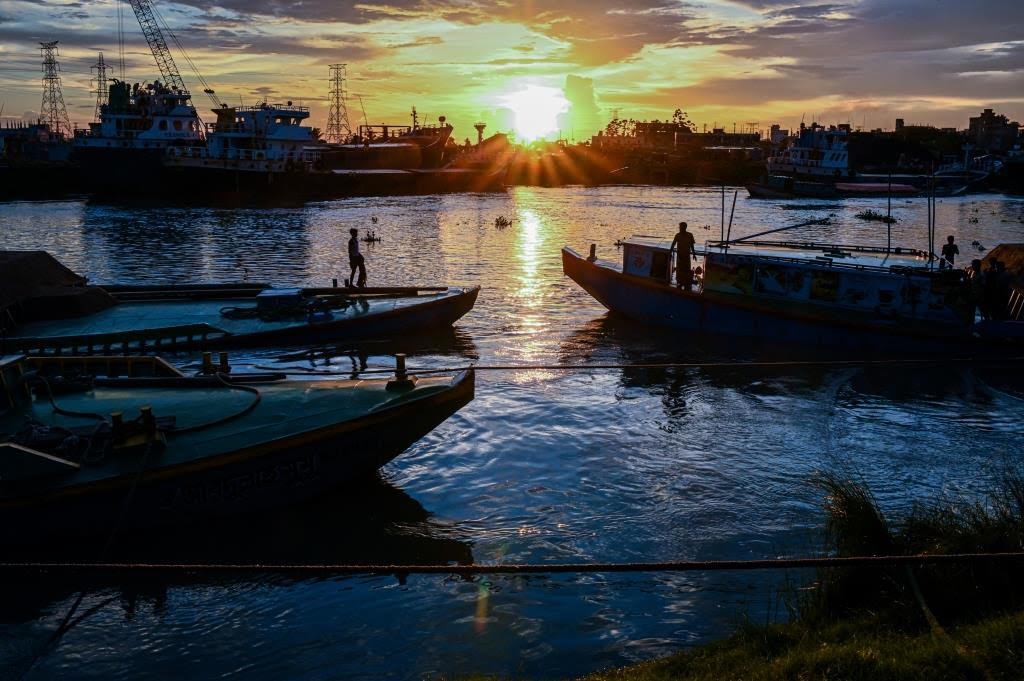
River Buri Ganga, lifeline of Dhaka, and the port at Gatboli
By Vikas Bajpai* 
Earlier this month I was in Dhaka to attend a one on one photography workshop with an extremely talented Bangladeshi photographer GMB Aakash. As I was set to leave for Dhaka a student of mine remarked – “Comrade, tussi abroad challe ho” (comrade, you are going abroad)? Nothing could have been more tragic for me than to feel like being ‘abroad’ in Bangladesh. I told my student friend – “I would just like to feel like being at home in Dhaka; like an overdue homecoming.”
My affliction here does not owe to any reason endogenous to me; it simply is for the reason that we are the same people either across our western border or the eastern border, united by a shared history extending over thousands of years. The borders albeit are only 75 years old and it is my belief that if people across the sub-continent could have their way, the borders, as a barrier to free intermingling of the people, would be gone sooner than later.
I need to admit here that Bangladesh did not disappoint me even in the least. Upon arrival as the immigration official at the airport saw my passport a smile crossed his face. “Welcome to Bangladesh Sir. You are from JNU! It’s a great university; at least the greatest in South Asia and you are in a great profession.” This was no coincidence, for on my return another officer at the immigration said much the same thing.
But this was not the first time that I earned plaudits from a Bangladeshi in Bangladesh for simply being part of the Jawaharlal Nehru University (JNU). There is a small village ‘Dawki’ on Indo-Bangladesh border in south-east Meghalaya where the Umngot river forms a lake on the Indian side before flowing across the border into Bangladesh. It is a picnic spot where the common people seemed to have sway over the paramilitary Border Guards right on the border, both in India and Bangladesh. I had been to the place in December 2017.
A rather modest nylon rope, stretched across the river to mark the border, seemed to bear the audacity of dividing thousands of years of our shared history into India and Bangladesh. But the people were equally intent, quite spontaneously rather than by design, upon mitigating the ‘audacity of the rope.’ Even as the hawkers on either side did brisk business by selling snacks to customers from either side, selfies were being clicked by picnickers from the two countries on either side of the ‘rope’, inside each other’s country.
It is there that I met a group of Bangladeshi students and some lawyers practicing in Bangladesh Supreme Court. Mere mention of being a professor at JNU earned me generous plaudits instantly along with an invite for a selfie in Bangladesh. The ‘rope’ was only a hapless witness to the will of the people.
I would let the plaudits rest here.
Before my arrival in Bangladesh, Aakash had asked me to come prepared with a wish list of what I would like to photograph. ‘People’ is all that I had in my mind. I told him that my interest was in the genre of photography where people would speak through my photographs, and so it was. 
We went almost exclusively to working class areas and among the workers during the workshop. They welcomed me with generous smiles and rarely declined a pose for the camera. Moreover, that I was from India elicited a measure of excitement and a lot of respect on their part – something, I believe, we in India need to learn from.
Here I have displayed some more impressions I have carried back with me. I just wish that these manage to nudge our opinions a little.
***
Opposite old Dhaka, across the Buri Ganga river there is this shipyard where old ships are refurbished and some smaller ones are forged anew from metal retrieved from breaking down old ships. I do not know the scale of it, but like India, Bangladesh is also a recipient of old ships from across the world to be broken down. 
The breaking down happens in Chittagong and the retrieved metal is then shipped to Dhaka by trawler boats and smaller ships where these labourers offload it. From what I saw, I can assure you that doing so is no mean task.
What I saw here were the feet that tirelessly bear the burden of this world, soiled even though they are; the hands that can hold up the sky, even though bonded into slavery of circumstances they are; burden off loaded to begin another round and the process goes on for at least eight hours a day; and a working woman, she steals a nap her mate keeps a strict vigil.
I met Anara Begom at Karwan Bazaar wholesale vegetable market, Dhaka. Anara’s husband was killed in Rawalpindi at the time of Bangladesh liberation war. She raised her children single handedly, and now that they are all married, she is left alone to fend for herself as her offspring can themselves manage only a hand to mouth existence.
Anara Begom
We found her tucked in a corner of Karwan Bazar sitting with an assortment of around a dozen pieces of vegetables on a mat waiting for a customer. All of her capital was worth no more than 10 to 15 takas, or so was her expectation. But who would buy this, one might wonder? As it was to be found, at Karwan Bazar there are layers within layers.
A headload worker
There are big wholesale traders, who supply the big and small retailers. In the transaction some vegetables fall off the sacks, or those that have started rotting in parts are discarded. Such vegetables are collected by people like Anara, washed, their decayed portions removed, and then sold to other poor people like her, of which there isn’t a dearth. Anara Begom thus manages to ward off the indignity of having to beg.
Then, there was a worker ferrying a headload of goods in the Karwan Bazar wholesale vegetable market; a worker enjoying a refreshing bath after the day’s hard work at Gabtoli cattle market in Dhaka; and a man and his machine (as I stood angling for this shot, I was incidentally reminded of Ritwik Ghatak’s 1958 film ‘Ajaantrik’).
Bangladesh is a land of mighty rivers. River Buri Ganga is the lifeline of Dhaka and the port at Gatboli is the busiest commercial port of the city handling major trade. Naturally then it is teeming with workers loading and unloading the ships. 
Nothing would exemplify better the adage -- ‘living by the sweat of the brow only to get browbeaten’ as these workers do. I captured lunch break at Gabtoli; Maimoona, who manages her tiny ‘dhaba’ (food stall) to provide cheapest possible food for the laborers at Gabtoli; an angry young man (I wonder, who will channelize his anger?); Rahimul and Khaleeda who ferry coal from the ships.
Maimoona, Rahimul, Khaleeda
Each basket of coal they ferry carries around 40 kg of coal which is to be offloaded at the depot that is around 100 meters from the ship. Each round trip earns them 3 takas and the count of the trips is kept by plastic tokens handed to them after each trip. Just calculate how many trips they would be making to earn a daily wage between 500 to 800 takas. It’s a sheer feat. Isn’t it humbling that they still managed a smile to make a great photograph. One can motice the kohl in Khaleeda’s eyes.
Then there was the proletarian Rambo, and a worker with flashy smile. You would have heard of descriptions like ‘Colgate smile’, ‘Binaca smile’ and ‘Cibaca smile’. His smile was twice as glorious as all three of them put together. Also, there was genial Hercules, Bilal Hossein, tall and muscular with broad shoulders on which rests the weight of many responsibilities.
He said that he toils hard so that his children can get all the education they need. I intervened just in time to prevent him from wiping out the beads of sweat on his countenance. The results are what they are. After the photograph was taken, Aakash asked the tea shop owner on site to open two one liter bottles of seven up for Bilal and his compatriots to quench their thirst.
As dusk cast its deep shadow over Gabtoli it was time to bid adieu.
---
*MD, MPH, PhD, Assistant Professor, Centre for Social Medicine and Community Health, Jawaharlal Nehru University New Delhi

Comments

TRENDING

Swami Vivekananda's views on caste and sexuality were 'painfully' regressive

By Bhaskar Sur* Swami Vivekananda now belongs more to the modern Hindu mythology than reality. It makes a daunting job to discover the real human being who knew unemployment, humiliation of losing a teaching job for 'incompetence', longed in vain for the bliss of a happy conjugal life only to suffer the consequent frustration.

Jayanthi Natarajan "never stood by tribals' rights" in MNC Vedanta's move to mine Niyamigiri Hills in Odisha

By A Representative The Odisha Chapter of the Campaign for Survival and Dignity (CSD), which played a vital role in the struggle for the enactment of historic Forest Rights Act, 2006 has blamed former Union environment minister Jaynaynthi Natarjan for failing to play any vital role to defend the tribals' rights in the forest areas during her tenure under the former UPA government. Countering her recent statement that she rejected environmental clearance to Vendanta, the top UK-based NMC, despite tremendous pressure from her colleagues in Cabinet and huge criticism from industry, and the claim that her decision was “upheld by the Supreme Court”, the CSD said this is simply not true, and actually she "disrespected" FRA.

Stands 'exposed': Cavalier attitude towards rushed construction of Char Dham project

By Bharat Dogra*  The nation heaved a big sigh of relief when the 41 workers trapped in the under-construction Silkyara-Barkot tunnel (Uttarkashi district of Uttarakhand) were finally rescued on November 28 after a 17-day rescue effort. All those involved in the rescue effort deserve a big thanks of the entire country. The government deserves appreciation for providing all-round support.

Urgent need to study cause of large number of natural deaths in Gulf countries

By Venkatesh Nayak* According to data tabled in Parliament in April 2018, there are 87.76 lakh (8.77 million) Indians in six Gulf countries, namely Bahrain, Kuwait, Oman, Qatar, Saudi Arabia and the United Arab Emirates (UAE). While replying to an Unstarred Question (#6091) raised in the Lok Sabha, the Union Minister of State for External Affairs said, during the first half of this financial year alone (between April-September 2018), blue-collared Indian workers in these countries had remitted USD 33.47 Billion back home. Not much is known about the human cost of such earnings which swell up the country’s forex reserves quietly. My recent RTI intervention and research of proceedings in Parliament has revealed that between 2012 and mid-2018 more than 24,570 Indian Workers died in these Gulf countries. This works out to an average of more than 10 deaths per day. For every US$ 1 Billion they remitted to India during the same period there were at least 117 deaths of Indian Workers in Gulf ...

Uttarakhand tunnel disaster: 'Question mark' on rescue plan, appraisal, construction

By Bhim Singh Rawat*  As many as 40 workers were trapped inside Barkot-Silkyara tunnel in Uttarkashi after a portion of the 4.5 km long, supposedly completed portion of the tunnel, collapsed early morning on Sunday, Nov 12, 2023. The incident has once again raised several questions over negligence in planning, appraisal and construction, absence of emergency rescue plan, violations of labour laws and environmental norms resulting in this avoidable accident.

Celebrating 125 yr old legacy of healthcare work of missionaries

Vilas Shende, director, Mure Memorial Hospital By Moin Qazi* Central India has been one of the most fertile belts for several unique experiments undertaken by missionaries in the field of education and healthcare. The result is a network of several well-known schools, colleges and hospitals that have woven themselves into the social landscape of the region. They have also become a byword for quality and affordable services delivered to all sections of the society. These institutions are characterised by committed and compassionate staff driven by the selfless pursuit of improving the well-being of society. This is the reason why the region has nursed and nurtured so many eminent people who occupy high positions in varied fields across the country as well as beyond. One of the fruits of this legacy is a more than century old iconic hospital that nestles in the heart of Nagpur city. Named as Mure Memorial Hospital after a British warrior who lost his life in a war while defending his cou...

New RTI draft rules inspired by citizen-unfriendly, overtly bureaucratic approach

By Venkatesh Nayak* The Department of Personnel and Training , Government of India has invited comments on a new set of Draft Rules (available in English only) to implement The Right to Information Act, 2005 . The RTI Rules were last amended in 2012 after a long period of consultation with various stakeholders. The Government’s move to put the draft RTI Rules out for people’s comments and suggestions for change is a welcome continuation of the tradition of public consultation. Positive aspects of the Draft RTI Rules While 60-65% of the Draft RTI Rules repeat the content of the 2012 RTI Rules, some new aspects deserve appreciation as they clarify the manner of implementation of key provisions of the RTI Act. These are: Provisions for dealing with non-compliance of the orders and directives of the Central Information Commission (CIC) by public authorities- this was missing in the 2012 RTI Rules. Non-compliance is increasingly becoming a major problem- two of my non-compliance cases are...

Pairing not with law but with perpetrators: Pavlovian response to lynchings in India

By Vikash Narain Rai* Lynch-law owes its name to James Lynch, the legendary Warden of Galway, Ireland, who tried, condemned and executed his own son in 1493 for defrauding and killing strangers. But, today, what kind of a person will justify the lynching for any reason whatsoever? Will perhaps resemble the proverbial ‘wrong man to meet at wrong road at night!’

Dowry over duty: How material greed shattered a seven-year bond

By Archana Kumar*  This account does not seek to expose names or tarnish identities. Its purpose is not to cast blame, but to articulate—with dignity—the silent suffering of a woman who lived her life anchored in love, trust, and duty, only to be ultimately abandoned.