By Shankar Sharma*
The tag line for the article on the issue of coal supply in the country, Coal back in focus as scorching summer spikes energy demand, says: "In 2018-19 all three thermal power stations in Karnataka received only 39.89 lakh tonnes of coal against the annual linkage quantity of 119.55 lakh tonnes."
Actually, Karnataka has five coal power stations: (1) RTPS at Raichur; (2) BTPS near Bellary; (3) NTPC at Kudigi (Vijayapura dist.); (4) UTPS near Udupi; (5) Yermarus (2x800 MW) Thermal Power Station, near Raichur.
The coal supply saga (especially for those states having no coal reserves within their own borders) in the country can only get worse, in view of the fact that more and more coal power plants are being added, and the railway/road/ sea based transportation infrastructure are already close to the saturation stage to transport coal from coal mines/ sea ports to power plants.
Since the agricultural IP sets constitute about 25% of the annual electricity consumption in the country (more so in the southern states, and about 35% in Karnataka), a satisfactory solution to the acute problems associated with the supply of reliable quality/ quantity of coal is feasible only by shifting the electricity demand of agricultural IP sets to solar power through locally commissioned solar power plants.
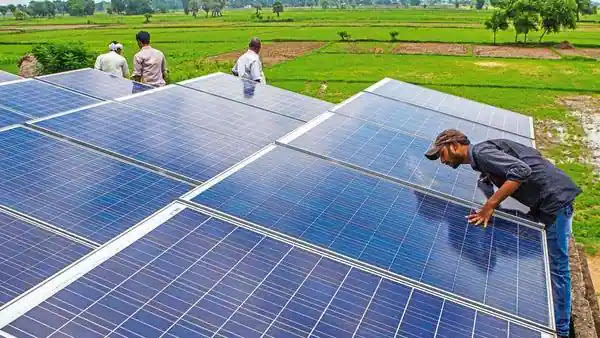
Since the solar powered IP sets are ideal for our farming community (with maximum output during day time and during summer months), an effective deployment of this technology across the state/ country will not only reduce the burden on the national electricity grid, but can also can provide net additional power capacity to the grid, if suitably designed grid interactive inverters are also used for these solar powered IP sets.
Such solar powered IP sets can feed the excess electricity generation back to the grid at no great additional cost to the economy, and at almost nil social and environmental cost to the country.
It is of great concern to the entire country, that many such low hanging fruits are not being harnessed fully, whereas coal, nuclear and dam based power plants are being added at enormous costs to the country.
So, the question that needs to be asked of our policy makers is: are they really interested in finding economical and sustainable solution to the acute problems of the power sector in the country? As has been the experience during the last few decades, it should be very clear that our policy makers are not at all considering strategic solutions; but they seem to be interested only in short term commercial benefits to few corporate houses.
Media can play an important role in persuading governments to think rationally on these lines, at a time when few individuals/ domain experts, who have been writing on such critical issues, have had no influence on the associated decisions of the government.
---
*Power and climate policy analyst
The tag line for the article on the issue of coal supply in the country, Coal back in focus as scorching summer spikes energy demand, says: "In 2018-19 all three thermal power stations in Karnataka received only 39.89 lakh tonnes of coal against the annual linkage quantity of 119.55 lakh tonnes."
Actually, Karnataka has five coal power stations: (1) RTPS at Raichur; (2) BTPS near Bellary; (3) NTPC at Kudigi (Vijayapura dist.); (4) UTPS near Udupi; (5) Yermarus (2x800 MW) Thermal Power Station, near Raichur.
The coal supply saga (especially for those states having no coal reserves within their own borders) in the country can only get worse, in view of the fact that more and more coal power plants are being added, and the railway/road/ sea based transportation infrastructure are already close to the saturation stage to transport coal from coal mines/ sea ports to power plants.
Since the agricultural IP sets constitute about 25% of the annual electricity consumption in the country (more so in the southern states, and about 35% in Karnataka), a satisfactory solution to the acute problems associated with the supply of reliable quality/ quantity of coal is feasible only by shifting the electricity demand of agricultural IP sets to solar power through locally commissioned solar power plants.
Since the solar powered IP sets are ideal for our farming community (with maximum output during day time and during summer months), an effective deployment of this technology across the state/ country will not only reduce the burden on the national electricity grid, but can also can provide net additional power capacity to the grid, if suitably designed grid interactive inverters are also used for these solar powered IP sets.
Such solar powered IP sets can feed the excess electricity generation back to the grid at no great additional cost to the economy, and at almost nil social and environmental cost to the country.
It is of great concern to the entire country, that many such low hanging fruits are not being harnessed fully, whereas coal, nuclear and dam based power plants are being added at enormous costs to the country.
So, the question that needs to be asked of our policy makers is: are they really interested in finding economical and sustainable solution to the acute problems of the power sector in the country? As has been the experience during the last few decades, it should be very clear that our policy makers are not at all considering strategic solutions; but they seem to be interested only in short term commercial benefits to few corporate houses.
Media can play an important role in persuading governments to think rationally on these lines, at a time when few individuals/ domain experts, who have been writing on such critical issues, have had no influence on the associated decisions of the government.
---
*Power and climate policy analyst
Comments
Post a Comment
NOTE: Hateful, abusive comments won't be published. -- Editor