Counterview Desk
Taking strong exception to the propaganda around Hariyali Mahotsav, Shankar Sharma, power and climate policy analyst, in a letter to Bhupender Yadav, Union Minister for Environment, Forests and Climate Change, has said that statements by our political leaders and ministers calling for the protection/ enhancement of our forests, natural resources and biodiversity are not serious because of the perception of "lack of honesty" behind such moves.
Taking strong exception to the propaganda around Hariyali Mahotsav, Shankar Sharma, power and climate policy analyst, in a letter to Bhupender Yadav, Union Minister for Environment, Forests and Climate Change, has said that statements by our political leaders and ministers calling for the protection/ enhancement of our forests, natural resources and biodiversity are not serious because of the perception of "lack of honesty" behind such moves.
The letter, whose copy has been sent to the Prime Minister members of the Union Cabinet, and the vice chairperson, NITI Aayog, insists, "There should be commitment at all levels of the government not to divert any forest land until at least till the total forest and tree cover in the country reaches the 33% target set by the national forest policy."
Text:
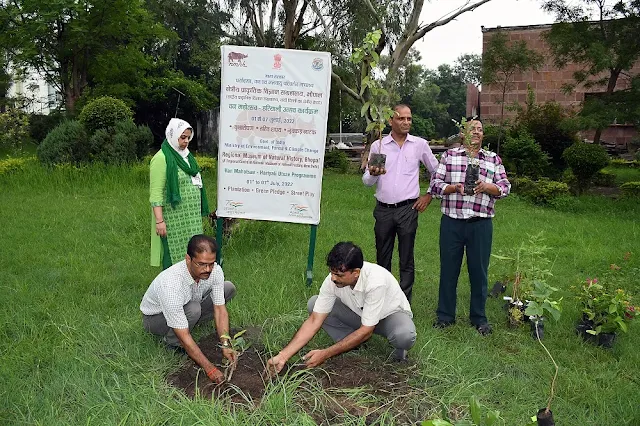
This has reference to the posting on PIB website stating that "Ministry of Environment, Forest & Climate Change celebrates Hariyali Mahotsav – Tree Festival". It also has stated: "India has demonstrated to the world the essence of mindful consumption of resources: Shri Bhupender Yadav".
May I please be excused to state that many statements and developments attributed to the Ministry of Environment, Forests and Climate Change (MoEF&CC) have never stopped amusing the environmentalists in the country.
May I please be excused to state that many statements and developments attributed to the Ministry of Environment, Forests and Climate Change (MoEF&CC) have never stopped amusing the environmentalists in the country.
It is not at all clear as to which section of our populations is expected to be positively influenced by celebrations such as 'Desertification and Drought Day', 'Hariyali Mahotsav', 'Environment Day' etc. in the present age of wanton destruction of our forests encouraged/ permitted by MoEF&CC and other govt. agencies.
It is hard to notice any honest commitment by most of the agencies of the government to make the environment green and highlighted that protection of rivers, mountains and environment, as in the statement: "Union Minister of Environment, Forest and Climate Change, Shri Bhupender Yadav, called the nation forward to make the environment green and highlighted that protection of rivers, mountains and environment is a deeply embedded Indian sentiment as inscribed in our national song ‘Vande Mataram’".
It is in such a larger context, that I may please be excused to say that many such statements by our political leaders and ministers of the day calling for the protection/ enhancement of our forests, natural resources and biodiversity are unlikely to be taken seriously by our people because of the perception of lack of honesty behind most of such unsubstantiated statements.
Whereas, it is necessary that every one of us should focus on protecting each tree and also grow more, what is alarming is the fact that the state and union governments are directly/indirectly responsible for cutting an enormous number of mature trees every year on one or the other pretext.
It is hard to notice any honest commitment by most of the agencies of the government to make the environment green and highlighted that protection of rivers, mountains and environment, as in the statement: "Union Minister of Environment, Forest and Climate Change, Shri Bhupender Yadav, called the nation forward to make the environment green and highlighted that protection of rivers, mountains and environment is a deeply embedded Indian sentiment as inscribed in our national song ‘Vande Mataram’".
It is in such a larger context, that I may please be excused to say that many such statements by our political leaders and ministers of the day calling for the protection/ enhancement of our forests, natural resources and biodiversity are unlikely to be taken seriously by our people because of the perception of lack of honesty behind most of such unsubstantiated statements.
Whereas, it is necessary that every one of us should focus on protecting each tree and also grow more, what is alarming is the fact that the state and union governments are directly/indirectly responsible for cutting an enormous number of mature trees every year on one or the other pretext.
According to a study by the World Resources Institute (WRI) the country lost about 1.6 million hectares of tree cover, and 16 million trees, between 2001 and 2018, of which 9.4 million trees were felled in just the last 5-6 years.
In such a deplorable scenario, it should be seen as totally a lost cause to expect civil society to make up for such unquantifiable losses by planting a few thousand road side tree saplings, which do not enjoy the necessary protection subsequently. Planting of tree saplings, or monoculture species, or growing plantation crops can never replace the ecological wealth of mature and tropical natural forests.
About 25 linear project proposals in the Western Ghats of Karnataka, which are being planned/ implemented should be paused
Hence, it must be stated that if we are serious about our environment/ ecology, the first step is to protect the existing natural forests; especially within the Protected Areas (PAs); and to take all possible measures to ensure the enhancement of the forest cover at least to 30% of the total land area of the country by 2030.
This should be done by enhancing the area under PAs status to at least 10% of the country's land area before 2030. There should be commitment at all levels of the government not to divert any forest land until at least till the total forest and tree cover in the country reaches the 33% target set by the national forest policy.
One way of moving towards these goals is to heed to the recommendations of an expert committee by the Supreme Court of India with regard to the credible valuation of tropical trees in India. It should be noted that few months ago the Supreme Court took judicial notice of its expert committee report, which said the felling of 300 heritage trees to construct five railway over-bridges in West Bengal will cost India a staggering ₹2,23,50,00,000 (₹2.2 billion).
The Union government should take this valuation seriously, and make it a part of the rule to mandate the recovery of such costs per tree (which comes to about Rs 75 lakh per tree) from those agencies who seek to cut trees for whatever reasons.
Additionally, the large number of project proposals (such as about 25 such linear project proposals in the Western Ghats of Karnataka alone), which are being planned/ implemented should be paused, diligently reviewed, and cancelled where feasible.
Can people of this country expect the Union government to exhibit such commitment to protect our environment?
One way of moving towards these goals is to heed to the recommendations of an expert committee by the Supreme Court of India with regard to the credible valuation of tropical trees in India. It should be noted that few months ago the Supreme Court took judicial notice of its expert committee report, which said the felling of 300 heritage trees to construct five railway over-bridges in West Bengal will cost India a staggering ₹2,23,50,00,000 (₹2.2 billion).
The Union government should take this valuation seriously, and make it a part of the rule to mandate the recovery of such costs per tree (which comes to about Rs 75 lakh per tree) from those agencies who seek to cut trees for whatever reasons.
Additionally, the large number of project proposals (such as about 25 such linear project proposals in the Western Ghats of Karnataka alone), which are being planned/ implemented should be paused, diligently reviewed, and cancelled where feasible.
Can people of this country expect the Union government to exhibit such commitment to protect our environment?
Comments