
We are sharing a study[1] based learning on climate resilience and adaptation strategies of pastoralists of Kachchh district, Gujarat. There are two objectives of the study: (i) to examine the impact of climate on traditional livelihood of pastoralists of Gujarat state; and (ii) to explore and document the adaptation strategies of pastoralists in mitigating climate adversities, with a focus on the role of women in it. In order to meet these objectives, the research inquiries focused on how pastoralists perceive climate change, how climate change has impacted their traditional livelihood, i.e., pastoralism in drylands (Krätli 2015), and how these pastoral families have evolved adaptation strategies that address climate change (CC)/ variabilities, i.e., traditional livelihood of pastoralists of Kachchh district, Gujarat state.
Pastoralism is more than 5,000 years old land-use strategy in India; it is practised by nomadic (their entire livelihood revolves around pastoralism), semi-nomadic herders (migrate to higher pastures with their cattle; may cultivate land during monsoon/seasonally, if they have any), long-distance or transhuman pastorals engaged with transhumance is a grazing strategy (Sharma et. al., 2003, p. 23) and in India. Each pastoral family rear a specific or more breed/s of animals (buffalo, camel, cow, goat and sheep); and they rear herd/cattle in large numbers.
Pastoralism in Kachchh district is in a dryland, semi-arid region, hosts almost 60% of the total pastoral population, approximately 1.2 million, of Gujarat state. Of traditional 10 pastoral communities, we have covered more than 100 respondents from three communities, residing in Kachchh, namely Jat, Rayma, and Rabari; of total 10 taluka, two taluka – Lakhpat, Rapar (traditionally known as Gardo and Vaagad region respectively) are covered. The respondents’ families are from Rapar taluka (far east Kachchh) and from Lakhpat taluka (far western Kachchh).
Pastoralism in Kachchh district belongs to dryland, semi-arid/arid region livelihood strategy. Historically, in the 20th century, Kachchh witnessed normal rainfall every third year; such climatic conditions have shaped up farming and pastoralism in Kachchh. In the 21st century, Kachchh faced erratic rainfall, frequent droughts and heat waves, flood once, and cyclone once.
Pastoralists and climate change adaptation strategies
Whenever we hear or read about climate change (CC), the narratives are largely presented with tenors of an apocalyptic collapse of the world, as a threat to sustainable development, and overall human survival. One of the mainstreamed solutions for CC is ‘climate stabilisation’, which is to be managed through scientific, technocratic, and managerial engineering with the help of law and order. In this scenario, we aligned with two arguments related to CC – (i) every discourse is culturally conditioned and historically situated, and can navigate the climatic future accordingly (Hulme 2007; McCarthy, 2014; Rishi and Schleyer-Lindenmann 2021); and (ii) ‘fuzzy cognitive mapping’ (FCMs) (Singh and Chudasama, 2021) provides scope for expanding Climate Resilient (or Compatible) Development Pathways (CRDPs) framework. FCMs are evolved based on field data to expand CRDPs with the bottom-up approach based on culture, community (pastoralist), and occupation based (pastoralism) narratives; their values, traditional knowledge, and worldview, inclusive climate governance (institutions, policy, and practice) at multiple levels.Figure 1: Climate Change, pastoralism, adaptation practices – our study’s approach

Four climate adaptation strategies of pastoralists of Gujarat
These adaptation strategies are articulated based on our field work and observations and sharpening them with ‘fuzzy cognitive mapping’ components to expand enabling conditions for CRDPs.We consistently asked one question: ‘which are the skills and capabilities of pastorals to mitigate climate change?’. Based on pastoralists’ responses, we formulated a set of key linkages: climate-cattle-rainfall-forage-water-market. In this framework, two considerations occupy centre-stage: (i) cattle is the main asset for the pastoralists; and (ii) creating ‘coping mechanism/s’, and ‘reducing vulnerability’ are the ways to sustain cattle centric livelihood.
Figure 2: Pastoralists’ adaptation strategies to deal with climate change/variabilities
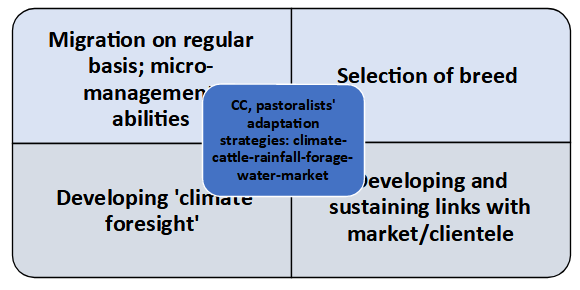
(a) Migration on regular basis
A popular saying among pastoralists is, ‘we migrate wherever the fodder is’ explains their ethos and way of life. Pastoralists believe that cattle must be mobile/always on move to keep them in good health. Therefore, pastoralists migrate on a regular basis with cattle.
Migration of pastoralists as an occupational activity demonstrates a gamut of different abilities of the pastorals: (i) memory-based selection of routes, flexibility for modifying routes as and when required; (ii) micro-management for migration[2]; and (iii) dynamic use of knowledge and resources, wherever they migrate.
The benefits of this practice are: moving with their assets (cattle, two-wheelers); flexibility in exploring to newer places/pastures on spatial and temporal basis; harmonising with nature; sharpening traditional knowledge and using resources in a prudent, dynamic fashion[3] (adjusting to crops/ cropping pattern, variety of vegetation, water); and ability to maintain/sustain clientele/market – farmers, milk buyers, meat sellers – every year.
This strategy is presented with detailed maps of migratory routes. For taking a decision regarding migration, prediction of rainfall occupies a centre-stage, which help pastoralists decide about migration, i.e., short (within 20 km radius) or long (ranging between 80 to 200 kms) distance. Kachchh as a dryland receives average annual 300-500 mm rainfall. Most Gujaratis remember drought years of 1985 to 1989. During these years, these pastoral families continued migration for four years; the longest possible route of migration in last 35 years of migration history, i.e., from far west to far east Gujarat. This longest route was taken by the camel rearers.
Map 1: Longest migration route of pastoralists during drought years (1985-89) in Gujarat

Map 2: Shortest migration route of camel rearers in Kachchh district

(b) Developing ‘climate foresight’ to enable adaptation to climate variabilities
In the climate-cattle-rainfall-forage-water-market framework, prediction of rainfall also occupies a centre-stage along with cattle. Based on such predictions, pastorals decide about migration, dealing with climate variabilities, and plan for future actions accordingly.
(c) Selection of breed
Selection and change of breed related decisions are taken based on the following considerations: managing herd population and its quality; ability to withstand climate variabilities; Dairy support (selling milk/milk products); and meat market (goat, sheep)[4]. Change in type of maal/animals, i.e., from zino maal to moto maal is mainly attributed to getting financial support from the government during extreme events.
Greater income as well as change in breed for seeking government support – these two strategies increase pastoralists’ ability to sustain the CC extreme events/variabilities.
(d) Access to market and sustaining market/clientele links at source and destination
Pastoralists earn their livelihoods from selling milk, manure, and meat to individual customers and to the market. The term ‘market’ refers to a place/entity as a ‘provider’ – it provides opportunity for income generation to pastoralists in organised manner, such as Dairy Cooperatives, meat sellers/producers, and manure buyers (farmers).
Basic economics of their livelihood is as follow: a group of 5-6 families migrate with about 2,000 goats and sheep for 250-300 kms. At destination, each family is able to earn Rs. 120,000-150,000 yearly, working with 100-120 farmers – through penning and dumpling of cattle on farms; selling manure, milk, and meat in markets.
Sustaining sources of income is identified as an adaptation strategy to continue traditional livelihood and to deal with climate variabilities.
As part of inclusive climate governance (institutions, policy, and practice), pastoral invisibility and non-recognition is a primary concern that needs to be duly addressed and recognised; pastoralists’ inabilities are to be reduced effectively through relevant climate governance measures, achieving climate compatible development.
Research regime on climate change could cover the following areas: (i) Two more areas that could be developed through research – climate litigation and pastoralists; and climate governance, FCM, CRD, and pastoralism; (ii) further studies combining scientific and technological base with social and cultural, community based narratives for pastoralism as a transhumance, livelihood strategy, on a temporal basis; (iii) Agroecology integrates low carbon based farming practices and pastoral support for natural manure, improving quality of soil, productivity, etc.; and (iv) need for research based police regime, rethink of the existing ‘conservation regime’ that restricts mobility to forests, and development of climate governance structures are suggested based on this study.
[2] This include ensuring adequate quality fodder for cattle from farms and rangelands, for a longer period; opportunities to be created for dynamic use of resources; calculation about manure production and income; milk production and its marketing in the nearby areas; availability and accessibility of water for livestock; addressing safety concerns and so on.
[3] Pastoralists keep different species and breeds to make use of different ecological niches; this practice is to avoid overgrazing of a particular region. This provides opportunity to the region/s for restoration of its ecosystem (land, vegetation, biodiversity, water resources, etc.) and rejuvenation.
[4] Due to prevalent stigma and vigilantism by the ruling party about selling animals for meat, we are not able to pursue this matter further. Greater income increases pastorals’ ability to sustain vis-à-vis CC extreme events/variabilities.
- We have documented about 40 ways of predicting rainfall, based on observations of: (i) nature/environment (wind direction; formation of dew, fog, and cloud; stars and constellation); (ii) behaviour of birds, animals (laying eggs; water consumption; camel’s sweat; change in chameleon’s body colour; etc.); (iii) behaviour of trees – flowering; spread of salty grass; change of colour; etc.; and (iv) other includes cultural practices.
- Women’s traditional knowledge about health care of livestock to withstand climate variabilities is a significant component.
(c) Selection of breed
Selection and change of breed related decisions are taken based on the following considerations: managing herd population and its quality; ability to withstand climate variabilities; Dairy support (selling milk/milk products); and meat market (goat, sheep)[4]. Change in type of maal/animals, i.e., from zino maal to moto maal is mainly attributed to getting financial support from the government during extreme events.
Greater income as well as change in breed for seeking government support – these two strategies increase pastoralists’ ability to sustain the CC extreme events/variabilities.
(d) Access to market and sustaining market/clientele links at source and destination
Pastoralists earn their livelihoods from selling milk, manure, and meat to individual customers and to the market. The term ‘market’ refers to a place/entity as a ‘provider’ – it provides opportunity for income generation to pastoralists in organised manner, such as Dairy Cooperatives, meat sellers/producers, and manure buyers (farmers).
Basic economics of their livelihood is as follow: a group of 5-6 families migrate with about 2,000 goats and sheep for 250-300 kms. At destination, each family is able to earn Rs. 120,000-150,000 yearly, working with 100-120 farmers – through penning and dumpling of cattle on farms; selling manure, milk, and meat in markets.
Sustaining sources of income is identified as an adaptation strategy to continue traditional livelihood and to deal with climate variabilities.
Limitations of pastoralists vis-à-vis climate governance and political negotiations
The pastoralists are known for their migration, ability to rear herds of animals, and climate resilience. However, they are not able to deal with their invisibility as semi-nomadic and adverse consequences, such as: (i) they lack of citizenship proof (name on voting roll, proof of residence) and subsequently access to basic amenities; (ii) they lack of political clout and absence of political negotiations (losing due to small number); (iii) they are deprived of philanthropic support as well as support from the government for animal care in times of scarcity/drought/flood (existing policy/ programme does not recognise zino maal for financial assistance); and (iv) existing forest and wildlife protection laws deprived them of grazing rights (consequent rich nourishment to cattle) due to prohibited entry to protected areas. Such invisibility and lack of social support and security left pastorals to be on their own, subsequently weakening their adaptive abilities, adding to their struggles, compelling them for long time and long distance migration.What can be done for pastoralists in climate change ear across the world?
The contribution of this study in the context of CC, climate governance, and sustainable livelihood/climate compatible development is – promoting culture based (traditional practices, knowledge), community based narratives (pastoralists and pastoralism) that deal effectively with CC. It adopted suitable methods (memory-based, life cycle approach) for documenting adaptation practices/strategies dealing with CC. By using fuzzy cognitive mapping, and adopting bottom up approach for inclusive climate governance, the study has articulated a need for recognition of pastoralism as a sustainable traditional livelihood, and its capability for ensuring climate compatible development.As part of inclusive climate governance (institutions, policy, and practice), pastoral invisibility and non-recognition is a primary concern that needs to be duly addressed and recognised; pastoralists’ inabilities are to be reduced effectively through relevant climate governance measures, achieving climate compatible development.
Research regime on climate change could cover the following areas: (i) Two more areas that could be developed through research – climate litigation and pastoralists; and climate governance, FCM, CRD, and pastoralism; (ii) further studies combining scientific and technological base with social and cultural, community based narratives for pastoralism as a transhumance, livelihood strategy, on a temporal basis; (iii) Agroecology integrates low carbon based farming practices and pastoral support for natural manure, improving quality of soil, productivity, etc.; and (iv) need for research based police regime, rethink of the existing ‘conservation regime’ that restricts mobility to forests, and development of climate governance structures are suggested based on this study.
References:
- Hulme, Mike. (2007). The Conquering of Climate: Discourses of Fear and Their Dissolution, The Geographical Journal, 174(1), pp.5-16.
- Krätli Saverio. (2015). Valuing variability: New Perspectives on climate resilient drylands development. IIED. Edited by de Jode, H. Available from: http://pubs.iied.org/ 10128IIED.html.
- McCarthy, James, Chery Chen, López-Carr David, Louise Barbara, and Endemaño Walker. (2014). Socio-cultural dimensions of climate change: charting the terrain, GeoJournal, 79(6), Special Section on Socio-Cultural Dimensions of Climate Change: Charting the Terrain, pp. 665-675.
- Mearns, Robin and Andrew Norton (eds.). (2010). Social dimensions of climate change: Equity and vulnerability in a warming world, Washington DC: The World Bank.
- Nassef, Magda, Anderson Simon and Ced HeSSe. (2009). Pastoralism and climate change: Enabling adaptive capacity, London: Overseas Development Institute.
- Rishi P., Schleyer-Lindenmann A. (2021) Psychosocial Dimensions of Culture-Climate Connect in India and France. In: Leal Filho W., Luetz J., Ayal D. (eds) Handbook of Climate Change Management.Springer, Cham. https://doi.org/10.1007/978-3-030-22759-3_93-1
- Sharma Vijay Paul, Ilse Kohler-Rollefson and Jon Morton. (2005). Pastoralism in India: A scoping study. Ahmedabad: Indian Institute of Management.
- Singh, P. K., & Chudasama, H. (2021). Pathways for climate resilient development: Human well-being within a safe and just space in the 21st century. Global Environmental Change, 68, 102277. doi:10.1016/j.gloenvcha.2021.1022
NOTES
[1] The study is prepared for MARAG (Maldhari Rural Action Group) and is funded by Azim Premji University as part of the Research Funding Programme 2020.[2] This include ensuring adequate quality fodder for cattle from farms and rangelands, for a longer period; opportunities to be created for dynamic use of resources; calculation about manure production and income; milk production and its marketing in the nearby areas; availability and accessibility of water for livestock; addressing safety concerns and so on.
[3] Pastoralists keep different species and breeds to make use of different ecological niches; this practice is to avoid overgrazing of a particular region. This provides opportunity to the region/s for restoration of its ecosystem (land, vegetation, biodiversity, water resources, etc.) and rejuvenation.
[4] Due to prevalent stigma and vigilantism by the ruling party about selling animals for meat, we are not able to pursue this matter further. Greater income increases pastorals’ ability to sustain vis-à-vis CC extreme events/variabilities.
---
*Varsha Bhagat-Ganguly is a professor, Institute of Law, Nirma University. She has worked, researched, and published widely on pastoralism and pastoralists, land issues and land rights, citizen’s rights and collective action, India’s Scheduled Areas, and e-waste management from the perspectives of rights and social justice.
Karen Pineiro has over 7 years’ work experience in programme management with development organisations and currently works as research consultant in association with social justice organisations in Gujarat on issues of gender, livelihoods, education, and health.
Karen Pineiro has over 7 years’ work experience in programme management with development organisations and currently works as research consultant in association with social justice organisations in Gujarat on issues of gender, livelihoods, education, and health.
Comments
Post a Comment
NOTE: Hateful, abusive comments won't be published. -- Editor