.jpeg)
With a steady drumbeat of bad news for the lives of ordinary citizens -- inflation at a multi-year high, rupee at an all-time low, negative job creation and when all forward indicators as seen by industry leaders point to recessionary clouds on the horizon, what’s a serially-incompetent government to do?
Dust out their time-tested-citizen-distraction playbook. The Gyanvapi-Masjid case is all of this -- as a weapon of mass distraction. This zeitgeist of our times is best captured by a recent opinion piece:
"The idea is to keep the pot on a perpetual boil, simmering at the top, whirling feverishly beneath. A restless society forever living precariously on the precipice arouses distrst, uneasiness, fear and discomfort, That is a toxic panoply for manufacturing rage, which can then be effortlessly mobilized at short notice. BJP is creating an eco-system of real-time instant delivery of hate-mongers. That is how we are suddenly experiencing a nuclear cloudburst of daily anti-Muslim rhetoric promoting their defenestration all over the country."
In the second quarter of 2021, just as the horrors of the Covid spike were in full swing, five women decided to petition the court to open up -- what they considered as a then -- currently somewhat inaccessible ‘Goddess Shringar Gauri' place of worship situated, they believed, adjacent to a mosque in Varanasi.
One of the five, a Delhi woman aided by her husband, founder of a 2018 era Yet-Another-Vishwa-Vedic-Sanathan-Sangh drove the petition, along with four other Varanasi women, among the latter a wife of a VHP Varanasi officer bearer; others seem to be stand-ins and foot-soldiers -- proxies really for the Hindutva complex.
Either way, the court accepted the plea and ordered a survey using video of the relevant area. The case came into the limelight this May because the Mosque management filed a counter-plea against the commissioner in-charge -- asking for his removal -- alleging that he was exceeding his mandate and had insisted on filming areas not authorised by the court.
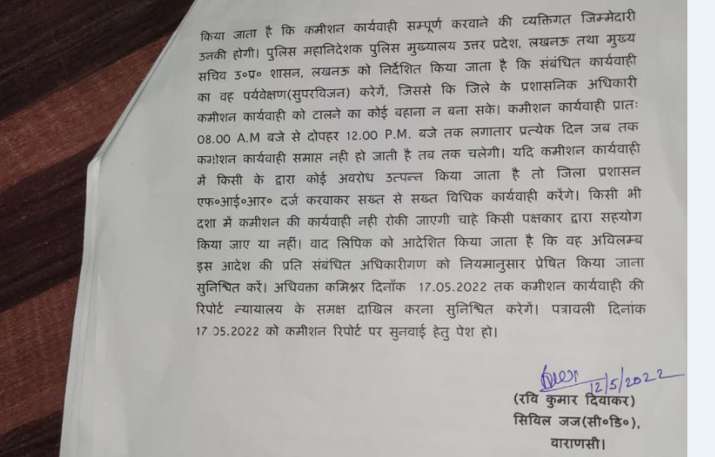
The court on hearing the plea doubled down on its original order, not only retaining the commissioner but also provided him two additional legal assistants to complete his work. The two-page order (one, two) asks for submission of timebound results. Over the weekend, accordingly work proceeded.
"The idea is to keep the pot on a perpetual boil, simmering at the top, whirling feverishly beneath. A restless society forever living precariously on the precipice arouses distrst, uneasiness, fear and discomfort, That is a toxic panoply for manufacturing rage, which can then be effortlessly mobilized at short notice. BJP is creating an eco-system of real-time instant delivery of hate-mongers. That is how we are suddenly experiencing a nuclear cloudburst of daily anti-Muslim rhetoric promoting their defenestration all over the country."
In the second quarter of 2021, just as the horrors of the Covid spike were in full swing, five women decided to petition the court to open up -- what they considered as a then -- currently somewhat inaccessible ‘Goddess Shringar Gauri' place of worship situated, they believed, adjacent to a mosque in Varanasi.
One of the five, a Delhi woman aided by her husband, founder of a 2018 era Yet-Another-Vishwa-Vedic-Sanathan-Sangh drove the petition, along with four other Varanasi women, among the latter a wife of a VHP Varanasi officer bearer; others seem to be stand-ins and foot-soldiers -- proxies really for the Hindutva complex.
Either way, the court accepted the plea and ordered a survey using video of the relevant area. The case came into the limelight this May because the Mosque management filed a counter-plea against the commissioner in-charge -- asking for his removal -- alleging that he was exceeding his mandate and had insisted on filming areas not authorised by the court.
The court on hearing the plea doubled down on its original order, not only retaining the commissioner but also provided him two additional legal assistants to complete his work. The two-page order (one, two) asks for submission of timebound results. Over the weekend, accordingly work proceeded.
It is troubling that the court took this case up, when expressly barred from exerting jurisprudence on it
Opponents to this legal drama are furious and have been insisting that this in-limine (at the outset) violates the Place of Worship (Special Provisions) Act, a 3-page 1991 law that lays a framework for exactly such scenarios. The law calls for a standstill in all and any such cases. It compels cease-and-desist -- from any party -- that attempts to convert a religious-house to a different denomination - retroactive to the known religious status of such places - as of and on August 15, 1947. Here:
‘3. Bar of conversion of places of Worship
No person shall convert any place of worship of any religious denomination or any section thereof into a place of worship of different section of the same religious denomination or of a different religious denomination or any section thereof.
4, Declaration as to the religious character of certain places of worship and bar of jurisdiction of courts, etc.
(1) It is hereby declared that the religious character of a place of worship existing on the 15th day of August, 1947 shall continue to be the same as it existed on that day."
More pertinently, the act itself bars - effective as of Sept 1991 going into the future - the involvement of courts in such matters. Note the last line in the extract below :
"(2) If, on the commencement of this Act. any suit, appeal or other proceeding with respect to the conversion of the religious character of any place of worship, existing on the 15th day of August, 1947, is pending before any court, tribunal of other authority, the same shall abate, and no suit, appeal or other proceeding with respect to any such matter shall lie on or after such commencement in any court, tribunal or other authority."
It is therefore troubling that the court took this case up, when expressly barred from exerting jurisprudence on it, and is indicative of the extent of ongoing judicial capture. We strongly object to the politicization of this matter, and the use of illegal lawfare -- expressly to keep the communal pot simmering.
This is a waste of public legal resources at a time when critical attention is needed towards solving pressing issues such as mass hunger. We urge the government and/or the Supreme Court to follow the written law of the land and halt/dismiss motions of the original petitioners.
---
*With Socialist Party (India)
‘3. Bar of conversion of places of Worship
No person shall convert any place of worship of any religious denomination or any section thereof into a place of worship of different section of the same religious denomination or of a different religious denomination or any section thereof.
4, Declaration as to the religious character of certain places of worship and bar of jurisdiction of courts, etc.
(1) It is hereby declared that the religious character of a place of worship existing on the 15th day of August, 1947 shall continue to be the same as it existed on that day."
More pertinently, the act itself bars - effective as of Sept 1991 going into the future - the involvement of courts in such matters. Note the last line in the extract below :
"(2) If, on the commencement of this Act. any suit, appeal or other proceeding with respect to the conversion of the religious character of any place of worship, existing on the 15th day of August, 1947, is pending before any court, tribunal of other authority, the same shall abate, and no suit, appeal or other proceeding with respect to any such matter shall lie on or after such commencement in any court, tribunal or other authority."
It is therefore troubling that the court took this case up, when expressly barred from exerting jurisprudence on it, and is indicative of the extent of ongoing judicial capture. We strongly object to the politicization of this matter, and the use of illegal lawfare -- expressly to keep the communal pot simmering.
This is a waste of public legal resources at a time when critical attention is needed towards solving pressing issues such as mass hunger. We urge the government and/or the Supreme Court to follow the written law of the land and halt/dismiss motions of the original petitioners.
---
*With Socialist Party (India)
Comments
Post a Comment
NOTE: Hateful, abusive comments won't be published. -- Editor