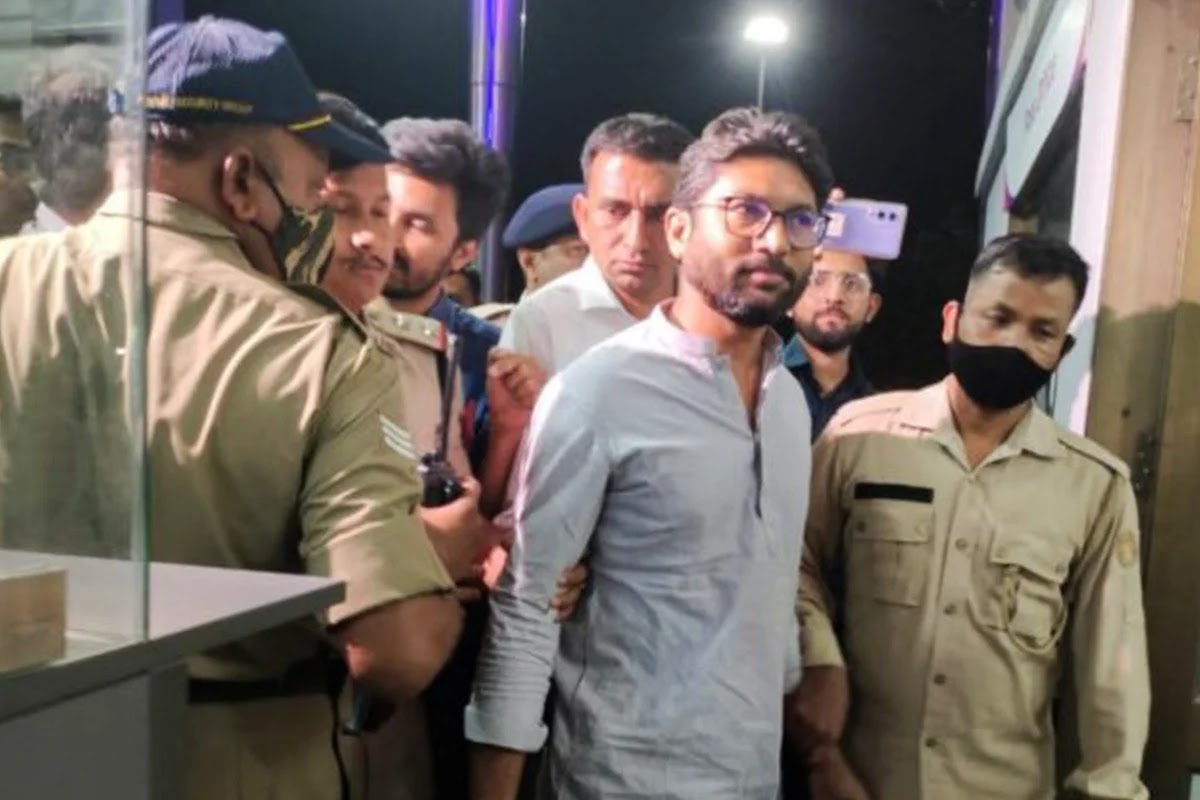
Calling it an example of “increase in blatant misuse of the state power by BJP”, Anhad, a human rights group based in Delhi, has said the arrest of top Dalit rights leader Jignesh Mevani is not only unlawful and undemocratic but suggests how India’s “quasi-fascist regime wants to suppress all those who want to raise their voices against their ill-policies, actions and governance.”
Signed by Anhad trustees Bhavna Sharma, Dev Desai, Leena Dabiru and Tarun Sagar, the statement, Anhad, “Today, all Indian citizens are living in an undeclared emergency. If an elected political representative can be harassed by police of another state like this, just imagine what this authoritarian regime is capable of doing to ordinary citizens and organizations who dare to speak against them.”
Text:
Late-night on 20 April 2022, Jignesh Mevani, MLA from Vadgam Assembly Constituency, was arrested from the government circuit house in Palanpur, Banaskantha district, Gujarat, by Assam Police. The arrest was made on a complaint filed by Arup Kumar Dey, a BJP member from Khokrajar, Assam, who took offence to one of the tweets posted by him during the visit of PM Narendra Modi in Gujarat.In his tweet, Jignesh Mevani appealed to PM Narendra Modi to take out time and restore peace in Himmatnagar and Khambhat areas, where communal violence had recently occurred following Ram Navami processions, especially in residential areas with a sizable minority population.
Anhad believes that being one of the most vocal opposition leaders and an elected public representative, Jignesh Mevani was performing his duty to hold PM Narendra Modi accountable and asking him to speak up on the issue of rising communal violence in India, on which Narendra Modi is always found silent.
It is important to note here that since Narendra Modi has come to power at the Centre, incidents of communal violence, according to Home Ministry have increased by 28% starting from 2014 till the end of 2017, with 822 incidents being recorded in 2017 alone.
These incidents of communal violence did not stop in 2017, as according to the latest data on the ‘Crime in India’ report released by the National Crime Records Bureau (NCRB), despite lockdowns due to Covid-19, communal riots registered an increase of 96% in 2020 as compared to the previous year.
Similarly, caste riots have increased close to 50%, agrarian riots have increase to 38% and riots during ‘andolan/morcha’ have increased by 33% as mentioned in the same report brought out by the Modi government in 2021. These figures are alarming, but we are convinced that unreported incidents of riots would be far more than the reported ones.
Rather than doing anything to stop the communal violence in India and continuing not to speak on these glaring issues, the current BJP regime, with the help of Assam and Gujarat governments have orchestrated this frivolous case against Jignesh Mevani.
On one hand, Assam Police has arrested and extradited Jignesh Mevani in the middle of the night like a criminal, whereas on the other hand, Gujarat Police has been intimidating and harassing members of Jignesh’s family members and his associates in Rastriya Dalit Adhikar Manch (RDAM).
Some of the incidents of such harassment have been reported until now are that Gujarat Crime Branch has visited Rastriya Dalit Adhikar Manch office in Rakhiyal, Ahmedabad, and confiscated their office computers. Gujarat Police has visited the home of Kamlesh Katariya, who is an associate of Jignesh Mevani and confiscated his mobile.
Gujarat Police has also visited Jignesh Mevani’s MLA quarters and confiscated two more desktops, CPUs. Gujarat Police also went to the residence of Satish, Jignesh Mevani’s personal assistant in Palanpur. As he was not there at his residence, they have seized mobile phones of his parents. Mobile phones of Jagdish Chavda and Amarnath, associates of Jignesh Mevani have been confiscated by the Gujarat Police.
They have also searched Jignesh Mevani’s home in Meghaninagar, Ahmedabad and confiscated some files in the presence of his father. Bhavesh, another associate of Jignesh Mevani has received a call from Gujarat Police and is being forced to appear in the Police Station.

Hence, this leaves no doubt that this arrest is a coordinated attack to silence Jignesh Mevani, who has been actively raising the issues of marginalized communities and firmly stood against destructive policies and actions of the current regime. The Bhartiya Janata Party is extremely vindictive against the opposition leaders who raise their voice against them.
Today, all Indian citizens are living in an undeclared emergency. If an elected political representative can be harassed by police of another state like this, just imagine what this authoritarian regime is capable of doing to ordinary citizens and organizations who dare to speak against them.
With such actions people are being pushed to the brink of civil strife with large sections living in fear. Clearly generating this fear, the quasi-fascist regime wants to suppress all those who want to raise their voices against their ill-policies, actions, and governance.
Anhad strongly condemns such undemocratic and unlawful arrest of Jignesh Mevani by Assam Police and harassment of his family, friends, and associates by Gujarat Police. We demand that Jignesh Mevani should be immediately released, and harassment of his associates and their families should not be continued through this coordinated attack by both, Assam and Gujarat governments.
Today, all Indian citizens are living in an undeclared emergency. If an elected political representative can be harassed by police of another state like this, just imagine what this authoritarian regime is capable of doing to ordinary citizens and organizations who dare to speak against them.
With such actions people are being pushed to the brink of civil strife with large sections living in fear. Clearly generating this fear, the quasi-fascist regime wants to suppress all those who want to raise their voices against their ill-policies, actions, and governance.
Anhad strongly condemns such undemocratic and unlawful arrest of Jignesh Mevani by Assam Police and harassment of his family, friends, and associates by Gujarat Police. We demand that Jignesh Mevani should be immediately released, and harassment of his associates and their families should not be continued through this coordinated attack by both, Assam and Gujarat governments.
Strong-arming elected representatives and harassing their friends, associates and families is only a proof of how democratic India is currently, under the leadership of Prime Minister Narendra Modi. We stand in solidarity with all individuals and organizations who have been harassed by the current regime through the blatant misuse of the state power.
Comments