The farmers' spirit, elevated and reverberated at a boiling point in Ferozpur like a spark turning into a prairie fire, appears to be behind Prime Minister Narinder Modi having being compelled to retreat to Delhi due to a virtually boycotted pandal. Demonstrations held just ahead of Modi's visit, especially in Firozpur, seemed to have already created tremors in the belly of the ruling party.
The speakers at these demonstrations summed up how BJP policies were bent on giving a blow to the economy in every sphere and destroy the fabric of democracy. They persuaded the farmers not to bear any illusions on the promises of the rulers and never derail from the path of struggle. Demonstrations were held in 16 districts and 17 cities. There were blockades and sit-ins. Farmer organizations protested Modi's rally in their respective areas.
Near Ferozpur, the Kisaan Mazdoor Sangharsh Committee came up with the biggest mobilization, while other organizations such as Bhartiya Kisan Union (BKU) Krantikari, BKU Ekta Ugrahan, Kirti Kisan Union, Punjab Kisan Union, BKU Dakonda held huge rallies in their strongholds. The buses (which were mostly empty anyway) which were moving to Firozpur were forced to go back.
Various agricultural and rural labourers' organizations such as the Punjab Khet Mazdoor Union and the Krantikari Pendu Mazdoor Union also participated in state-wide demonstrations in their own respective areas. Most of these demonstrations took place on January 5.
Earlier, senior leaders of the Krantikari Kisan Union, Azad Kisan Committee Doaba, Jai Kisan Andolan, BKU (Sidhupur), Kisan Sangharsh Committee Kotbudha, Lok Bhalai Welfare Society, BKU Krantikari, Dasuha Ganna Committee and others, held a meeting in Barnala and announced protests to be held in villages and district headquarters across the State opposing Modi's visit.
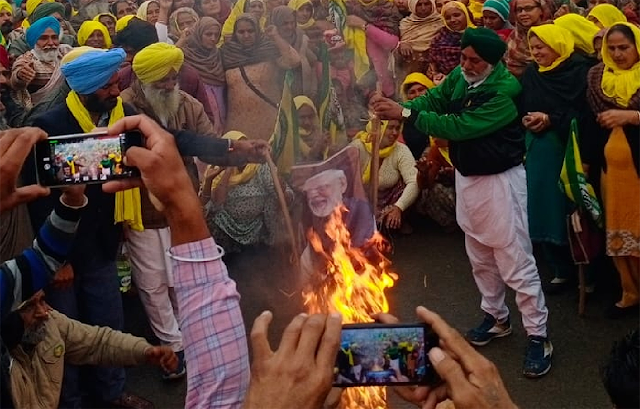
Volunteers held huge effigy burning programmes amidst rain, creating effect of lightning, raising the slogan 'Modi Go Back'. They termed their event as a kind of vengeance towards the Prime Minister, who ignored farmers for one and a half years, leading to the death of more than 700 farmers and farm labourers.
Farmer leader Sukhdev Singh Kokri Kalan, through a press statement, stated that the cause of such a huge protests was, while on one hand the government was refusing to file the case of murder in the Lakhimpur Kheri incident and was showing no sign of removing Ajay Mishra Taini as Union minister, local farmer leaders were being huddled in jails.
It urged the government to waive of all kinds of government and non-government loans on farmers and farm workers, adding there is strong resentment because of the non-implementation of Swaminathan Commission report for price fixation of crops, and two crore jobs annually as promised in the election manifesto.
Farmer leaders alleged that the Modi government is not only conspiring to reinforce the black laws but is also selling public property and the natural resources of the country to the lap of Indian and foreign corporates. During his visit to Punjab, Modi was seeking to hoodwink people with false assurances.
Volunteers held huge effigy burning programmes amidst rain, creating effect of lightning, raising the slogan Modi Go Back
The fact of the matter is, they said, burning issues like minimum support price (MSP), public distribution system, fuel oil prices, selling of public establishments, release of the human rights activists and such other public interest issues connected with life and liberty of the masses were not being addressed, even as the government was patronising the Indian corporates and MNCs.
The demonstrators took place despite a very significant polarisation between farmer organisations which had come together under the Samyukt Kisan Morcha (SKM) from on the issue what stand they should take in state elections in Punjab. A big chunk insisted on fighting polls, while others said it was not their job.
BKU (Ugrahan) insisted that their platform cannot be turned into a forum of the ruling class parties and under no condition would support any candidate. On the other hand, the BKU (Rajewal) appeared to support Sikh politics by becoming part and parcel of electoral politics. Following a meeting with several farmer leaders, Balbir Singh Rajewal announced the decision to contest the elections on all 117 Assembly seats.
Though leaders claimed they would not join hands with any other party, sources amongst the farmer leaders as well as the Aam Aadmi Party said alliances were being worked out by chalking out a common minimum programme.
Of the 32 unions part of the SKM, nine — Krantikari Kisan Union (Dr Darshan Pal), BKU Krantikari (Surjit Phool), BKU Sidhupur (Jagjit Dallewal), Azad Kisan Committee Doaba (Harpal Sangha), Jai Kisan Andolan (Gurbakhsh Barnala), Dasuha Ganna Sangharsh Committee (Sukhpal Daffar), Kisan Sangharsh Committee Punjab (Inderjit Kotbudha), Lok Bhalai Insaaf Welfare Society (Baldev Sirsa) and Kirti Kisan Union Punjab (Hardev Sandhu) — declared not to be part of any political front.
---
Freelance journalist based in Mumbai, who toured India Punjab duing farmers' agitation
The demonstrators took place despite a very significant polarisation between farmer organisations which had come together under the Samyukt Kisan Morcha (SKM) from on the issue what stand they should take in state elections in Punjab. A big chunk insisted on fighting polls, while others said it was not their job.
BKU (Ugrahan) insisted that their platform cannot be turned into a forum of the ruling class parties and under no condition would support any candidate. On the other hand, the BKU (Rajewal) appeared to support Sikh politics by becoming part and parcel of electoral politics. Following a meeting with several farmer leaders, Balbir Singh Rajewal announced the decision to contest the elections on all 117 Assembly seats.
Though leaders claimed they would not join hands with any other party, sources amongst the farmer leaders as well as the Aam Aadmi Party said alliances were being worked out by chalking out a common minimum programme.
Of the 32 unions part of the SKM, nine — Krantikari Kisan Union (Dr Darshan Pal), BKU Krantikari (Surjit Phool), BKU Sidhupur (Jagjit Dallewal), Azad Kisan Committee Doaba (Harpal Sangha), Jai Kisan Andolan (Gurbakhsh Barnala), Dasuha Ganna Sangharsh Committee (Sukhpal Daffar), Kisan Sangharsh Committee Punjab (Inderjit Kotbudha), Lok Bhalai Insaaf Welfare Society (Baldev Sirsa) and Kirti Kisan Union Punjab (Hardev Sandhu) — declared not to be part of any political front.
---
Freelance journalist based in Mumbai, who toured India Punjab duing farmers' agitation
Comments