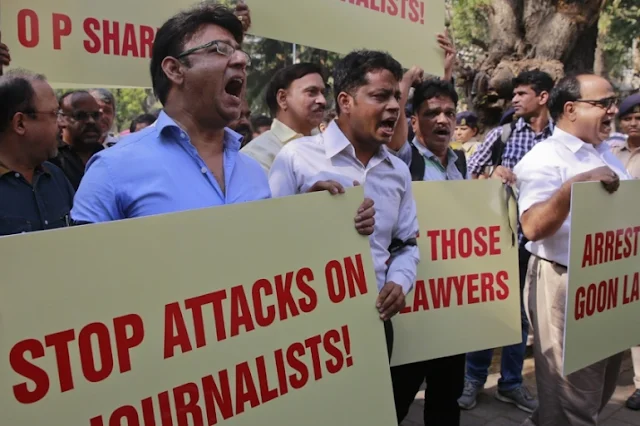
With six journos killed this year, India follows Pakistan as 4th 'most dangerous country'

By A Representative 

Afghanistan, Mexico, Pakistan and India are the "most dangerous" countries for media work this year, the Geneva-based Press Emblem Campaign (PEC) said in its annual report. Since January 1, as many as 76 media workers have been killed in 28 countries around the world. Afghanistan leads with 12 assassinations, ahead of Mexico where 10 journalists were killed. Among the most dangerous countries are Pakistan (7), India (6), Yemen (4), Democratic Republic of Congo (3) and the Philippines (3 killed).
Two deaths were recorded in Azerbaijan, Bangladesh, Brazil, Burkina-Faso, Colombia, as well as in Ethiopia, Kenya, Nigeria, Somalia and Turkey. Finally, one victim has been identified in the following countries: Ecuador, Gaza, Georgia, Ghana, Greece, Guatemala, Haiti, Lebanon, Netherlands, Syria, and the United States of America.
Of the 76 journalists murdered, 29 were in war zones (Afghanistan, Azerbaijan, Burkina Faso, DRC, Ethiopia, Gaza, Somalia, Syria, and Yemen). Terrorist groups were responsible of at least 20 murders (Afghanistan, Burkina Faso, Pakistan, Somalia and Yemen), an increase compared to previous years. By region, Asia, with 39 dead (+6), is ahead of Latin America 17 (-10), Africa 14 (+5), Europe 5 (+2) and North America 1 (+1).
Condemning these attacks and calling those responsible for these crimes to be brought to justice, PEC Secretary General Blaise Lempen said, “The number of journalists killed decreased by 8% compared to the same period of last year, a slight improvement. Improvement has taken place in Latin America outside of Mexico, deterioration is observed in Africa and Europe. Mexico and Afghanistan have been among the most dangerous countries for journalists for many years, but the rise in Africa is particularly worrying."
In Europe, the targeted killings of three journalists, in Greece, Georgia and the Netherlands is a very sad development. In Burma (Myanmar) after the coup and in Afghanistan after the departure of the NATO troops, press freedom has registered a very serious setback.
Over the last five years, Mexico has recorded the highest victims (66), ahead of Afghanistan (53), then India (40), Pakistan (35), Syria (29), the Philippines (21), Iraq (18), Yemen (17), and Somalia (16). In ten years, from 2012 to 2021, 1150 journalists were killed, or 115 per year, 2.2 per week, according to figures from the PEC.
One positive development, says PEC President Hedayat Abdel Nabi, is that the awareness across the globe has become more widespread due to the enthusiastic engagement of media colleagues to spread the message of media protection and the safety of journalists as well as press freedom.
“India has recently lost Buddhinath Jha (journalist cum Right to Information (RTI) activist, also known as Avinash Jha), whose body was found in Madhubani locality of Bihar on November 12. The Benipatti-based family claimed that Buddhinath was offered a lot of money (as bribes) by some illegal healthcare clinic owners, but he did not listen to them. Later he received a number of threatening calls from unknown persons,” said Nava Thakuria, PEC’s India representative.
Prior to him, India lost five journalists -- Ashu Yadav, Sulabh Srivastava, Ch Keshav, Manish Kumar Singh and Raman Kashyap to assailants this year. Indian photojournalist Danish Siddiqui was killed in Afghanistan. India’s two neighbours Pakistan and Bangladesh reported seven and two media casualties respectively. Bhutan, Nepal, Tibet (China), Maldives, Sri Lanka and Myanmar have not reported any incident of journo-murder till date this year.

Comments

TRENDING

Swami Vivekananda's views on caste and sexuality were 'painfully' regressive

By Bhaskar Sur* Swami Vivekananda now belongs more to the modern Hindu mythology than reality. It makes a daunting job to discover the real human being who knew unemployment, humiliation of losing a teaching job for 'incompetence', longed in vain for the bliss of a happy conjugal life only to suffer the consequent frustration.

Jayanthi Natarajan "never stood by tribals' rights" in MNC Vedanta's move to mine Niyamigiri Hills in Odisha

By A Representative The Odisha Chapter of the Campaign for Survival and Dignity (CSD), which played a vital role in the struggle for the enactment of historic Forest Rights Act, 2006 has blamed former Union environment minister Jaynaynthi Natarjan for failing to play any vital role to defend the tribals' rights in the forest areas during her tenure under the former UPA government. Countering her recent statement that she rejected environmental clearance to Vendanta, the top UK-based NMC, despite tremendous pressure from her colleagues in Cabinet and huge criticism from industry, and the claim that her decision was “upheld by the Supreme Court”, the CSD said this is simply not true, and actually she "disrespected" FRA.

Stands 'exposed': Cavalier attitude towards rushed construction of Char Dham project

By Bharat Dogra*  The nation heaved a big sigh of relief when the 41 workers trapped in the under-construction Silkyara-Barkot tunnel (Uttarkashi district of Uttarakhand) were finally rescued on November 28 after a 17-day rescue effort. All those involved in the rescue effort deserve a big thanks of the entire country. The government deserves appreciation for providing all-round support.

Urgent need to study cause of large number of natural deaths in Gulf countries

By Venkatesh Nayak* According to data tabled in Parliament in April 2018, there are 87.76 lakh (8.77 million) Indians in six Gulf countries, namely Bahrain, Kuwait, Oman, Qatar, Saudi Arabia and the United Arab Emirates (UAE). While replying to an Unstarred Question (#6091) raised in the Lok Sabha, the Union Minister of State for External Affairs said, during the first half of this financial year alone (between April-September 2018), blue-collared Indian workers in these countries had remitted USD 33.47 Billion back home. Not much is known about the human cost of such earnings which swell up the country’s forex reserves quietly. My recent RTI intervention and research of proceedings in Parliament has revealed that between 2012 and mid-2018 more than 24,570 Indian Workers died in these Gulf countries. This works out to an average of more than 10 deaths per day. For every US$ 1 Billion they remitted to India during the same period there were at least 117 deaths of Indian Workers in Gulf ...

Uttarakhand tunnel disaster: 'Question mark' on rescue plan, appraisal, construction

By Bhim Singh Rawat*  As many as 40 workers were trapped inside Barkot-Silkyara tunnel in Uttarkashi after a portion of the 4.5 km long, supposedly completed portion of the tunnel, collapsed early morning on Sunday, Nov 12, 2023. The incident has once again raised several questions over negligence in planning, appraisal and construction, absence of emergency rescue plan, violations of labour laws and environmental norms resulting in this avoidable accident.

Celebrating 125 yr old legacy of healthcare work of missionaries

Vilas Shende, director, Mure Memorial Hospital By Moin Qazi* Central India has been one of the most fertile belts for several unique experiments undertaken by missionaries in the field of education and healthcare. The result is a network of several well-known schools, colleges and hospitals that have woven themselves into the social landscape of the region. They have also become a byword for quality and affordable services delivered to all sections of the society. These institutions are characterised by committed and compassionate staff driven by the selfless pursuit of improving the well-being of society. This is the reason why the region has nursed and nurtured so many eminent people who occupy high positions in varied fields across the country as well as beyond. One of the fruits of this legacy is a more than century old iconic hospital that nestles in the heart of Nagpur city. Named as Mure Memorial Hospital after a British warrior who lost his life in a war while defending his cou...

New RTI draft rules inspired by citizen-unfriendly, overtly bureaucratic approach

By Venkatesh Nayak* The Department of Personnel and Training , Government of India has invited comments on a new set of Draft Rules (available in English only) to implement The Right to Information Act, 2005 . The RTI Rules were last amended in 2012 after a long period of consultation with various stakeholders. The Government’s move to put the draft RTI Rules out for people’s comments and suggestions for change is a welcome continuation of the tradition of public consultation. Positive aspects of the Draft RTI Rules While 60-65% of the Draft RTI Rules repeat the content of the 2012 RTI Rules, some new aspects deserve appreciation as they clarify the manner of implementation of key provisions of the RTI Act. These are: Provisions for dealing with non-compliance of the orders and directives of the Central Information Commission (CIC) by public authorities- this was missing in the 2012 RTI Rules. Non-compliance is increasingly becoming a major problem- two of my non-compliance cases are...

Pairing not with law but with perpetrators: Pavlovian response to lynchings in India

By Vikash Narain Rai* Lynch-law owes its name to James Lynch, the legendary Warden of Galway, Ireland, who tried, condemned and executed his own son in 1493 for defrauding and killing strangers. But, today, what kind of a person will justify the lynching for any reason whatsoever? Will perhaps resemble the proverbial ‘wrong man to meet at wrong road at night!’

Dowry over duty: How material greed shattered a seven-year bond

By Archana Kumar*  This account does not seek to expose names or tarnish identities. Its purpose is not to cast blame, but to articulate—with dignity—the silent suffering of a woman who lived her life anchored in love, trust, and duty, only to be ultimately abandoned.