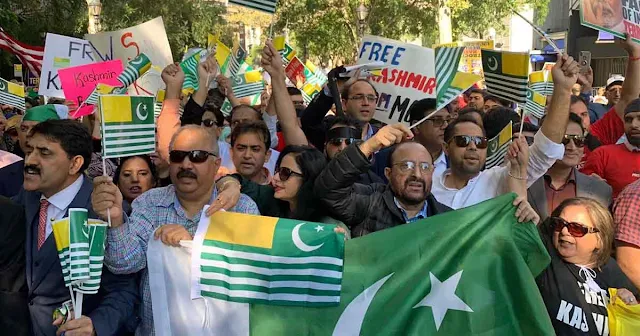
A Pakistan-backed Kashmiri diaspora group based in the US is terribly perturbed. Calling itself World Kashmir Awareness Forum, its general secretary Dr Ghulam Nabi Fai, a controversial figure who was sentenced to two years’ prison for working as an agent of the Pakistan government in the US without disclosing his affiliation, has sharply criticised the US administration for maintaining a "largely leave-it-alone posture" towards the Kashmiri problem.
Speaking at a Islamic union conference in Istanbul, Dr Fai said, the US posture as that of other western powers have failed to stop hostilities on Kashmir with the conflict remaining "unresolved", leading to a "colossal waste of an arms race" between India and Pakistan, with the alleged potential of putting at stake the fate of "1.5 billion people of South Asia which is one fifth of total human race." The conference where he spoke was organised, among others, by the Pakistan Centre for Aerospace and Security Studies (CASS).
Suggesting how the US has changed its stance, Dr Fai said, in 1947-48, it championed the stand that the future status of Kashmir must be ascertained in accordance with the wishes and aspirations of the people of the territory while sponsoring of the resolution #47 which was adopted by the UN Security Council on April 21, 1948.
He claimed, there was now a "misplaced focus of the world powers including the US on the wrong-headed talk about the 'sanctity' of the line of control in Kashmir", adding, "It is forgotten that this line continues to exist only because the international agreements which had been concluded between India and Pakistan, with the full support of the US."
Calling the line of control "temporary" pending the demilitarization of Jammu and Kashmir, and advocating the holding of a plebiscite under "impartial" observers to determine its future, he insisted, "Any kind of agreement procured to that end, whether by the US or under its influence, will not only not endure; it will invite resentment and revolt against whichever leadership in Kashmir will sponsor or subscribe to it."
Dr Fai wondered, “What should be the procedure for putting the Kashmir dispute on the road to a settlement? For the US to do so by itself would be to arouse undue suspicion as though it has its own axe to grind. The better way would be that US asks the Secretary General of the United Nations, with the concurrence of the Security Council, to engage itself."
Comments