 |
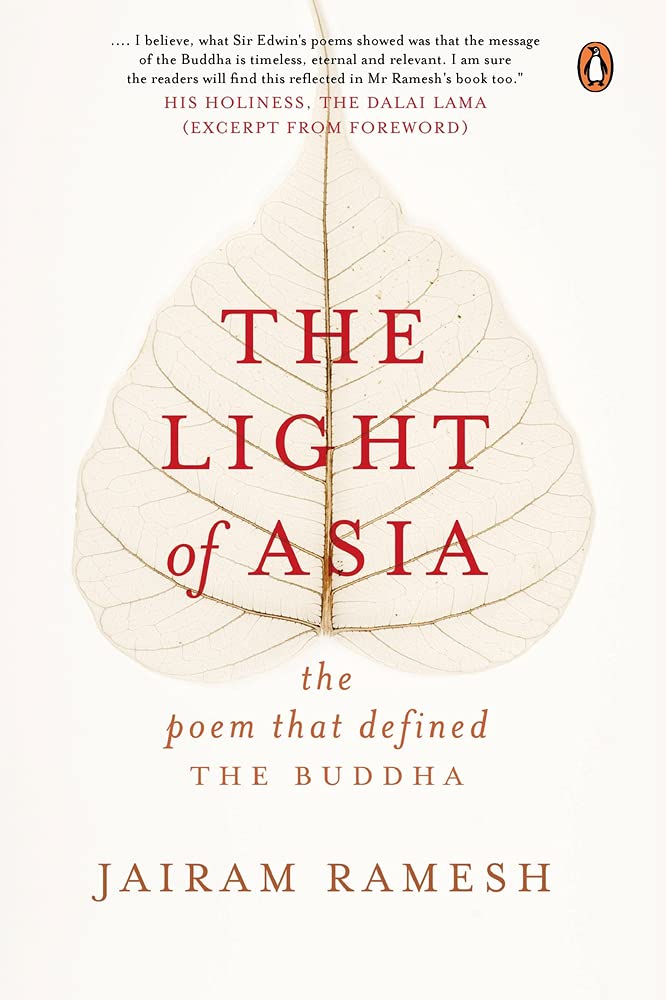
Book “The Light of Asia: The Poem that Defined the Buddha” is a compelling and comprehensive account of the epic poem of the same name authored by Sir Edwin Arnold that was first published in 1879. The book goes into intricate detail to unearth the nuances present in one of the richest narrative poems ever written.
A book discussion on, ‘The Light of Asia: The Poem that Defined The Buddha’, a narrative of the life and message of the Buddha was organized on the 7th of October by the Center for Human Dignity and Development at the Impact and Policy Research Institute (IMPRI), New Delhi.
The distinguished panelists included the Author and Speaker Jairam Ramesh, Member of Parliament, Rajya Sabha (Karnataka); Author and Former Union Minister, Prof Tansen Sen, Professor of History, Director, Center for Global Asia, NYU Shanghai; Global Network Professor, NYU, Prof Wasantha Seneviratne, Professor and Head, Department of Public and International Law, Faculty of Law, University of Colombo, Sri Lanka and the moderator Prof Amita Singh, President, NAPSIPAG Disaster Research Group; Professor (Retd.), Jawaharlal Nehru University (JNU), New Delhi; and Prof Kancha Ilaiah Shepherd; Former Director, Centre for the Study of Social Exclusion and Inclusive Policy, Maulana Azad National Urdu University, Hyderabad.
Re-illumines Edwin Arnold’s epic poem
The moderator of the session Prof Amita Singh initiated the discussion by stating that ‘The Light of Asia: The Poem that Defined The Buddha’, covers a wide range of issues including the colonial and caste segregated society which is the inception for the light of Asia and the evolution of academic institutions, the monopoly of the cast over the right of others.Buddha Lies in Every Indian Heart
Talking about the inspiration for the book Jairam Ramesh stated that it was a fascination with the life of the Buddha-like every Indian irrespective of their religious affiliation and the cause behind the poem going viral during 1879. Alongside the personality of the poet, Sir Edwin Arnold who despite being a traditional British was inspired by the works of Indian Philosophers also inspired Ramesh to comprehend the poem better.
Believing in the universality of religions, Sir Edwin Arnold translated other texts into English and enhanced the reach of philosophies despite being an agnostic. Jairam Ramesh further goes on to state that the poem by Arnold talks not about the divinity of Buddha but his humanity which gave the poem an extraordinary appeal, not just to the English but Mohandas Karamchand Gandhi, Rabindranath Tagore, and other leaders alike. And given that India is a divinity surplus humanity deficit country, the impact of the poem becomes all the more important.
“The Life of the Buddha, was an inspiration to many including the anti-caste movements led by B R Ambedkar, Swami Vivekananda”, he said.
Prof Amita stated that the last part of the book takes us to the important point of Hinduism–Buddhism interface and its effect on each other. Though Hinduism eventually managed to assimilate Buddhism into its fold by tactfully recognizing Buddha as an avatar of Vishnu, Hinduism, too, was not the same again as many of the doctrines of Buddhism like ahimsa, vegetarianism, emphasis on inner realization, ethical living, and equality of all human beings became an integral part of Indian society which are cherished even today.
A worthy contribution to modern Buddhist studies
Prof Tansen Sen, Professor of History, Director, Center for Global Asia, NYU Shanghai, addressed the audience by emphasizing about three things, being, the social impact of translations, the impact of networks and connections that Arnold had, the impact of the period during which the poem was written and its translations.Delving deeper into the discussion, Prof Sen enquired about why the translations had a greater social impact than the English original in India. To this, Jairam Ramesh replies by stating that the Indian languages did not have biographies of Buddha before this, the English version would have been popular only amongst the Bengali and Tamil Brahmins but with translations, the reach widens and these translations eventually became tools in the hands of social reformers which enhanced the social impact of translations as compared to the English version. Alongside there was a political agenda behind these translations, to challenge the Brahmanical orthodoxy.
He further highlighted that an aspect which has been well highlighted by the author is about the issue of the control of the Mahabodhi temple in Bodh Gaya which was with the Hindu mahants. It was the dogged persistence of Arnold, who was one of the first to raise the issue with his fellow Englishmen in power, that eventually culminated in the mahants’ partial sharing of responsibilities with Buddhists in 1954.
Links life of Buddha with the contemporary world
Prof Wasantha Seneviratne, Professor, and Head of, Department of Public and International Law, Faculty of Law, University of Colombo, Sri Lanka, remarked that the book is enlightening and intricately links the life of the Lord Buddha with the contemporary world. Responding to this Jairam Ramesh stated that Sri Lanka plays a major role in the revival of Buddhism and the philosophies of Buddha as it withheld sources used by scholars alike to understand Buddhism.Prof Kancha stated a perspective that Arnold’s poem and Ashvaghosha “Buddhacharita” are very similar to each other. He underlines that in Arnold’s poem Buddha is not a tribal but a fully Kshatriya prince like Rama. He questions the reaction of Arnold’s poem in English or translations to Hindu icon communities. Responding Shri Jairam said that the poem had a huge impact on swami Vivekananda and he describes the poem as a tribute of advaitik Hinduism.
Dr Kokila agreed with Jairam Naresh’s effort of highlighting the humanity part of Buddhism and states that Buddhism is daily basis practice of life. In her opinion Lord Buddha was a rebellion who went against all the conventional traditional and beliefs. She further commented that anyone can be Buddhist despite their belief in God.
Conclusion
Prof Singh summed up the entire book by stating, “teaching how fair this earth would be if all living beings were linked bloodless and pure, the golden grain bright fruits seeing that knowledge grows life is one and mercy committed to the merciful”.Jairam Ramesh concludes by urging Indians to give up their obsession with divinity and discover the roots of humanity which are to be sought in the life of the buddha. He also reiterated that he is unsure if Buddhism is the answer to today’s world but to him, Buddha is the answer.
“Let’s give up our obsession of divinity and discover the roots of Humanity, the roots of Humanity are sought in the life of the Buddha”, says Jairam Naresh.
—
Acknowledgment: Srimedha Bandi, Research intern at IMPRI
Comments