
Elementary education a fundamental right? Not in this Jharkhand village

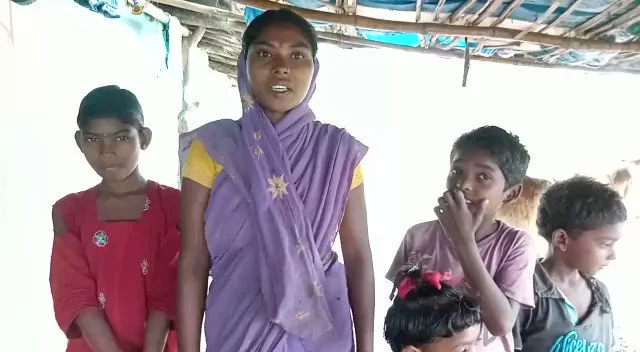
Nemi Devi
Freelance scholars and student volunteers interested in action-oriented research, socio-economic rights and related issues have carried out a survey on primary school children in a village in Jharkhand. A small writeup based on Road Scholarz’s twitter thread:
***
We did a house-to-house survey of primary-school children in Dumbi, a fairly typical Dalit-Adivasi hamlet of Jharkhand. Out of 36 children, 30 could not read a single word. Many parents feel that their children are lapsing into illiteracy. Nemi Devi explains.
Online learning is a fiction in Dumbi. With the village closed in the last 16 months, primary education is at a standstill. Most children are just milling around, some are working in the fields.
Kusmi Devi
In almost every house there was a sad story of poor parents who are struggling to educate their children, but most have no smartphone and no money for tuitions. Kusmi Devi, mother of 4 illiterate children, explains.
One of Kusmi’s daughters, Chandni, is in Class 5. She is unable to read a single word in hindi but she is expected to read this thick English textbook, with sentences like “gravity speeds up communication means, it also explains why Pisa leans”.
Even in the few houses of Dumbi where there is a smartphone, it is rarely used for online studying. Children easily get side-tracked – here in a game of Ludo.
Bottom line: every single parent in Dumbi wants the local school to re-open as soon as possible. Who would guess that elementary education is a fundamental right in India?

Comments

TRENDING

Neville Cardus: The man who turned cricket writing into poetry

By Harsh Thakor*  Neville Cardus was one of the most remarkable literary figures of the twentieth century. A prolific English writer and critic, he achieved distinction in two vastly different fields: cricket and classical music. Entirely self-taught, Cardus rose from humble beginnings to become both the cricket correspondent and chief music critic of The Manchester Guardian . His achievements in these contrasting disciplines earned him widespread acclaim and established him as one of the foremost critics of his generation. In February 2025, the cricketing and literary world marked the fiftieth anniversary of his death, which occurred in February 1975.

​Ideological shifts and structural realities within India's left-wing insurgency

​By Harsh Thakor*  The Maoist insurgency in India is arguably at its weakest point since the formation of the Communist Party of India (Maoist) in 2004. Years of sustained counterinsurgency operations, leadership losses, shrinking territorial influence, declining recruitment, and growing technological advantages enjoyed by the state have significantly eroded the movement's operational capabilities. 

The Dalit body on screen: Stereotypes, sacrifice, and subjugation in Hindi films

By Dr. Prem Singh*  Despite centuries of reformist efforts, from Gandhi and Ambedkar to contemporary activists, the caste system remains deeply embedded in the Indian psyche. One of the primary reasons for this persistence is the religious sanction provided by Brahminical scriptures, which have shaped not only social structures but also cultural and artistic expressions.