By Harsh Thakor*
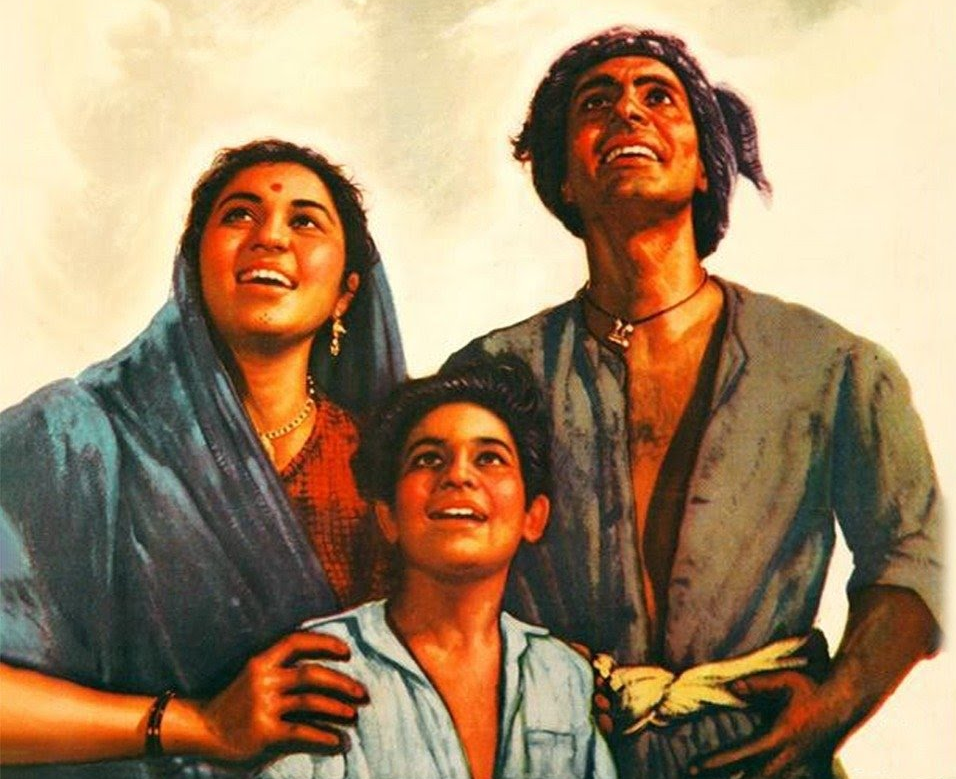
To me ‘Do Bigha Zameen’ is the best movie ever made in India and the most relevant even today. In a most artistic manner it reveals the oppression of feudalism or capitalism, brilliantly weaving a set of characters into a plot. The film contains no element of melodrama or fantasy but still hits the core of your soul. Enacting character of Shambu Mahato Balraj Sahni is so much in the skin of the character that you feel he is the actual person. No film has portrayed Indian social reality in such depth and how socio-economic conditions shape the life of a family. I praise the movie portraying how peasants were compelled to work in the cities which is a predominant feature today in India and the third world. India today has lakhs of migrant labour swapping role in working in fields and factories
Today feudalism in India is rampant in another form .Peasants are not directly subordinated to the landlords but still they often are forced to mortgage their land at ten times less than the price value or auctioned land at unaffordable rates. Caste polarization has been further accentuated. In cities globalization has caused massive retrenchment and forced many workers to return to their villages. Seizure of land by big corporates has become a routine affair, with the ruling party literally sponsoring them. Even in states like Punjab and Haryana commission agents operate. There is hardly any implementation of the land ceilings act preventing any farmer from owning more than 30 acres. Nor has the declaration awarding 1/3rd panchayat land to dalits been implement. Unemployment, price rise or inflation has reached a magnitude as never before. The nation has witnessed over ten lakh suicides because of farmers unable to repay interest on loans. We may boast of cyber cafes in rural areas but still there is insufficient drinking water.. In the age with globalisation thriving gloss and glamour is virtually the only trend in the film industry. Lakhs of people still are denied adequate food shelter, medicine or literacy. Morally all the hits of last 30 years have glorified affluence ,relegating poverty or social reality into the oblivion.
Today the people of India or the world are literally given a most distorted image by the Bollywood of India as though the nation is rolling or flourishing in wealth or prosperity. The films glorify the development but throw no light on the untold disparity or unevenness of growth.
The character of Shambu Mahato depicts the struggle to confront the waves unleashed by the tyranny of landlordism. To pay his interest he goes to the extent of pulling a rickshaw. The film portrays brilliant character child roles reflecting the social values prevailing .Shabu Mahato’s son brilliantly enacts the role symbolising a child in a peasant family. The expressions of hope and despair on the face of Shabu Mahato are like the contrast between a hot summer day and a snowy winter day. The intensity on his face tell it all whether when pleading with his landlord, pulling a rickshaw, scolding and pleading for mercy with his son, or of hearing his court sentence. It was virtually the face of the pauperised people of India.
The theme of the story is how Shambu Mahato is indebted to Thakur Harnam Singh for a prolonged period. Harnam Singh offers Shambu a price to sell his land to relies his debts but he refuses because the tow bighas of land are his only source of living. Later Shambu is tormented by Harnam and even duped with the his debt magnified in herculean proportions by five times its actual level..Circumstances force Shabu to migrate to Calcutta with his son where he pulls a rickshaw and his son polishes shoes. The scenes when his son literally sells himself for the sake of his father’s survival embezzles in the heart of any sensitive person. Ironically he even resorts to stealing. To earn he is compelled to chase another rickshaw of a colleague when sadly the wheel collapses in the penultimate stages.. Sadly his wife falls ill which forces Shambu to use all his earnings to save her. Satirically on the verge of his mother dying he claims it is a retribution for his wrong deeds.
Back to the village the land is auctioned because Shambu could not pay back the debt and father Gangu becomes insane. The land, now owned by Harman Singh, sees the beginning of mill construction. Shambu and his family return to the village, only to see their land sold and a factory being constructed on it. He then tries to get a handful of dirt (soil) from his land but is stopped by a strongman (security guard). The film ends as Shambu and his family walk away from their former land.
Few movies ever had better scene dissection and direction or a more coherent plot to convey a message. With touches of genius he has woven a plot to illustrate the theme. Bimal Roy must be saluted for this masterpiece which pioneered the cause of championing the rural people. No Movie has ever been a more honest portrayal of the social reality of India. It is praiseworthy that it has nothing in common with European cinema and purely an Indian design. No doubt it has shades of ‘The Bicycle thief’ in the father-child scenes.
Balraj Sahni’s acting performance arguably surpassed that of anyone enacting a common man. It was as natural as water sparking in a stream or a rose blooming. He illustrated that art belonged to the common man and that art reached it’s zenith only when relating to social reality. The expressions of Balraj Sahni defined the character of a peasant in every respect. I doubt there has ever been a more clinical or artistic performance by an actor portraying a peasant, immersing in the very skin of the character. The classic rickshaw pullers race is a symbol of how even an honest man selling his labour could be de-humanised. No actor mastered the art of neo-realistic acting like Balraj Sahni who gave similar performances in K.A .Abbas’s ‘Dharti ke Lal’.Balraj ‘s genius gave a 360 degree somersault to the aristocratic stage acting ,taking feature of simplicity to region snot traversed. The very mannerisms and gestures of a suffering peasant wee portrayed, in accordance to circumstances faced. I cannot conceive a film which is also ends so artistically or poignantly with the faces literally telling the story.Projecting Scene of Balraj Sahni even refused to carry a handful of dirt from the soil is artistic genius personified.
Child artist Rattan Kumar as Kanhaiya is brilliant immersing into the very heart of the grave situations and taking realism to its ultimate dimension. His chemistry with his father has most touching effects .His scene of redemption or retribution with his mother on the verge of dying is one of the finest acting displays by a child artist in Indian films. Even Jagdeep as a child artist enacting role of a shoeshine boy as Laloo Ustad gives great flavour to the plot.Nirupa Roy depicts untold sensitivity in her expressions. The scene when she thwarts the bid of a man from taking her into captivity to rape her is heart touching as well as her working on a construction site and hearing the depressing news of her husband’s accident.
Today the people of India or the world are literally given a most distorted image by the Bollywood films of India as though the nation is rolling or flourishing in wealth or prosperity. The films glorify the development but throw no light on the untold disparity or unevenness of growth. We need to re construct films like this to counter the lies of the social media on the true state of the economy and become a thorn in the flesh to consumerist values or imperialist culture. A film of this type must be re-made in another form. I wonder how a remake of ‘Do Bigha Zameen ‘ could be made in the modern era.To me it would have to project the advent of the computer age or mechanization and place much greater emphasis on the imperialist culture. It would have to convey how robots may take over production, replacing all manual labour.
The movie emulated the Italian neo-realist style. In spite of not incorporating fiction like movies’Awaara’ etc it still was a success. Bimal Roy depicted great mastery of craft in inter-weaving scenes and characters and allowing the audience to remain detached ,rather than getting carried away. Perhaps this film missed out on projecting the resultant class struggle or organized resistance which was a dominant feature in those days in India or could have had a sequel portraying theme of revolt. In many ways the film was reminiscent of movie ‘Bicycle Thief. ‘I strongly feel this movie should have had a sequel or atleast remake inappropriate form in the 1970’s 0r 80’s or later in the era of globalization.
Other films that champion social reality at the highest magnitude and most artistically are Sahib bibi aur Gulam” ,’Paar’ ,’Ankur’ ,’Mirchi Masala’ ,’Ganga Jamuna’ “Awara ‘Jagte Raho’,’ ,’Shri 420’Mother India’, ‘Satya’ ,Mrityudand’ and ‘Boot Polish.’ and ‘Mand
—
*Freelance journalist who has travelled around India
Comments