
When 14 families from areas surrounding Chorbhatti village under Bodla block in Kawardha district of Chhattisgarh decided to settle down at Amlidih hamlet in 2002, their status was slightly better than non-citizens. Devoid of primary documents such as voter identity, ration and job cards, besides land-related papers, the Baiga families, who belong to the Particularly Vulnerable Tribe Groups, neither had access to government schemes nor did they possess any rights. They eked out a living from ‘nature’s gifts’ they collected from a nearby forest.
It took 12 years before 40-year-old Asdu Singh Baiga and his family could assert some degree of rights and entitlements thanks to the intervention by Samerth Trust, an Ahmedabad-based NGO which started its activities in Chhattisgarh as far back as 2006. Samerth took up a host of projects, each tied to the other, but primarily focused on access to water. “We believed at the time that access to water often opens up avenues to attaining and accessing other entitlements,” Samerth’s senior team member, Mr Iqbal Baig said.
Since intervening in Chorbhatti village, Samerth sought to adopt a five-pronged approach that would go a long way in ameliorating the lot of the Baigas: a) cooperative efforts with the Baigas to identify their problems, b) organised mini gram sabhas (village councils) to highlight and inform the target community about the various government schemes, c) approached the Public Information Centres to make available application forms to the Baigas, d) cooperative efforts were established with the local administration to draw up a plan to address the problems faced by the community, and e) opened up and built ties with officials of the government departments concerned.
The initial results bore fruit: All the 14 families at Amlidihod Bolda block of Kwardha district were able to obtain primary documents. This, needless to say, had a positive impact on Asdu who left his former village, Bokkarkhar, to settle at Amlidih hamlet. Besides, his given possession of 4.5 acres of land which subsequently yielded 10 quintal rice. Over time, he also came in rightful possession of the other vital documents.
Four years after Samerth’s successful intervention in Chorbhatti and other villages with the support from Arghyam Trust, Bangalore, Frank Water, UK and India Development Relief Fund, USA, the organisation has spread its wings in other parts of Kawardha where a substantial section of the population, mostly tribals, live on the margins.

Samerth, which had dug roots in Bodla a few years earlier and was pursuing water conservation work, had by this time expanded across several gram panchayats — 50 in Bodla and 15 in Pandariya blocks, covering 15,000 households. Samerth has been working on watershed and INRM-based work in coordination with the state government’s MGNREGA Cell and allied departments, leveraging various schemes for promoting livelihood activities with existing self-help groups (SHGs). These are primarily related to farm and non-farm-based activities, since Bodla and Pandariya are essentially tribal-dominated blocks, and Samerth has been facilitating more on agriculture, NTPF collection, fishery, poultry, goatry and piggery for sustainable livelihood.
The progamme’s execution started with the baseline of the selected gram panchayat households and sought to orient community members between panchayati raj institutions (PRIs) and SHGs with watershed principles, integrated natural resource management (INRM), fame and non-farm-based livelihood activities so they could double their income and raise their socio-economic status. Participatory rural appraisal (PRA) was conducted, followed by transact walk along with the community members, besides preparing social, resource and existing and proposed activity maps.
At the same time, Geographical Information System-based planning was conducted along with community members preparing GIS-based Detail Project Reports (DPRs) of all 65 selected gram panchayats. In accordance with Samerth’s proposed work plan of all gram panchayats, a resolution was passed by the gram panchayat for sanctioning of plan janpath and zila panchayat. In 2019-2020, two check/stop dams, 12 community ponds, 108 farm ponds, 121 wells, 511 land levelling and farm bunding and 34 30*40 model proposed plan was sanctioned and implemented, leveraging an amount of Rs 14 crore.
After the execution of the proposed structures of the household, a livelihood intervention plan was prepared for both farm and non-farm-based livelihoods under the leadership of Dr Manjeet Kaur Bal, head of the Samerth Chhattisgarh programmes. In relation to farm-based livelihood, the focus has been more on kharif agriculture interventions aimed at encouraging the community members to adopt improved cultivation practices such as seed selection, seed treatment, raised nursery bed preparation, transplantation of paddy, line sowing, use of paddy weeder, preparing organic fertiliser and pesticides etc.
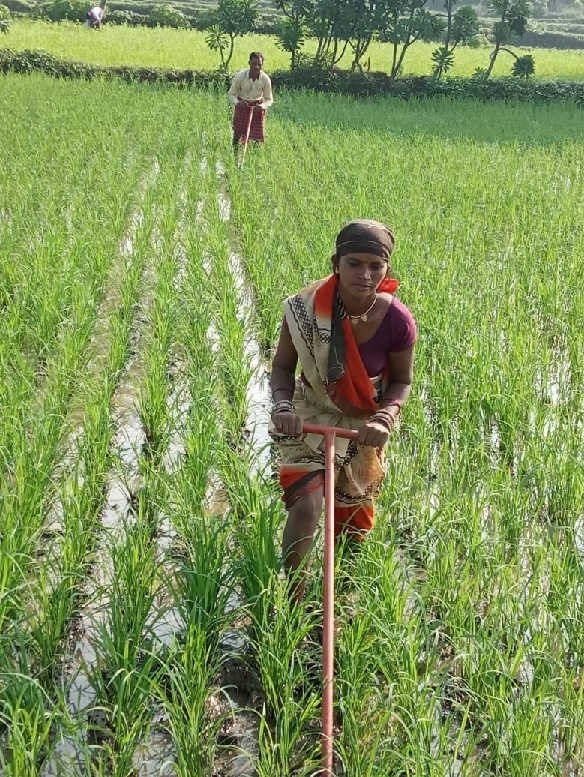 |
Samerth is working intensively with 1,500 households (HHs) under agriculture interventions covering nine gram panchayats and 30 villages. More than 1,000 HHs have been diverted from broadcasting to transplanting paddy with 100 HHs paddy sown in line, maintaining proper spacing. Nearly 100 demonstrations were done on vegetables such as brinjal, cauliflower, tomato, bitter gourd, long beans, bottle gourd, chilli etc. Besides, ‘machan kheti’ was promoted on vegetable crops, including 45 machans related to bitter gourd, tomatoes and beans were demonstrated.
In non-farm-based livelihood activities, Samerth has been promoting piggery, goatry, backyard poultry and fishery for the targeted tribal community. This covers 377 HHs non-farm-based livelihood activities — 67 HHs piggery, 105 HHs poultry, 29 HHs goatry and 176 HHs fishery.
A major aim has been achieving capacity building of the team and active SHG leaders, especially on their habitat, feed and disease management so that livelihood management acts as an additional income for the families. Liaisoning with veterinary and fishery department for availing different scheme benefits for the tribal community and assisting the Krishi Vigyan Kendra for training the staff and farmers by providing all technical guidance related to agriculture farming and allied activities are also being duly undertaken.
An initiative has been taken to revive indigenous seeds in villages at two clusters. A ‘seed bank’ was established at Shivnikala and Chorbhatti gram panchayats, after organising a cluster level meeting with GP, SHG, farmer field school (FFS) and producer group (PG) members. It was proposed that an old vacant building of the gram panchayat be procured for storing indigenous paddy seeds. A management committee for the seed bank was formed during the meeting and a member each from the gram panchayats of the cluster was selected. We went a step further by proceeding with the registration of the management committee and opening a bank account since it would be a registered entity supplying indigenous seeds in the rural areas.
Samerth has been promoting ‘Organic Farming and Indigenous Seeds’ so that farmers grow local varieties or cereals, pulses, oil seeds and vegetables. The seed bank’s management committee will be responsible for procuring and distributing the indigenous seeds among farmers and facilitating them to grow and expand the area, besides becoming self-sufficient in supplying indigenous seeds.
Apart from the seed bank, Samerth has introduced a tool bank in two clusters of its project area. Its concepts are the same as that of the seed bank. All basic tools such as paddy weeder, motor pumps, irrigation pipes, sprayers were stored and supplied to farmers as and when they required these. While proper registers were maintained by the committee, subsequently it was decided that a small fee would be charged for supplying the tools to the farmers. This would help in maintaining the seed and tool banks, leaving the committee to be financially strong enough to run both banks.
Input support provided to poor and vulnerable families for cropping season: Under this intervention Samerth has selected 143 households who will do intensively paddy cultivation through improved methods such as seed selection, seed treatment, nursery development, transplanting, line sowing and use of paddy weeder. Samerth has purchased 3 tonnes of certified paddy seed (MTU-1010) from Beej Nigam Ltd, Kawardha, and distributed it among 143 households (20 kg per HH). Besides, support has been provided to all selected paddy farmers for land preparation and 20 paddy weeders have been arranged, though these will be kept in the tool bank and given to beneficiaries according to their requirement, through the seed and tool bank committees. Two electric motor pumps, two bundles of extension wire and four bundles of irrigation pipes have also been provided. Samerth has encouraged the families to go for transplanted paddy to increase production as well as income so that the financial status of the families improves substantially.
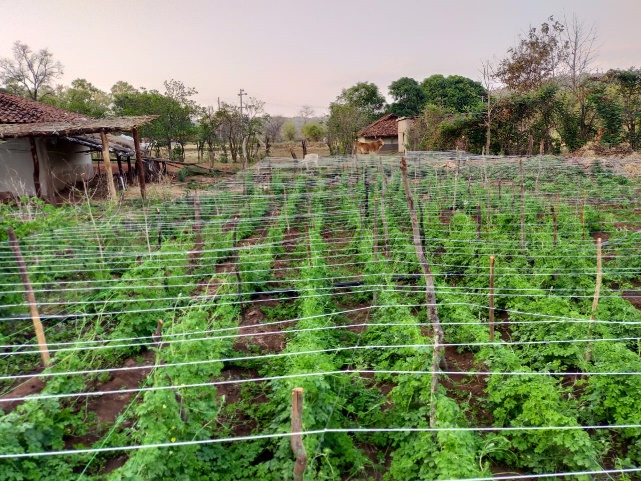
We have identified two clusters within our kharif intervention area, where we have mobilised families for vegetable cultivation and fruit crops near bunds. Both the clusters are situated on two sides of the stream banks. At Bahanakhodra cluster, watershed-based planning has been completed whereas at Chorbhatti cluster patch survey has been done and file preparation for technical sanctions has already started. While most of the families are migrant workers and moved to nearby sugarcane farms for labour once the kharif season was over, they reported that following Samerth’s intervention they would prefer to work on their own fields for all the seasons and influence the rest of the community against seasonal and annual migration. We are also encouraging planting fruit crops such as mango, drumsticks and other indigenous fruits for additional nutrient supplements and income.
Our beneficiaries have very small land holdings and grow vegetables nearby homes (kitchen gardens) only for personal consumption. Very few farmers sell at the local market. Once personal consumption is taken care of, the surplus produce is taken to the market to be sold. The income thus generated is used for purchasing items of daily needs. Samerth is promoting machan kheti for creeper variety of vegetables so that production goes up and beneficiaries get maximum benefit. Plans are also afoot to form two ‘Model Vegetable Clusters’ where only vegetables will be grown.
Input support provided for cultivation of short duration food crop like – vegetable, maize and millets: In this intervention we have focused on pulses, vegetables, maize and minor millets(kutki). These methods will increase production, reduce insects, pests and diseases infestation and increase the income of the poor farmers. Within 10 selected gram panchayats 130 HH were identified for such short duration cash crop interventions. To ensure good production, selected beneficiaries were provided with vermi-compost, tricoderma, good quality seeds of vegetables, pulses, maize and minor millets. A total of 130 HH were involved in vegetable, arhar, maize and kutki cultivation under this short duration intervention. As many as 35 HH of nine villages were involved in arhar cultivation over 55 acres land, 40 HH of 10 villages were engaged in maize cultivation over 59 acres land, 42 HH of nine villages were ready to grow vegetables over 50 acres and only 13 HH of eight villages chose minor millets (kutki) over 25 acres. All selected households are poor migrant labours of Bodla block. Hand-holding support was provided to these migrant workers who had returned from nearby block and district.

Support provided to the migrant families for alternative livelihoods – livestock and Non Timber Forest Produce (NTFP): In this intervention we selected only migrant workers without any land ownership. We sought to target 100 households but found that of a total of 400 HHs, 127 were landless. We therefore took all the 127 HHs under this intervention for alternative livelihood options involving livestock only. The Baiga and Gond tribal communities inhabit this area and rear pigs, backyard poultry and goats. Samerth therefore distributed livestock to all the selected landless migrant labourers according to their choice or interest in rearing. NTFP produce was collected but in lesser quantity meant for the local market. Since the Baigas and the Gonds have no cultivable agricultural land, they work on other farms as labour during this season before migrating to nearby areas of the district in search of other means of income.
Samerth distributed 1,200 chicks to 55 households with each family given 21 chicks, 110 piglets to 43 HHs in the ratio of 1:2 (male:female) or 1:1 (male:female). Some families who had the capacity to manage three piglets were given as many while others were given two. Seventy goat kids were distributed among 29 households in the ratio of 1:2 (male:female) or 1:1 (male:female) according to the necessity of the families in eight villages. This apart, networking with government veterinary department and private agencies for vaccination and livestock training by our pasu sakhis (veterinary nurse) has been down so that timely vaccination can be ensured for all the distributed livestock.
Promoting Women SHG on Pisciculture for Sustainable Livelihood Options: Pisciculture is being practiced for a long time by a specific category of people belonging to the Kewat caste (fishing community). In July 2020, Samerth initiated fish rearing. For this purpose, 19 SHGs (14 men and 5 women) and 24 individuals farmers, covering 252 HHs, were selected for fish rearing at the village and individual ponds. The community took the village pond on lease with permission of the gram panchayat which laid down certain rules and regulations. In some cases, a gram panchayat collected contributions from all households and let the fish eggs into the pond before harvesting the fish and distributing them equally among the families which had made the initial monetary contribution. Suffice it to say that pisciculture interventions are mainly done by men and not the womenfolk but Samerth is mobilising women SHGs as a source of income in addition to agriculture and livestock farming for sustainable livelihoods.
All the SHGs entered into a seven-year agreement with the gram panchayat for fish rearing at the pond maintained by the gram panchayat. The yearly tax would be paid to the gram panchayat. The fisheries department is playing an important role in establishing a ‘Model SHG for Fish Rearing’ in Samerth’s project area. At the same time, capacity-building of the SHG members is being done by organising SHG level meetings and they are being taken for visits at the fishery department hatchery.
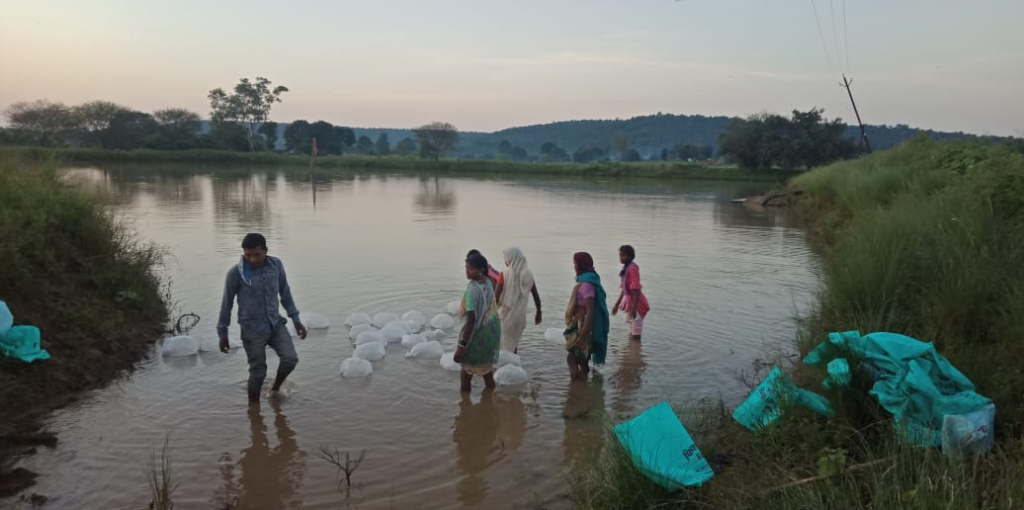
As much as 231 kg fish eggs (fingerling size) was purchased from the hatchery. However, only 32 kid fish egg is being provided to SHGs through Samerth’s project fund, while the remaining 199 kg is self-purchased by SHG members. In one pond, 12 kg fish seed containing 4,200 to 4,800 fingerlings (1 kg contains 350-400 fingerlings) was released into the pond. All preventive measures such sprinkling 10-20 kg of lime (which destroys insects) were taken before releasing the fish seeds into the pond. Three varieties of fish seed, belonging to the katla, rohu, mirgel families, were provided since each has different characteristics and they don’t harm each other. Most of the natural feeds such as cow dung, rice bran, mustard and groundnut cake are available at home. Azolla is one of the most important feed for fish as it contains 25-30 percent protein which helps in fast growth. As many as 30 pits have been formed by SHG members, at their own cost and by their labour, for Azolla production and its feeding to fish.
Fishery department officials have been extremely cooperative and continue to guide the SHG members for proper management of the fish. Insurance cover for accidents, Kisan Credit Cards for pisciculture, training and exposure visits for SHGs are organised free of cost. Even as the SHG members experienced pisciculture for the first time, they have shown high levels of interest in this additional means of income.
Key Learnings: a) Working through networking, b) Liaisoning and coordination with government department, c) Adopting new technology for communication and d) Understanding the process of mitigating migration.
Samerth could facilitate support the families to avail entitlements announced by the government. In the process of our work Samerth has leveraged Rs 14 crores worth government programmes from various rural departments of the state for the communities.
—
*Gazala Paul is the founder and executive director, Pankaj Mishra is the programme coordinator based at Kwardha district of Chhattisgarh with Samerth Charitable Trust. For more information visit us at: www.samerth.org
Comments