
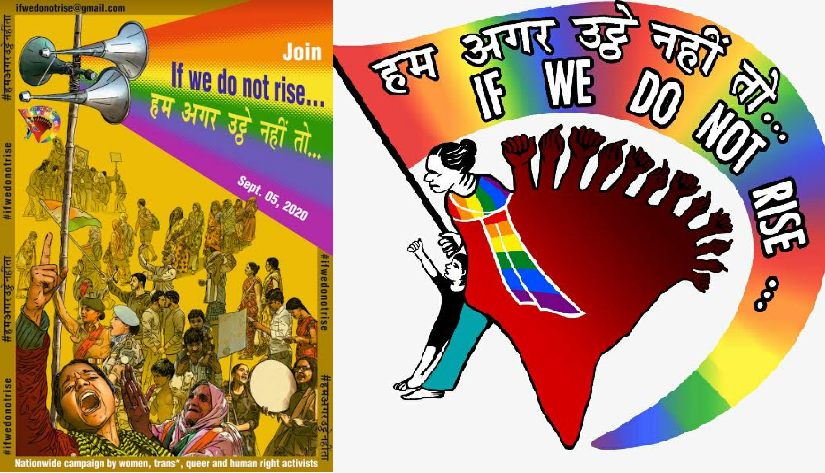
More than 400 gender rights groups and human rights organisations across the country have announced Hum agar uthhe nahin toh… (If we do not rise…) campaign on September 5, 2020, marking the third anniversary of the assassination of journalist-activist Gauri Lankesh. “The campaign is aimed at uniting voices against targeted attacks on the constitutional rights of the people of India”, a joint statement issued by them said.
The statement regrets, while undermining democratic institutions, including the judiciary, the Government of India is turning the Covid- 19 crisis into an “opportunity” to further “dilute and destroy laws protecting hard won workers’ rights”, is “busy” privatising public sector units that belong to India’s people, and is seeking to “destroy” the Environmental Impact Assessment processes thereby facilitating “plunder” of natural resources.
The statement regrets, while undermining democratic institutions, including the judiciary, the Government of India is turning the Covid- 19 crisis into an “opportunity” to further “dilute and destroy laws protecting hard won workers’ rights”, is “busy” privatising public sector units that belong to India’s people, and is seeking to “destroy” the Environmental Impact Assessment processes thereby facilitating “plunder” of natural resources.
Text:
India’s democracy and Constitution are facing an unprecedented crisis. The last few years have seen a collapse of democratic institutions in the country. The independence of the judiciary and other institutions of oversight has come under a serious cloud and the functioning of the Parliament has been gravely compromised.The government has institutionalised corruption and lack of transparency in election funding with the system of Electoral Bonds, which allows corporations to surreptitiously divert black money to the coffers of the ruling party. The dilution of the Right to Information Act has hit at the fundamental democratic right of citizens to question the government and hold it accountable.
The growth of fascist and neo-liberal forces in the country, and the resulting rise in violence in society, has deeply impacted the lives of women and members of the LGBTQIA communities. Attacks on religious minorities have created an atmosphere of fear and insecurity. The country has witnessed a systematic attempt to spread communal hatred and divide people on religious lines.
The growth of fascist and neo-liberal forces in the country, and the resulting rise in violence in society, has deeply impacted the lives of women and members of the LGBTQIA communities. Attacks on religious minorities have created an atmosphere of fear and insecurity. The country has witnessed a systematic attempt to spread communal hatred and divide people on religious lines.
The Citizenship Amendment Act (CAA) pushed through Parliament by the government, together with the National Register of Citizens (NRC) and National Population Register (NPR), destroys the secular fabric of India’s Constitution by making religion a basis for giving Indian citizenship. People all over India rose up in a peaceful and unique, women led movement to protect the Constitution. Unfortunately, targeted communal violence was unleashed in response to the movement. Instead of arresting leaders who made hate speeches inciting violence, the women and people who worked for unity, peace and the Constitution are being arrested and incarcerated.
In August 2019, the Government assaulted India’s Constitution and federalism by abrogating Article 370 and destroying the statehood of Jammu & Kashmir. The internet has not been restored even one year on; there is a complete clampdown on speech and democracy, and Kashmiri political prisoners are incarcerated in jails all over India without trial, and even former Chief Ministers are being held in house arrest. More recently, the Government has amended the region’s domicile law.
The last few years, have witnessed a frontal attack on the freedom of expression guaranteed by the Constitution – the right to dress, speak, write, eat and choose one’s religion– which has impacted women and the LGBTQIA communities disproportionately. Voices of dissent have been systematically silenced and labelled anti-national.
In August 2019, the Government assaulted India’s Constitution and federalism by abrogating Article 370 and destroying the statehood of Jammu & Kashmir. The internet has not been restored even one year on; there is a complete clampdown on speech and democracy, and Kashmiri political prisoners are incarcerated in jails all over India without trial, and even former Chief Ministers are being held in house arrest. More recently, the Government has amended the region’s domicile law.
The last few years, have witnessed a frontal attack on the freedom of expression guaranteed by the Constitution – the right to dress, speak, write, eat and choose one’s religion– which has impacted women and the LGBTQIA communities disproportionately. Voices of dissent have been systematically silenced and labelled anti-national.
Activists, journalists and academics engaged in various movements are languishing in jails, without access to the legal provision of bail; and women like Gauri Lankesh have had to pay with her life for exercising the fundamental right to speech and expression. The Unlawful Activities Prevention Act (2019) has been amended and used to implicate dissenters and arrest them.
There has been a steady deterioration in the rule of law with alarming cases of police excesses, including custodial deaths.
Regressive laws like the Transgender Persons (Protection of Rights) Act have adversely impacted the rights of Transgender persons. There are very few provisions in place to protect the safety and rights of the entire LGBTQIA community. There have also been several moves to dilute SC/ST/OBC reservations and the SC/ST Prevention of Atrocities Act.
 Neo-liberal economic policies and growing crony capitalism have adversely impacted women in general, but especially those who belong to the Dalit, Adivasi and other marginalised communities. Their fragile economic base has been devastated.
There has been a steady deterioration in the rule of law with alarming cases of police excesses, including custodial deaths.
Regressive laws like the Transgender Persons (Protection of Rights) Act have adversely impacted the rights of Transgender persons. There are very few provisions in place to protect the safety and rights of the entire LGBTQIA community. There have also been several moves to dilute SC/ST/OBC reservations and the SC/ST Prevention of Atrocities Act.
Covid-19 crisis has been turned into an opportunity by the current regime to dilute and destroy laws protecting hard won workers’ rights
The Covid-19 crisis has further exposed the apathetic and anti-poor nature of the current regime. The unplanned and harsh lockdown imposed to combat the pandemic resulted in economic devastation. It meant instant cessation of all income earning opportunities for millions leading to unemployment, hunger and destitution among the working poor, especially migrant workers. Heart-rending reports and images of migrants walking for hundreds of kilometers, often carrying children came to characterize the lockdown.
India’s economy was already struggling to recover from the demonetisation disaster and the country was facing the worst unemployment crisis in 45 years. The lockdown has pushed the crisis to catastrophic proportions. The pandemic has also exposed the dismal state of the country’s public health system. Gender based violence and caste-based atrocities against Dalits have risen sharply during the lockdown.
The Covid-19 crisis has been turned into an opportunity by the current regime to dilute and destroy laws protecting hard won workers’ rights. At a time when the pandemic prevents people from protesting in large numbers, the Government is busy privatising public sector units that belong to India’s people, and seeking to destroy the Environmental Impact Assessment processes thereby facilitating plunder of our rivers, forests and land and at the same time proposing adverse changes to agrarian policies.
The New Education Policy is riddled with several problems - it seeks to ensure greater centralisation, communalisation and commercialisation of the education system. There have been moves to dilute laws to protect women in the name of mitigating Covid-19 revealing the anti-women attitude of the regime.
Women and LGBTQIA persons have been at the forefront of the movement to save India’s Constitution. The Hum agar uthhe nahin toh… “if we do not rise” campaign is an initiative to safeguard constitutional values and principles.
As part of the campaign, thousands of individuals and groups will come together across the country to raise their voices on the issues mentioned both on-line and on the ground. They will:
We appeal to all artists, intellectuals, academicians and concerned citizens to join the campaign on September 5.
We stand together to defend our Constitution and our democracy.
The Covid-19 crisis has been turned into an opportunity by the current regime to dilute and destroy laws protecting hard won workers’ rights. At a time when the pandemic prevents people from protesting in large numbers, the Government is busy privatising public sector units that belong to India’s people, and seeking to destroy the Environmental Impact Assessment processes thereby facilitating plunder of our rivers, forests and land and at the same time proposing adverse changes to agrarian policies.
The New Education Policy is riddled with several problems - it seeks to ensure greater centralisation, communalisation and commercialisation of the education system. There have been moves to dilute laws to protect women in the name of mitigating Covid-19 revealing the anti-women attitude of the regime.
Women and LGBTQIA persons have been at the forefront of the movement to save India’s Constitution. The Hum agar uthhe nahin toh… “if we do not rise” campaign is an initiative to safeguard constitutional values and principles.
As part of the campaign, thousands of individuals and groups will come together across the country to raise their voices on the issues mentioned both on-line and on the ground. They will:
- Make videos of 2-5 minutes which will be shared on various social media platforms
- Do Facebook lives
- Create posters, animation, memes, songs and performances and circulate on the social media
- While observing physical distancing norms, gather in small groups with placards and slogans
- Give memoranda on different issues to local authorities
We appeal to all artists, intellectuals, academicians and concerned citizens to join the campaign on September 5.
We stand together to defend our Constitution and our democracy.
Comments