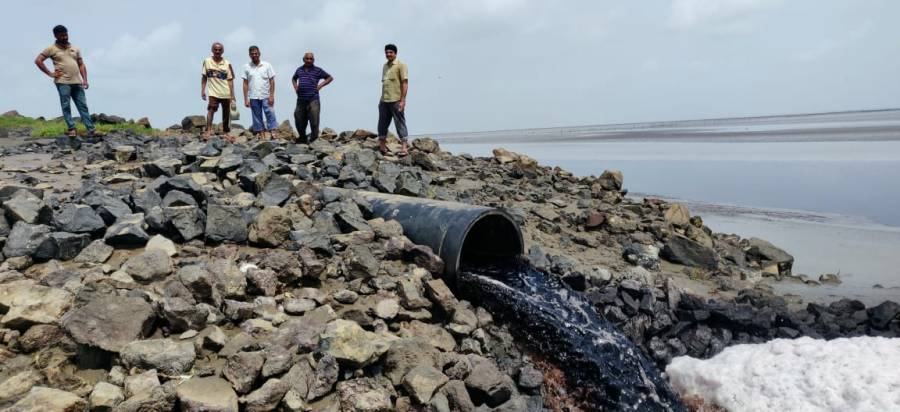
Senior environmental activists Rohit Prajapati and Krishnakant of the Paryavaran Suraksha Samiti, Vadodara, Gujarat, in a letter to the secretary, Ministry of Environment, Forests and Climate Change (MoEFCC), have insisted that concerned authorities should not renew the Consolidated Consent and Authorization (CC&A) dated January 6, 2015 to the Vadodara Enviro Channel Limited’s (VECL), and implement the closure order dated December 13, 2018 of the Gujarat Pollution control Board (GPCB) under section 33 A of the Water (Prevention and Control of Pollution) Act, 1974. Text:
***
The Vadodara Enviro Channel Limited’s (VECL) has continued non-compliance of GPCB’s prescribed norms, terms and conditions of its Consolidated Consent and Authorization (CC&A) dated January 6, 2015 since its inception. It clearly demands that their Consolidated Consent and Authorization (CC&A) needs to be cancelled. A copy of the same is attached herewith.CC&A of VECL clearly mentions:
“…VECL have only one outlet for the discharge of its effluent and no effluent shall be discharged without requisite treatment & without meeting with the GPCB norms.”
If we are not wrong, Satish Panchal, managing director of VECL, openly states that it is not the responsibility of VECL to maintain the prescribed norms at J Point. This means that VECL throughputs whatever that is dumped by polluters, unmonitored.
This means that all the terms and conditions embodied in the environmental clearance granted to VECL by GPCB are conveniently ignored as, perhaps, it is good for their business. There are many more such terms and condition mentioned in CC&A but the concerned authorities have failed to look into the compliance of these. There is no dispute among concerned authorities, industries, and VECL that at J Point of the Effluent Channel of VECL the effluent is consistently not able to meet the prescribed GPCB norms.
Monsoon rains on July 31, 2019 onwards removed the soil above the pipeline of the Effluent Channel Project (ECP) and exposed the reasons for the pipeline leakages underground. Even monsoon rains on August 2 and 3, 2019 were also able to reveal and expose that leakage of pipeline over ground, in last stretch of ECP. VECL’s carelessness has led to filling up of two ponds of Nodhana Village with industrial effluent. Industrial effluent also entered into agriculture land of Uber, Valipur, Nodhana, Samoj, and Sarod villages.
Number of meetings were organised in the presence of the member secretary of the GPCB, the representatives of the industries of the ECP area, and representatives of affected villages and voluntary organisations working in this area on environmental concerns. In these meetings, there was no dispute about contamination of groundwater and spreading of contamination in the area. There is acknowledgement and agreement that the ECP channel and a number of industries along the ECP channel are responsible for this dangerous level of contamination of the surface water and land as well as the groundwater.
Neither GPCB nor industrialists have denied that the groundwater is severely contaminated, that the contamination is spreading in different areas, and it has reached irreversible / irreparable levels because of incessant industrial activities.
We are extremely disturbed that the chief secretary, Gujarat State, and the chairman and member secretary of GPCB are openly allowing VECL to consistently and admittedly violate the environment laws of the land. They are also turning a blind eye to the known and admitted violation of the Order, dated February 22, 2017, of the Supreme Court in Writ Petition (Civil) No 375 of 2012 (Paryavaran Suraksha Samiti & Anrs v/s Union of India & Ors) and the National Green Tribunal, principal bench, Delhi, Order, dated August 3, 2018, and February 19, 2019, in Original Application No 593 of 2017 (Paryavaran Suraksha Samiti & Anrs v/s Union of India & Ors). This is amounts to contempt of the Supreme Court Order.
There are number of farmers who had been practicing organic farming but because of the groundwater pollution, they are no longer organic. Affected farmers with small landholding and villagers often have no choice but to use this contaminated water for farming and their livelihood including in their own households and for their cows and buffaloes.
The farmers who are affected by groundwater contamination and pollution have not been compensated in terms of money or in kind, in spite of the fact that nobody disputes the fact that the problem of contamination of groundwater and air pollution is because of the polluting industries located around the villages and areas vis-à-vis ECP.
Polluters need to pay. Industries need to be categorized as polluters. There are too many loopholes for polluters to get away from responsibility to pay. Polluters need to pay if it is externalized from their respective compounds. There has to be a system to assess and pay the affected in time. It is the duty of the authorities to ensure that polluters pay the affected.
As far as industrial clusters around ECP are concerned, they are located in the vegetable basket of Gujarat, on fertile land, which is prima facie contradictory and illegal. Majority of the industries located in this cluster do not even have the required buffer zone as per the stipulated condition in the environment clearance.
The main purpose of the buffer zone is to avert the effect of negative impact of pollution on the surrounding rural residential and agricultural areas. No action has been taken against these defaulting industries even after repeated letters about the violations.
Keeping in mind the above alarming facts and undisputed realities even accepted by CPCB, GPCB, Vadodara Enviro Channel Limited, and the industries located in this area, we can surely declare this grave situation as a major “chemical emergency”.
In order to reduce further harm to the people and the environment, we demand that:
- Concerned Authorities should not renew but Consolidated Consent and Authorization (CC&A) dated January 6, 2015 of VECL.
- Immediately implement the Closure Order dated December 13, 2018 of GPCB under section 33 A of the Water (Prevention and Control of Pollution) Act, 1974.
- File a criminal case against VECL and defaulting polluting industries of ECP Industrial Cluster. The case may please be heard in a Special Court on day-to-day basis.
We expect your prompt and positive response in the interest of life, livelihoods, and environment in the affected areas. Ours is an expression of the affected.
—
*Copies sent to top officials attached with the Central Pollution Control Board (CPCB), the Gujarat Pollution Control Board (GPCB), the Gujarat chief secretary, managing director, Vadodara Enviro Channel Limited (VECL), and the district collector, Vadodara, among others
Comments
Post a Comment
NOTE: Hateful, abusive comments won't be published. -- Editor