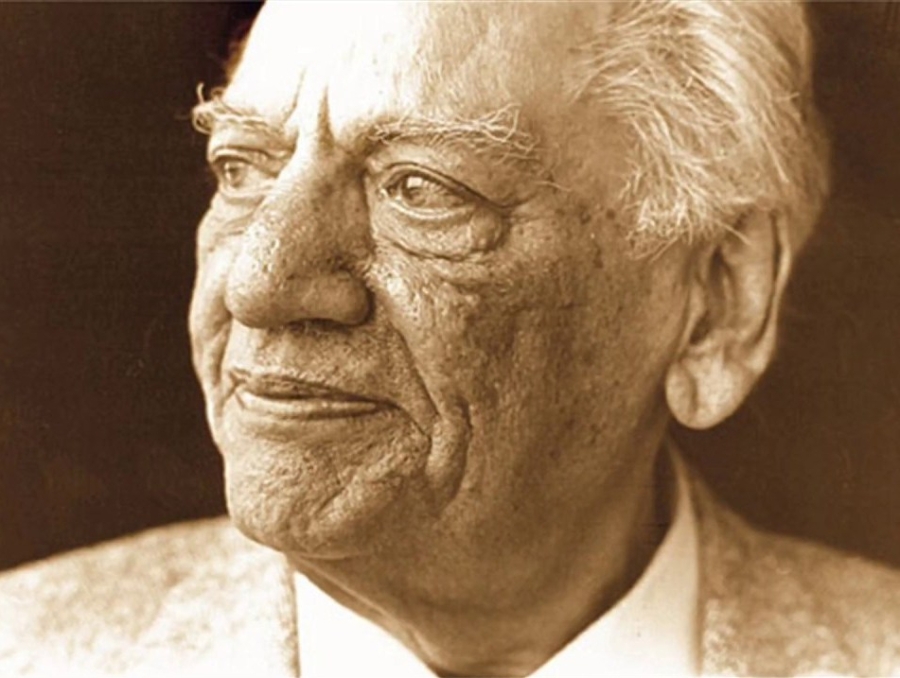
By Moin Qazi*
Faiz Ahmed Faiz – the poet, teacher, editor, freedom-fighter, progressive writer and Lenin Peace Prize recipient – is one of the greatest poets of the Indian subcontinent. He was not a mere dreamer of dreams but was an iconoclast who inspired a million mutinies.
Great poets like Faiz are warriors and serve as the sentinels of the collective conscience of their times. Countries have frontiers but the war against slavery and exploitation has no frontier. Faiz understood that a society without meaningful poetry is a society on the last legs of its wretched existence. It is a society bereft of dreams and thus, a society bereft of hope. Faiz’s verses wee redolent with prison terms, privation, exile, protest, resistance.
Faiz espoused the cause of freedom and ranks with poets like Pablo Neruda, Nazim Hikmet, and Louis Aragon. His poetry, rich with the classical hue of Ghalib and Iqbal, acquired a characteristic tone and he excelled in the nazm and ghazal, the two major forms of Urdu poetry, blazing a trail of love and revolution.
At the hands of an artistic rebel like Faiz, even surrealism became a weapon in the advance of the proletariat. Faiz was traditional in the sense that he was inspired by the Sufi tradition of dissent and was progressive in the sense that he was an avowed Marxist.
Faiz became one of Pakistan’s most prominent and beloved poets of all time, next only to the legendary Iqbal. He realised at an early age that it was the content and not the form which was basic in the art of poetry. He firmly believed that originality had little to do with formal experimentation and was primarily a matter of a profound understanding of human existence in its totality and wholeness.
Faiz’s literary studies laid the foundation for him to construct a modern Urdu verse that took on larger social and political issues of his times while still retaining the polished style and diction of the ghazal. He consciously wrote poetry that reflected the concerns of the masses: Oppression, injustice, exploitation, poverty, the suffering of ordinary people and women.
Those who attempted to put labels on him didn’t understand the essence of his poetry. Or maybe labels were used to cover up their superficial understanding of these issues. Faiz’s lament at India’s independence is characteristic of his passion for freedom for the masses and not just for the country from colonialism:
“This is not the morning we’d fought for,
In whose eager quest, all comrades
Had set out, hoping that somewhere
In the wilderness of the sky
Would emerge the ultimate destination of stars…”
Faiz’s work is replete with religious symbolism but his understanding of religion was more in line with Sufi thought and not the obscurantist interpretations advanced by religious scholars. References to the beloved (which in Sufi is always the Creator) are most vital. He once said, “The true subject of poetry is the loss of the beloved.” His philosophy was one of inclusivity, collectiveness, love for all beings, and no anger or aggression. He didn’t resent even those who imprisoned him, maligned him and wanted him dead or silent. All of these are reflections of Sufi beliefs.
As a Marxist, Faiz rejected the notion of “art for art’s sake”. Referring to the poet Keats’s famous lines that beauty is love and love is beauty and a beautiful object is an eternal source of joy, Faiz says that, notwithstanding what Keats may have felt, beauty can only be eternal when it is creative, when it inspires the onlooker’s enthusiasm, thought and action with promoting more beauty. Faiz’s poetry reflected a syncretic spirit, both across place and time. He navigated the space between Hindus and Muslims with grace and his poetry resonated with the same poignancy in both cultures. The best English translations of his poetry have come from India.
Faiz’s poetry hybridised several styles and devices straddling centuries of literary history’ fusing classical forms like the 14th-century with the free verse that the British had been importing into the subcontinent since the Raj took hold of it a century earlier. He was greatly influenced by W.H. Auden and it is likely that Auden’s poetry stimulated Faiz to use the modern British literary form.
Faiz’s work reverberated with the pathos of contemporary times which were both turbulent and significant markers of historical changes. His verses challenged both structures of power and the failure of governments to poetry itself—a revolutionary one. Most importantly, Faiz adopted and adapted the forms, themes, and images of Urdu poetry to galvanise the masses against the oppressive colonial regimes. In the words of Dylan Thomas his was this fervent belief :
“Do not go gentle into the good night
Rage rage against the dying of the light’.
This rebellious spirit is patent in his every verse:
“Speak, your lips are free.
Speak, it is your own tongue.
Speak, it is your own body.
Speak, your life is still yours.
See how in the blacksmith’s shop
The flame burns wild, the iron glows red;
The locks open their jaws, And every chain begins to break.”
Later came poetic gems like:
"Shaam ke pech o kham sitaron se
Zeena zeena utar rahi hai raat"
(From the winding stars in sky
Stair by stair descends the night)
Aside from being a poet, Faiz was a journalist, songwriter, and activist. He is the voice of conscience of the suffering humanity of our times. A voice which is a song as well as a challenge, which has a burning faith and cries out against the agony of its era, a constant endeavour and the thunder of the revolution, as well as the sweet recital of love and beauty. This had particularly affected the colonial economy of India. Thus, according to Faiz:
“My heart repents neither this love nor the other,
My heart is spotted with every kind of sorrow,
Except the mark of repentance.”
If Faiz had become a legend during his lifetime, it was because he was a versatile genius—a political thinker who was committed to Marxism in his early years, a distinguished poet, a liberal humanist and, above all someone who never compromised his integrity with the Pakistani rulers of his time. Faiz was, truly speaking, a citizen of the world who did not recognise any barriers between religions, languages, and countries. Being an irrepressible social and political activist, he spent many years in prison, and also as an exile in Lebanon and England. It is no wonder that prison emerges as an expanded metaphor in several of his poems.
Faiz made the transformation of the individual human being and his passage through the infinite variety of situations and moods the subject of his poetry. He was concerned, above all, with the experience of the individual human soul in the long and arduous journey of revolutionary struggle. And yet love remained the leitmotif of his poetry.
Faiz is one of the great lyricists who has sung of nothing with greater passion than love which, he believed, was the primary engine for human progress. Faiz’s acceptance speech when he was awarded the Lenin Peace Prize, which appears as a brief preface to his collection Dast-i-tah-i-Sang (Hand under the Rock), is a great piece of humanist literature:
“Human ingenuity, science and industry have made it possible to provide each one of us everything we need to be comfortable … However, this is only possible if the foundations of human society are based not on greed, exploitation and ownership but on justice, equality, freedom and the welfare of everyone….”
---
*Development expert
Comments