By Moin Qazi*
The idea that helping others is part of a meaningful life has been around for several years. For Muslims, charity is a central aspect of faith and practice. In Islam, a culture of giving is interwoven into the fabric of its modes of worship and it is one of the five basic requirements (arkan or “pillars”) of Islam. It connotes the path to purity, comprehension of material responsibility, and a heightened sense of spirituality.
The centrality of zakat is underscored by the many times it is coupled with the command for prayer and also identified as a continuation of the practice of past prophets. In the Qurʾān, almsgiving is often cited along with prayer as a duty of the Muslim: ‘Perform the prayer, and give the alms’ (Q2: 43, 110, 277). . The two are often mentioned simultaneously in the symmetrical rhythm of the Qur’an.
The tradition of humanitarian stewardship and egalitarian values are at the foundation of Islamic beliefs. Governed by a worldview in which all things come from God and finally return to Him, Muslims are taught to live as trustees of God’s blessings and spend their wealth in accordance. Islam is a complete way of life and one important facet is that there is a duty to serve those who are less privileged than us.
Ramadan is the focal point of philanthropy. During this month, people’s obligation to give to the poor gets intensified. Arab societies have elaborate and nuanced social codes that demand excessive generosity and hospitality towards visitors and strangers. This is embedded in the ancient Arab proverb: “A guest is greeted like a prince, held like a captive [to your generosity] and departs like a poet [to sing your praises].”
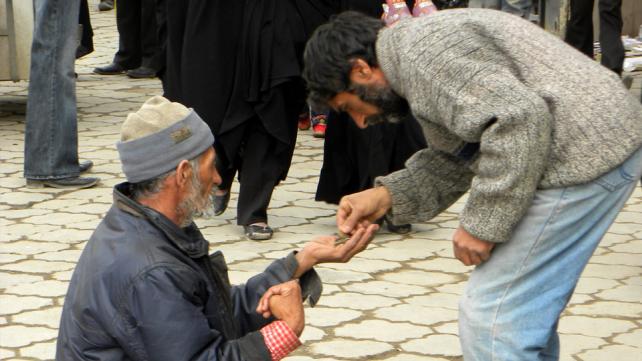
The Qur’an provides both a spiritual framework for the possession of wealth, and practical guidelines for its dispensation. Frugality with self and generosity with others underpins the Qur’anic message of charity. On several occasions, when we are handing someone charity, it first passes through the Hand of God before it reaches the recipient’s hand. Holding wealth is truly an immense blessing that comes with great responsibility and untold reward when we pass it along. All good deeds done in Ramadan fetch manifold rewards in the afterlife. Thus, apart from being a personal religious voyage, the season of sharing and giving reconfigures one’s social bonds.
Muslims give in the form of either Zakat, which is mandatory form of charity ordained by God, or Sadaqa, which is voluntary and meant to go beyond the mere religious obligations. All adult Muslims of sufficient financial means are mandated by the Qur’an to pledge a determinate portion of a set level of specified categories of their lawful financial assets for the benefit of the poor and other enumerated classes.
The idea of zakat is based on the direct, legitimate claim of the poor on the wealth of the rich. In fact, the tradition of giving zakat to the have-nots is a bigger social contract about sharing resources with the lesser privileged. Zakat means purification and comes from the Arabic verb zaka, which also signifies “to thrive,” “to be pure” and “to be wholesome.”
Muslims “purify” their wealth by giving a portion of it every year in charity. As the Qur’an says: “Of their goods, take Zakat, so that you might purify and sanctify them.” (Q9:103). This Islamic practice is one way of learning self-discipline, freeing oneself from the love of possessions and greed. In a way, the man who spends of his wealth affirms the truth that nothing is dearer to him in life than the love of God and that he is prepared to sacrifice everything for His sake.
Zakat is binding on all Muslims who meet the necessary criteria of wealth.): it’s limited, in a way, by your ability. According to the rules of the Qur’an, all Muslims, on whom zakat is mandatory, must donate at least 2.5% of a set value of the financial assets based on the minimum wealth criteria (known as the nisab) each year for the benefit of the poor, destitute and others ,classified as mustahik. The exact percentage to be paid on different categories of assets varies and interpretations differ between the schools of law. The primary forms of wealth subject to zakat includes gold, silver, livestock, agricultural produce, articles of trade, currency, shares and bonds, and other liquid assets.
Zakat is distributed to eight categories of individuals specified by the Qur’an. These categories are usually defined to include orphans, the poor, travelers, beggars, debtors, slaves, and the efforts to propagate Islam. The Quran says: “Zakah expenditures are only for the poor and for the needy and for those employed to collect [zakah] and for bringing hearts together [for Islam] and for freeing captives [or slaves] and for those in debt and for the cause of Allah and for the [stranded] traveller – an obligation [imposed] by Allah. And Allah is knowing and wise.” (Q, 9:60)
By this definition, zakat is not simply a means to manage poverty, but rather is inherently focused on building dignity, honour, and self-sufficiency in the wider community. This is reflected in the diversity of the categories of genuine zakat recipients.
Deeply embedded in the Islamic concept of zakat are the notions of welfare, altruism and justice which can be seen as a way of harnessing human potential to resolve insurmountable challenges to human society. Charity and altruism are rooted in the basic concern for the welfare of others, while Islam has added to it the notion of justice, which is seen as a way of building a just and equitable society. According to the Qur’an, “the likeness of those who spend their wealth in the way of Allah is as the likeness of a grain that sprouts seven spikes. In every spike there are 100 grains, and Allah multiplies for whom He will”. (Q 2:261).
It is the human predilection for riches that the Qur’an cautions against, yet it acknowledges that spiritually immature souls may jeopardise their own moral standing by indulging in reckless acts of charity that leave them destitute. Some verses (including Q17:29 and 25:67) speak of maintaining a balance between extravagance and parsimony. This is in recognition of human nature, which has the dual impulses of compassion and an inherent love of wealth. In this way, Islam’s legal teachings counsel temperance and prudence; whereas Islam’s spiritual teachings urge selflessness and generosity.
In the Islamic paradigm, voluntary charity is not restricted just to money or physical goods but covers all actions based on a simple understanding that what really ties an individual to a common humanity is compassion. A well known saying of the Prophet captures the essence of this concept: “Charity is due upon every joint of the people for every day upon which the sun rises. Being just between two people is charity. Helping a man with his animal and lifting his luggage upon it is charity. A kind word is charity. Every step that you take towards the mosque is charity, and removing harmful things from the road is charity.”(Sahih al-Bukhari 2827, Sahih Muslim 1009)
The real spirit of giving lies in doing it without leaving a trace of oneself. Giving with motives attached not only nullifies one’s own happiness but also burdens the receiver. After planting your seeds, you should expect absolutely nothing in return. It is nobler to follow the Biblical injunction. “Let not thy right hand know what thy left hand doeth.” When you give to someone with no strings attached you are as nourished as the receiver.
An oft-repeated story in the Muslim world tells of a Shah in Persia who came upon an old man planting an olive tree, which takes years to produce good fruit. When asked why he was planting a tree that will not benefit him, the old man replied: “Those who came before me planted, and we benefitted. I am planting so that those who come after me shall benefit.”
—
*Development sector expert
Comments