
Rallies, hunger strike, demand for self-rule in Narmada Valley villages of Madhya Pradesh, Maharashtra

By A Representative
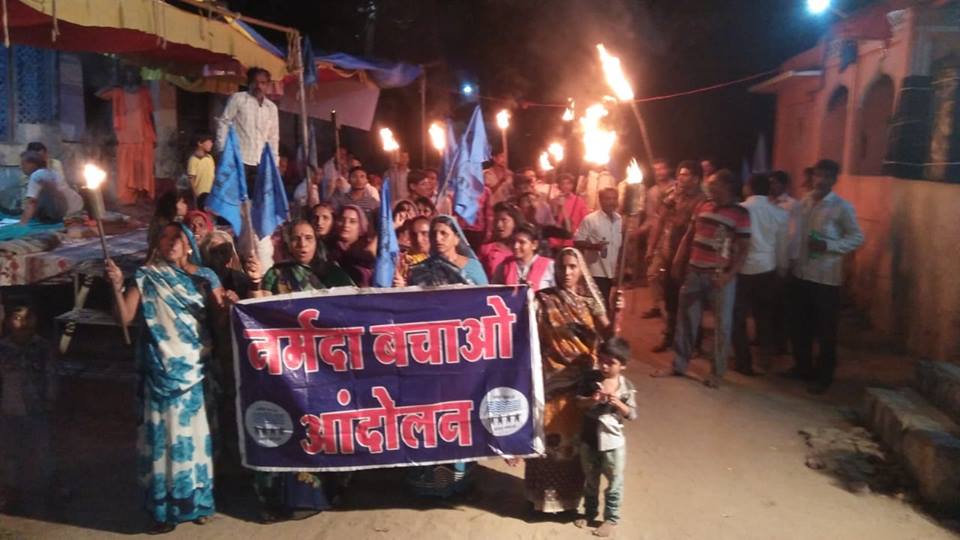
Following demonstrations and meeting in several villages of Madhya Pradesh protesting against the alleged failure to rehabilitate Narmada dam oustees, top anti-dam organization, Narmada Bachao Andolan (NBA), in a statement, has regretted that the state government’s top functionaries, including the chief minister and his ministers, appeared to think that the World Indigenous Day, which it celebrated a week ago, was a religious festival.
NBA accused them of  spending crores of rupees, "even as the question of ‘self-rule’ is being categorically denied to adivasis". NBA said, “Part IX of the Indian Constitution states that in spite of any other article or section, there will be independent administration for tribals. Article 243-N clearly states that after the 73rd amendment of the Constitution in 1992 any laws of states contrary to it will not be applicable after 1993.”
It added, “After the 73rd amendment came the Panchayati Raj (Extension to Schedule Areas) Act (PESA Act) in 1996, which was an addition to the Panchayati Raj Act 1993. But instead of extending the special powers given to villagers and panchayats to adivasi gramsabhas, their rights are being crushed. PESA is in cold storage.”
According to NBA, “States, including Madhya Pradesh, are rejecting the claim and ownership of adivasi gramsabhas to natural resources and right to participation in development planning of those resources. Widespread exploitation of natural resources are being undertaken without due process, consultation and consent of gram sabhas.”
Pointing out that “sonsent is the minimum required by law and still it is not being followed. Even Rules for PESA have not been made in Madhya Pradesh”, NBA regretted that the situation is not very different in other states. Thus, “There is death by starvation of dalit-adivasis in Jharkhand, malnutrition of adivasis of Nandurbar or Melghat (Maharashtra) or the displacement of tribals all over India is a result of this.”
NBA regretted, “In a valley like Narmada, where adivasis co-owned the rivers and mountains for generations, they were not even told of the disastrous consequences of damming the river, let alone rehabilitating them. The Narmada Tribunal in its 10 years of inspection hasn’t even met the tribal representation.”
“Even today”, NBA said, “In hilly areas adivasi homes have been broken by the administration without any hope to gain alternative house plot. After fighting for 33 years adivasis have secured their right to rehabilitation. But after submitting false reports the government wants to exclude thousands of adivasis from rehabilitation benefits.”
“Neither PESA Act, nor rehabilitation, nor prohibition of alcohol sales is being implemented by the state”, NBA said, adding, “The Forest Rights Act is not even implemented in single village situated on the banks of Narmada in Badwani, Alirajpur and Nandurbar districts.”  
“Does the Madhya Pradesh government (or any other) have any right to ‘play empty drums’ in the name of adivasi rights?”, it asked, adding, it wasn’t without reason that on the occasion of the World Indigenous Day, relay hunger strike was undertaken in several of the villages, including “Pichhodi, Avalda, Kasravad, Rajghat, Kukra, Bhilkheda, Bagud, Piplud, Seganv, Dhanora, Nisarpur, Kapadkheda, Kadmal, Bajarikheda, Chikhalda, Gopalpura, Gangli, Kavthi, Bada Barda, Dharampuri, Navdatoli etc.”
As part of the protest, submergence villages hoisted the tricolour on the occasion of Independence Day, and special gram sabhas passed the resolution for the stay of the fake displacement process, NBA said, adding, “Until now, 192 villages and 1 town displaced by the Sardar Sarovar Dam have not been rehabilitated.”
Claiming that 35,000 displaced are yet to be rehabilitated by the Madhya Pradesh government, the Narmada Valley Development Corporation, and the Narmada Control Authority, NBA recalled, “Avalda, Pichhodi, Bagud, Kasravad, Chikhalda and Kaparkheda gram sabhas belong to Scheduled Areas and hence PESA Act is applicable.”
It said, “According to Section 4 of this act prior consultation and consent of gram sabha is mandatory before land acquisition. But since this is not followed in Madhya Pradesh, it is contempt of this law and of the gram sabha. The gram sabhas on August 15, 2018 condemned such an attitude, unanimously passed the resolution to keep the gates of the Sardar Sarovar Dam opened and let river Narmada flow.”

Comments

TRENDING

When democracy becomes a performance: The Tibetan exile experience

By Tseten Lhundup*  I was born in Bylakuppe, one of the largest Tibetan settlements in southern India. From childhood, I grew up in simple barracks, along muddy roads, and in fields with limited resources. Over the years, I have watched our democratic system slowly erode. Observing the recent budget session of the 17th Tibetan Parliament-in-Exile, these “democratic procedures” appear grand and orderly on the surface, yet in reality they amount to little more than empty formalities. The parliamentarians seem largely disconnected from the everyday struggles faced by ordinary exiled Tibetans like us.

Study links sanctions to 500,000 deaths annually leading to rise in global backlash

By Bharat Dogra  International opinion is increasingly turning against the expanding burden of sanctions imposed on a growing number of countries. These measures are contributing to humanitarian crises, intensifying domestic discord, and heightening international tensions, thereby increasing the risks of conflicts and wars. 

Dhurandhar: The Revenge — Blurring the line between fiction and political narrative

By Mohd. Ziyaullah Khan*  "Dhurandhar: The Revenge" does not wait to be remembered; it arrives almost on the heels of its predecessor, released on March 19, 2026, just months after the first film’s December 2025 debut. The speed of its arrival feels less like creative urgency and more like calculated timing—cinema responding not to storytelling rhythm but to the emotional climate of its audience. Director Aditya Dhar, along with actor Yami Gautam, appears acutely aware of this moment and how to harness it.

Beyond the island: Top mythologist reorients the geography of the Ramayana

By Jag Jivan   In a compelling new analysis that challenges conventional geographical assumptions about the ancient epic, writer and mythologist Devdutt Pattanaik has traced the roots of the Ramayana to the forests and river systems of Central and Eastern India, rather than the peninsular south or the modern island nation of Sri Lanka.

BJP accounts for 99% of political donations in Gujarat: Corporate giants dominate

By Jag Jivan   An analysis of the official data on donations received by national parties from Gujarat during the Financial Year 2024-25 reveals a staggering concentration of funding, with the Bharatiya Janata Party (BJP) accounting for nearly the entirety of the contributions. The data, compiled in a document titled "National Parties donations received from Gujarat during FY-2024-25," lists thousands of transactions, painting a detailed picture of the financial backing for political parties from one of India’s most industrially significant states.

Alarming decline in India's repair culture threatens circular economy goals: Study

By Jag Jivan  A comprehensive new study by environmental research and advocacy organisation Toxics Link has painted a worrying picture of India's fading repair culture, warning that the trend towards replacement over repair is accelerating the country's already critical e-waste crisis.

Captains extraordinaire: Ranking cricket’s most influential skippers

By Harsh Thakor*  Ranking the greatest cricket captains is a subjective exercise, often sparking passionate debate among fans. The following list is not merely a tally of wins and losses; it is an assessment of leadership’s deeper impact. My criteria fuse a captain’s playing record with their tactical skill, placing the highest consideration on their ability to reshape a team’s fortunes and inspire those around them. A captain who inherited a dominant empire is judged differently from one who resurrected a nation’s cricket from the doldrums. With that in mind, here is my perspective on the finest leaders the game has ever seen.

Swami Vivekananda's views on caste and sexuality were 'painfully' regressive

By Bhaskar Sur* Swami Vivekananda now belongs more to the modern Hindu mythology than reality. It makes a daunting job to discover the real human being who knew unemployment, humiliation of losing a teaching job for 'incompetence', longed in vain for the bliss of a happy conjugal life only to suffer the consequent frustration.

‘No merit’ in Chakraborty’s claims: Personal ethics talk sans details raises questions

By Jag Jivan  A recent opinion piece published in The Quint by Subhash Chandra Garg has raised questions over the circumstances surrounding the resignation of Atanu Chakraborty from HDFC Bank , with Garg stating that the exit “raises doubts about his own ‘ethics’.” Garg, currently Chief Policy Advisor at Subhanjali and former Secretary of the Department of Economic Affairs, Government of India, writes that the Reserve Bank of India ( RBI ) appears to find no substance in Chakraborty’s claims, noting, “It is clear the RBI sees no merit in Atanu Chakraborty’s wild and vague assertions.”