
Banaskantha floods: Caste distinctions, prejudices have failed to wash away


By Martin Macwan*
As I was driving down the road from village Baspa (about 15 km from Sami) to Radhanpur, my mind traced the memories of 2001 earthquake of Gujarat. I could see that once again the human disaster was greater than the natural, in the wake of floods. Banas waters had washed away one side of the national highway, but at a distance, one could see the minor Narmada linked canals, washed away like paper trash. Was it the poor construction or the speed at which they were constructed to hit the time target, was a question no one seemed to ask at this point when the chief minister himself is focusing on distributing relief that is limited to food packets, clothing and cash doles of Rs 65 and 45 for an adult and a minor, respectively, covering a period of ten days.
The Maldharis had taken over one side of the road with their buffaloes as self-possessed shelter. The relief truck before me was flinging bundles of used clothes at the local people that eagerly waited for such relief material carrying vehicles. I saw that the pillion riders on a motor cycle too could manage to fetch one such bundle of clothes and shoved the bundle in an empty travel bag. It was a common sight that the local people quickly selected if they found something interesting before throwing away the rest which lay spread on the roads.
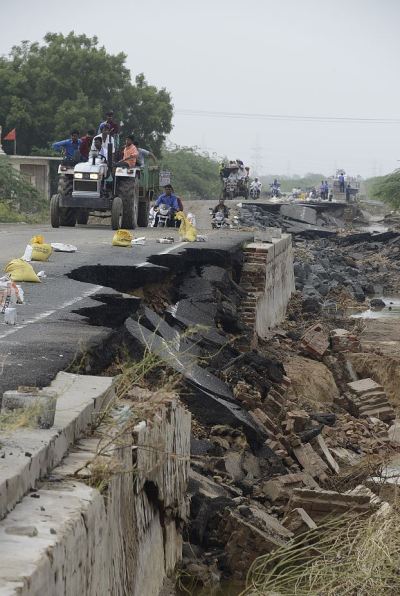
The highway from Radhanpur to Byavar had a great deal of police presence as there were numerous politicians visiting area. We reached village Runi of Kankrej area. The village has presence of the Jain temple that has its property spread in 20 bighas of land with surrounding compound wall. Part of the wall had collapsed. Across the road, opposite the temple, is the Dalit area, having living quarters of leather workers and the scavengers. Most homes had one living room of barely eight feet by eight feet with an open extension with an overhead roof serving as the veranda. Some people had managed to empty their homes of the sludge and sand that had filled the living room up to the ceiling. The water levels had risen in this area at the level of about 13 feet from the ground. People had taken shelter on the top floor of the village co-operative society or over the small terraces, braving the rain and winds for about 30 hours before the army had reached them with some biscuits.
We could see on one room house with terrace that a young Dalit man had lost all his post graduate degree certificates along with two children in the primary school, whose books were drying on the terrace tarred with dirt and water.
It was in 1979, I had volunteered as a college student in Morbi after the Machhu dam had burst. We, as volunteers, helped the locals to clear their homes of the sludge. Here, I saw in the Runi village that there were no volunteers helping the local people. There were only visitors and relief distributors. The rich in the village had access to the JCB machines as Dalits waited to hire tractors to dump away the rotten grain, beddings and other soiled material from their quarters. The Government did not pay them the rents of these hired tractors.

The scavenger families were still stuck with their quarters filled with sludge as many of the old people were unable to clear it themselves in absence of their young children away as migrant labor force. An old woman had the assistance of her two sons-in-law who had come specially to help their mother-in-law to clear her one-room home, as there was no other place for her today. An old man was sitting in one corner. He had lost his buffalo. He earned his living by playing drum and making supda, the caste-based occupations.
Each Dalit family I visited had lost an average of 800 kilograms of grain that they had stored, part of the community system of storing one year of ration for the family. As the trucks distributing packed food occupied the narrow village road, the locals refused to take the food as they were tired of the same. They were worried about cleaning of their homes of the sludge fearing the epidemic. The stench of rotting grain was too strong and they barely had place to sleep leave alone the swamps of mosquitoes.
The rich in the village had access to the JCB machines as Dalits waited to hire tractors to dump away the rotten grain, beddings and other soiled material from their quarters. The Government did not pay them the rents of these hired tractors
At the centre of the village under a tree lay a heap of used garments, dumped by the relief workers as there were no takers. Some families of the Majirana community sat in the midst of some open land around the mud homes with bamboo roofs which had tumbled on the ground. People in the village had never ever in the history of their life met with such tragedy. They said they were battered by the main Narmada Canal. At a distance, the canal was visible, as a large portion of the canal unable to withstand the pressure had given away quickly raising the water levels in the village. As per people, the ganda baval trees have deep roots which have penetrated the base of the canal, weakening it.
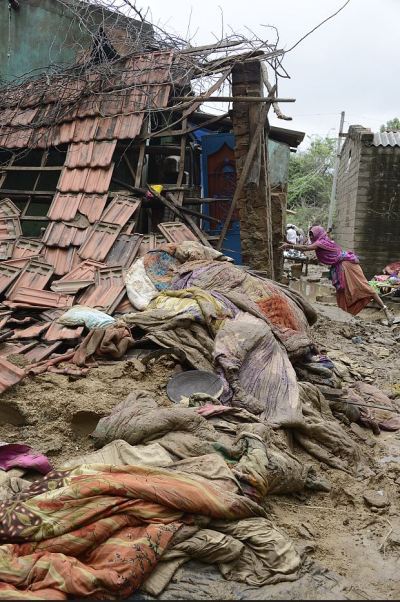
Dalits were happy that they were able to bargain from the village panchayat and thus had got a pucca cement-brick wall was constructed around some of their dwellings. The wall constructed barely six months ago is no more as it did not have deep enough foundations required and mandated by law. All that had collapsed in the vicinity were the new government scheme constructions, as the many year old structures stood firmly on the ground.
Next, we visited village Khariya, the village which has found more than 22 dead bodies from beneath the sand. The road is washed away at the end of the village as several villages could be seen at a far distance, submerged in the flood waters and were accessible only by the boat. The police and the volunteers were guarding the queue of people, whose homes were on the other side and were awaiting their turn to the two boats that were ferrying people. No one has idea here about the human deaths. Most people live here scattered in their farms. Worse, the migrant labourers from other areas lived in these farms and no one has the actual number of these laborers.
Part of the population is at a safer distance from river Banas. Although their homes were flooded, now they were clean and had no sludge as we saw in the previous village. But all the relief teams have focused relief distribution here. We saw large stack of mattresses which were locked away in a room awaiting distribution. Relief teams had their flags on vehicles and the Khastriya-Thakor Sena and RSS were more visible. It was common sight that the local people were rejecting the relief material, as they did not require them anymore. The caste distinctions and prejudices are intact and have refused to be washed away with flood waters or be submerged under the sludge. Local people do ask for the ‘caste’ of the visitors and often the relief workers, too.

The damage has been to the homes of people. They have lost grain stored for their annual requirement. They have lost their savings as most people do not deposit them in the bank. Worst, those who have farm lands have lost the top soil. The farm boundaries have disappeared. My colleagues, who were with me Narendabhai, Mohanbhai, Kalpeshbhai, said, “For some there is blessing in disguise. If one class of people have smile on their faces, they are the sand mafia. The Banas has brought along with its flood water multi-million tons of sand which finds its way even to Ahmedabad construction sites.”
As the politicians are busy blaming each other, it is the army and the civil society that has performed, saving the lives of people and providing them the relief. Except for the police, there is little presence of the government in the area. The quick survey for the purpose of paying cash doles has been completed by the primary school teachers. Poor people’s helplessness is visibly disturbing.

*Founder, Navsarjan Trust, Ahmedabad. Pix: Tathya Macwan

Comments

TRENDING

Swami Vivekananda's views on caste and sexuality were 'painfully' regressive

By Bhaskar Sur* Swami Vivekananda now belongs more to the modern Hindu mythology than reality. It makes a daunting job to discover the real human being who knew unemployment, humiliation of losing a teaching job for 'incompetence', longed in vain for the bliss of a happy conjugal life only to suffer the consequent frustration.

Jayanthi Natarajan "never stood by tribals' rights" in MNC Vedanta's move to mine Niyamigiri Hills in Odisha

By A Representative The Odisha Chapter of the Campaign for Survival and Dignity (CSD), which played a vital role in the struggle for the enactment of historic Forest Rights Act, 2006 has blamed former Union environment minister Jaynaynthi Natarjan for failing to play any vital role to defend the tribals' rights in the forest areas during her tenure under the former UPA government. Countering her recent statement that she rejected environmental clearance to Vendanta, the top UK-based NMC, despite tremendous pressure from her colleagues in Cabinet and huge criticism from industry, and the claim that her decision was “upheld by the Supreme Court”, the CSD said this is simply not true, and actually she "disrespected" FRA.

Stands 'exposed': Cavalier attitude towards rushed construction of Char Dham project

By Bharat Dogra*  The nation heaved a big sigh of relief when the 41 workers trapped in the under-construction Silkyara-Barkot tunnel (Uttarkashi district of Uttarakhand) were finally rescued on November 28 after a 17-day rescue effort. All those involved in the rescue effort deserve a big thanks of the entire country. The government deserves appreciation for providing all-round support.

Urgent need to study cause of large number of natural deaths in Gulf countries

By Venkatesh Nayak* According to data tabled in Parliament in April 2018, there are 87.76 lakh (8.77 million) Indians in six Gulf countries, namely Bahrain, Kuwait, Oman, Qatar, Saudi Arabia and the United Arab Emirates (UAE). While replying to an Unstarred Question (#6091) raised in the Lok Sabha, the Union Minister of State for External Affairs said, during the first half of this financial year alone (between April-September 2018), blue-collared Indian workers in these countries had remitted USD 33.47 Billion back home. Not much is known about the human cost of such earnings which swell up the country’s forex reserves quietly. My recent RTI intervention and research of proceedings in Parliament has revealed that between 2012 and mid-2018 more than 24,570 Indian Workers died in these Gulf countries. This works out to an average of more than 10 deaths per day. For every US$ 1 Billion they remitted to India during the same period there were at least 117 deaths of Indian Workers in Gulf ...

Uttarakhand tunnel disaster: 'Question mark' on rescue plan, appraisal, construction

By Bhim Singh Rawat*  As many as 40 workers were trapped inside Barkot-Silkyara tunnel in Uttarkashi after a portion of the 4.5 km long, supposedly completed portion of the tunnel, collapsed early morning on Sunday, Nov 12, 2023. The incident has once again raised several questions over negligence in planning, appraisal and construction, absence of emergency rescue plan, violations of labour laws and environmental norms resulting in this avoidable accident.

Celebrating 125 yr old legacy of healthcare work of missionaries

Vilas Shende, director, Mure Memorial Hospital By Moin Qazi* Central India has been one of the most fertile belts for several unique experiments undertaken by missionaries in the field of education and healthcare. The result is a network of several well-known schools, colleges and hospitals that have woven themselves into the social landscape of the region. They have also become a byword for quality and affordable services delivered to all sections of the society. These institutions are characterised by committed and compassionate staff driven by the selfless pursuit of improving the well-being of society. This is the reason why the region has nursed and nurtured so many eminent people who occupy high positions in varied fields across the country as well as beyond. One of the fruits of this legacy is a more than century old iconic hospital that nestles in the heart of Nagpur city. Named as Mure Memorial Hospital after a British warrior who lost his life in a war while defending his cou...

New RTI draft rules inspired by citizen-unfriendly, overtly bureaucratic approach

By Venkatesh Nayak* The Department of Personnel and Training , Government of India has invited comments on a new set of Draft Rules (available in English only) to implement The Right to Information Act, 2005 . The RTI Rules were last amended in 2012 after a long period of consultation with various stakeholders. The Government’s move to put the draft RTI Rules out for people’s comments and suggestions for change is a welcome continuation of the tradition of public consultation. Positive aspects of the Draft RTI Rules While 60-65% of the Draft RTI Rules repeat the content of the 2012 RTI Rules, some new aspects deserve appreciation as they clarify the manner of implementation of key provisions of the RTI Act. These are: Provisions for dealing with non-compliance of the orders and directives of the Central Information Commission (CIC) by public authorities- this was missing in the 2012 RTI Rules. Non-compliance is increasingly becoming a major problem- two of my non-compliance cases are...

Pairing not with law but with perpetrators: Pavlovian response to lynchings in India

By Vikash Narain Rai* Lynch-law owes its name to James Lynch, the legendary Warden of Galway, Ireland, who tried, condemned and executed his own son in 1493 for defrauding and killing strangers. But, today, what kind of a person will justify the lynching for any reason whatsoever? Will perhaps resemble the proverbial ‘wrong man to meet at wrong road at night!’

Dowry over duty: How material greed shattered a seven-year bond

By Archana Kumar*  This account does not seek to expose names or tarnish identities. Its purpose is not to cast blame, but to articulate—with dignity—the silent suffering of a woman who lived her life anchored in love, trust, and duty, only to be ultimately abandoned.