Want to write to Gujarat chief minister online? Govt site takes you to Anandiben Patel's personal, copyrighted site!
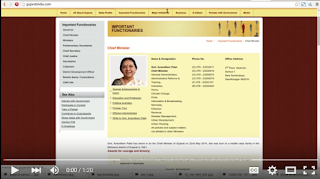 |
| gujaratindia.com, which takes one to CM's copyrighted site |
In an interesting expose, an upcoming political activist in Ahmedabad has brought to light that Gujarat chief minister Anandiben Patel wants people to write to her online on any issues they may have not on a Gujarat government website but her personal website, anandibenpatel.com.
Anyone visiting the Gujarat government’s official state portal, http://gujaratindia.com/, and clicking on Chief Minister in the section “Important Functionaries” is taken to her complete profile page, which includes her contact details, her past and present activities, and her lifestyle.
However, as one clicks on “Write to Smt. Anandiben Patel”, one is immediately shifted away from the Gujarat government’s official site to the chief minister’s personal site, whose address is http://anandibenpatel.com/write-to-cm-smt-anandiben-patel/.
Curious though it may sound, the Gujarat government does not seem to “own” its chief minister, Anandiben Patel’s website, either: On the right hand side corner of the site prominently displays “© 2015 Smt Anandiben Patel. All Rights Reserved.”
This stands in sharp contrast to Prime Minister Narendra Modi’s personal website, www.narendramodi.in, which does not carry any copyright tag. Modi’s website was created when Gujarat chief minister. It is not known if Patel is aware of the nuance involved.
It is noteworthy that the “copyrighted” website carries the official information about the official functions of the chief minister, and her activities under the banner of “Gateesheel Gujarat”, which she envisaged after Patel became Gujarat chief minister, and this includes the Gruh Yojna for the urban poor, the metro rail project, open defecation free Gujarat, implementation of revenue reforms, and so on.
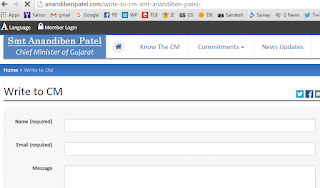 |
| Want to write to chief minister? Visit her personal site |
While it is not known if someone who seeks to use this copyrighted material will invite legal action, the activist, Roshan Shah, who is also a software engineer, in a written complaint to senior Gujarat government officials – both administrative and police – has questioned as to why “write to chief minister” data and information “is captured on a personal site.”
“Any citizen who is writing to the chief minister is writing to the chief minister under the pretext and assumption that the representation made and so the record is part of official government representation, but it is clearly evident that any representation done on this form is not going to be part of government record and it will have no relevance when Patel will not be the chief minister”, Shah says in his plea.
Shah further states, “Content on anandibenpatel.com site is state subject and it has featured events and programmes promoted by state government and much of the content is exclusively found on this site.” He wonders as to who owns this site, who is paying for it, and whether its control will be “retained by state government” once she is not the chief minister.
Shah also asks, as to who is “paying for content creation (text, videos, audio) etc.” of the site, and how much has been “paid till date to whom and by what means”, adding, “Who is in charge of uploading the content and how much had been paid till date to whom and by what means?”
He has also wished to know if there is a government resolution (GR) under which the copyrighted site of the chief minister exists. Displaying the contents of how gujaratindia.com takes one to the chief minister’s personal site, anandibenpatel.com on Youtube (October 15), Shah alleges, asking people to write to her on her personal site “violates citizens’ privacy and does breach of trust.”
“Any citizen who is writing to the chief minister is writing to the chief minister under the pretext and assumption that the representation made and so the record is part of official government representation, but it is clearly evident that any representation done on this form is not going to be part of government record and it will have no relevance when Patel will not be the chief minister”, Shah says in his plea.
Shah further states, “Content on anandibenpatel.com site is state subject and it has featured events and programmes promoted by state government and much of the content is exclusively found on this site.” He wonders as to who owns this site, who is paying for it, and whether its control will be “retained by state government” once she is not the chief minister.
Shah also asks, as to who is “paying for content creation (text, videos, audio) etc.” of the site, and how much has been “paid till date to whom and by what means”, adding, “Who is in charge of uploading the content and how much had been paid till date to whom and by what means?”
He has also wished to know if there is a government resolution (GR) under which the copyrighted site of the chief minister exists. Displaying the contents of how gujaratindia.com takes one to the chief minister’s personal site, anandibenpatel.com on Youtube (October 15), Shah alleges, asking people to write to her on her personal site “violates citizens’ privacy and does breach of trust.”
Comments